


A White House official who once led the oil industry's fight against limits on greenhouse gases has repeatedly edited government climate reports in ways that play down links between such emissions and global warming, according to internal documents.
In handwritten notes on drafts of several reports issued in 2002 and 2003, the official, Philip Cooney, removed or adjusted descriptions of climate research that government scientists and their supervisors, including some senior Bush administration officials, had already approved. In most cases, the changes appeared in the final reports.
The dozens of changes, while sometimes as subtle as the insertion of the phrase "significant and fundamental" before the word "uncertainties," tend to produce an air of doubt about findings that most climate experts say are robust.
Cooney is chief of staff for the White House Council on Environmental Quality, the office that helps devise and promote administration policies on environmental issues.
Before going to the White House in 2001, he was the "climate team leader" and a lobbyist at the American Petroleum Institute. A lawyer with a bachelor's degree in economics, he has no scientific training.
The documents were obtained by the New York Times from the Government Accountability Project, a nonprofit legal-assistance group for government whistle-blowers. The group is representing Rick Piltz, who resigned in March as a senior associate in the office that coordinates government climate research.
A White House spokeswoman, Michele St. Martin, said Tuesday that Cooney would not be made available to comment because he was not cleared as a spokesman.
Other White House officials said the changes made by Cooney were part of the normal interagency review that takes place on all documents related to global environmental change. Cooney's alterations are sometimes as simple as the insertion of an adjective, but they cause clear shifts in the meaning of the documents.
Meanwhile, President George W. Bush's decision not to sign the US up to the Kyoto global warming treaty was partly a result of pressure from ExxonMobil, the world's most powerful oil company, and other industries, according to US State Department papers seen by the Guardian.
The documents reinforce widely-held suspicions of how close the company is to the administration and its role in helping to formulate US policy.
In briefing papers given before meetings to the US under-secretary of state, Paula Dobriansky, between 2001 and last year, the administration is found thanking Exxon executives for the company's "active involvement" in helping to determine climate change policy, and also seeking its advice on what climate change policies the company might find acceptable.
Other papers suggest that Dobriansky should sound out Exxon executives and other anti-Kyoto business groups on potential alternatives to Kyoto.
Until now Exxon has publicly maintained that it had no involvement in the US' rejection of Kyoto.
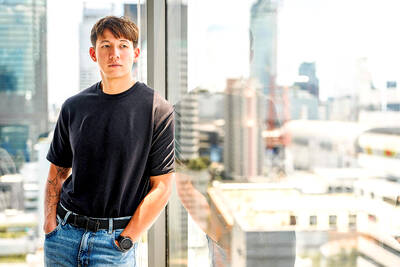
SPEAKING OUT: After Siranudh Scott’s allegations surfaced, celebrities and public figures took to social media to share their own experiences of sexual misconduct and abuse A high-profile alleged sexual abuse case within a wealthy Thai beer brewing family has prompted a wave of painful accounts from survivors of unconnected abuse in the conservative nation. Siranudh Scott, a member of the billionaire Thai family that founded the ubiquitous Singha beer brand, posted an emotional video this month accusing his elder brother Sunit of repeatedly abusing him when he was a teenager. Sunit, who is in his 30s, later denied the allegations in a video posted online, but Singha parent Boonrawd dismissed him from his executive role with the company on Tuesday last week. “I felt I needed to speak

A Hong Kong astronaut is to join a Chinese space mission for the first time as part of a three-person crew launching today, as Beijing edges closer to its goal of landing people on the moon. The Tiangong space station — crewed by teams of three astronauts that are typically rotated every six months — is the crown jewel of China’s space program, boosted by billions in state investment in a bid to catch up with the US and Russia. The Shenzhou-23 mission is to blast off at 11:08pm from the Jiuquan Satellite Launch Center in northwestern China, carrying three astronauts to
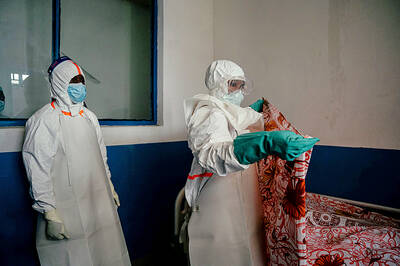
UPGRADED ALERT: The risk inside DR Congo is now considered ‘very high,’ while neighboring countries face a ‘high’ threat as the outbreak continues, the WHO said Ebola is spreading faster than responders can track it in eastern Congo, where health workers managed to follow up with barely one in five identified contacts in a single day. Authorities in the Democratic Republic of the Congo (DR Congo) reported 83 confirmed infections, 746 suspected cases and 1,603 identified contacts as of Thursday, but health workers were able to follow up on only 342 contacts that day — about 21 percent of the total under monitoring — data released by the DR Congo Ministry of Public Health on Friday showed. The figures suggest the response is falling behind the outbreak itself,

SEEKING ORDER: Rodrigo Paz said that ‘anyone who wants to destroy the nation will have to deal with this president and the full force of the constitution’ Bolivian President Rodrigo Paz on Wednesday said that the nation was at a “breaking point” after nearly a month of protests that have caused shortages of food, fuel and medicine. Paz, who took office six months ago amid the worst economic crisis there in four decades, is battling a groundswell of fury over his policies. The political capital, La Paz, has been besieged by low-income workers and members of the indigenous majority calling for his resignation. “The country needs order and is reaching breaking point,” the 58-year-old said at a public event in La Paz, renewing his appeal for dialogue. On Tuesday, the Bolivian


 RSS
RSS