


Two Israeli soldiers on Thursday claimed they were ordered to carry out a series of revenge attacks on Palestinian policemen after the killing of six soldiers by militants.
For the first allegation of its kind, the unnamed soldiers gave testimony to Breaking the Silence, an organization of former soldiers dedicated to gathering evidence of abuses by the Israeli army.
One soldier, from the Yael reconnaissance unit, described a "crazy blood revenge rush" on the day of the attacks three years ago.
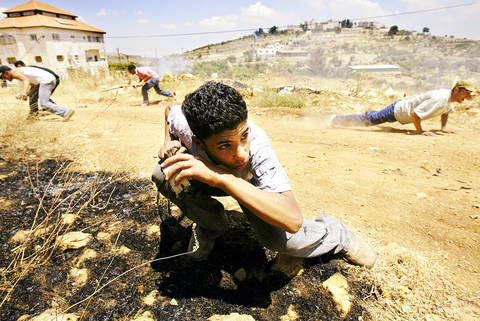
PHOTO: AP
The Israeli army issued a statement later on Thursday which did not deny the soldiers' account, saying: "It was decided that the IDF [the army] will hunt down all those involved in terror activities, including members of the PA [Palestinian Authority] security apparatus."
The killings began on Feb. 19, 2002 when gunmen from the Fatah-affiliated al-Aqsa Martyrs Brigade attacked an Israeli checkpoint near the West Bank city of Ramallah, killing six out of the seven soldiers at the checkpoint.
"They attack and we defend. In the past we attacked and they defended. We need to return to that," Gideon Ezra, the internal security minister, said at the time:
According to the soldier from the Yael unit, "we were going to kill six Palestinian policemen somewhere, revenging our six they took down."
He was told there was a suspicion that the gunmen who had killed the Israeli soldiers had passed through a checkpoint manned by the Palestinian policemen.
The Yael troops attacked a checkpoint at Deir as-Sudan, close to the Israeli settlement of Hallamish in the West Bank.
"The idea was simply to kill them all. Whenever they arrived we would kill them, regardless whether armed or not," the soldier said.
"It was ... really ... I really enjoyed it. It was the first time we were in an advance storm situation like in our training exercises. And we acted flawlessly. We performed superbly," he said.
The wounded policeman escaped into a hut which the soldiers fired at, blowing up a gas cylinder and starting a blaze.
A third tried to escape but was shot.
According to the witness, none of the men they had attacked was armed.
The second soldier, from the paratroop reconnaissance unit, also recalled orders given in the presence of his commanding officer, Brigadier Cochavi, in the early hours of Feb. 20.
"The order called to approach three Palestinian checkpoints, manned by Palestinian police in the Nablus area, from what I remember: approach three positions, and shoot at the Palestinian police."
The soldiers were told to kill Palestinian policemen at the checkpoints.
The soldier said it was clear it was a revenge attack, adding that the targeted policemen had a good working relationship with the soldiers.
It is not clear how many Palestinian policemen were killed. Media reports and Palestinian Human Rights Monitoring Group figures suggest 18 were killed in Gaza and the West Bank.

‘CROSSING THE LINE’: China’s embassy in Seoul criticized US Forces Korea Commander General Xavier Brunson, asking if his ‘hostile’ remarks were authorized by Washington South Korea and the US are in talks over recent public remarks by the commander of US Forces Korea, Seoul’s presidential office said yesterday, after the comments drew sharp criticism from China. In a recent podcast interview, US Forces Korea Commander General Xavier Brunson described South Korea as “the dagger in the heart of Asia” from China’s east coast, prompting the Chinese embassy in Seoul to say that he had “truly crossed the line.” The interview came amid growing speculation that Washington might seek to expand the role of US Forces Korea in countering the growing regional influence of China, a key

SEEKING ORDER: Rodrigo Paz said that ‘anyone who wants to destroy the nation will have to deal with this president and the full force of the constitution’ Bolivian President Rodrigo Paz on Wednesday said that the nation was at a “breaking point” after nearly a month of protests that have caused shortages of food, fuel and medicine. Paz, who took office six months ago amid the worst economic crisis there in four decades, is battling a groundswell of fury over his policies. The political capital, La Paz, has been besieged by low-income workers and members of the indigenous majority calling for his resignation. “The country needs order and is reaching breaking point,” the 58-year-old said at a public event in La Paz, renewing his appeal for dialogue. On Tuesday, the Bolivian

Australian researchers have trained lab-grown brain cells on a silicon computer chip to play the 1990s shooter game Doom and said they are just scratching the surface of what the neurons could be capable of doing. It is the science-fiction work of biotech boffins at Cortical Labs, who researched and developed the technology that harnesses the workings of the brain’s networking system. Each so-called “biological computer” contains about 200,000 living human brain cells, grown from stem cells that were harvested from blood donations. Having mastered the simple computer game Pong, where a paddle is moved up and down to send a ball

Through the noise of rushing papers and whirring belts at a print factory in Kyoto, two creators watch their photo essay come to life in broadsheet form — part of an effort to win new audiences in the age of artificial intelligence (AI). Despite the decline of the publishing industry, self-publication and handmade “zine” magazines are growing in popularity in Japan, reflecting the nation’s enduring love of paper in the digital era. While speaking to Agence France-Presse at the plant, his hands black with ink, one of the creators, Kazuma Obara, said: “I think [paper] is a medium that engages all five


 RSS
RSS