


Police set up road blocks yesterday around a southern Afghan city searching for accomplices of a suspected al-Qaeda suicide bomber who killed 20 people in one of the worst terror attacks here since the ouster of the Taliban in 2001, officials said.
The attacker detonated explosives strapped to his body during the funeral Wednesday in Kandahar city of a moderate Muslim cleric who had spoken out against Taliban-led insurgents. Among the dead was the Kabul police chief and six of his bodyguards. Some 42 people were wounded.
Security forces in Kandahar set up checkpoints on all roads out of the city and were checking vehicles for anyone suspected of having links to the bomber.
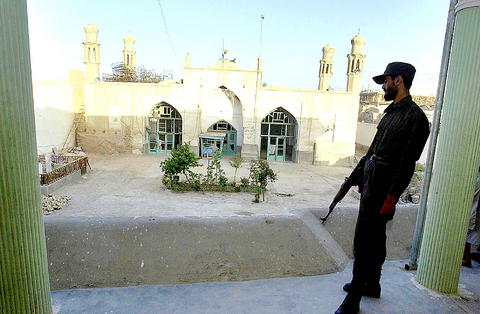
PHOTO: AFP
"We believe others were involved in the attack and we are trying to arrest them as soon as possible," said deputy police chief Salim Khan.
Parts of the bomber's body were found and Kandahar Governor Gul Agha Sherzai said he belonged to Osama bin Laden's terrorist network. He said documents found on the body "show he was an Arab."
Sherzai also said that an intelligence report had earlier indicated that "Arab al-Qaeda teams had entered Afghanistan and had been planning terrorist attacks." He did not elaborate.
Defense Ministry spokesman Mohammed Zaher Azimi declined to comment on the report, saying "it is too early to talk about this."
President Hamid Karzai condemned the bombing as an "act of cowardice by the enemies of Islam" and ordered a high-level investigation.
The body of Kabul police chief Akram Khakrezwal was taken yesterday to his home in Khakrez district, just north of Kandahar, for burial. Several top officials were expected to attend and security was tight.
The attacker detonated the explosives after coming close to the police commander, a Karzai supporter, but it was not clear if he was targeted, said Interior Ministry spokesman Latfullah Mashal. Hundreds of others were in the mosque for the funeral of cleric Mullah Abdul Fayaz.
Fayaz, also a supporter of Karzai, was shot to death in Kandahar on Sunday by suspected Taliban gunmen -- a week after he led a call for people not to support the rebels. Kandahar was a stronghold of the Taliban regime that was ousted from power in late 2001 by US-led forces.
The bombing drew widespread condemnation, including from UN Secretary-General Kofi Annan who described it as a "heinous act of terrorism," UN associate spokesman Stephane Dujarric said.
The blast -- which came on the heels of a major upsurge in rebel violence in recent months including assassinations, almost daily clashes with rebels and the kidnapping of an Italian aid worker -- further raised fears that militants here are copying the tactics of insurgents in Iraq.
The rebels themselves have suffered a heavy price -- losing about 200 men according to American and Afghan officials -- but the drumbeat of attacks has belied US claims that it is stabilizing the country, nearly four years after driving the Taliban from power.

‘CROSSING THE LINE’: China’s embassy in Seoul criticized US Forces Korea Commander General Xavier Brunson, asking if his ‘hostile’ remarks were authorized by Washington South Korea and the US are in talks over recent public remarks by the commander of US Forces Korea, Seoul’s presidential office said yesterday, after the comments drew sharp criticism from China. In a recent podcast interview, US Forces Korea Commander General Xavier Brunson described South Korea as “the dagger in the heart of Asia” from China’s east coast, prompting the Chinese embassy in Seoul to say that he had “truly crossed the line.” The interview came amid growing speculation that Washington might seek to expand the role of US Forces Korea in countering the growing regional influence of China, a key

SEEKING ORDER: Rodrigo Paz said that ‘anyone who wants to destroy the nation will have to deal with this president and the full force of the constitution’ Bolivian President Rodrigo Paz on Wednesday said that the nation was at a “breaking point” after nearly a month of protests that have caused shortages of food, fuel and medicine. Paz, who took office six months ago amid the worst economic crisis there in four decades, is battling a groundswell of fury over his policies. The political capital, La Paz, has been besieged by low-income workers and members of the indigenous majority calling for his resignation. “The country needs order and is reaching breaking point,” the 58-year-old said at a public event in La Paz, renewing his appeal for dialogue. On Tuesday, the Bolivian

Through the noise of rushing papers and whirring belts at a print factory in Kyoto, two creators watch their photo essay come to life in broadsheet form — part of an effort to win new audiences in the age of artificial intelligence (AI). Despite the decline of the publishing industry, self-publication and handmade “zine” magazines are growing in popularity in Japan, reflecting the nation’s enduring love of paper in the digital era. While speaking to Agence France-Presse at the plant, his hands black with ink, one of the creators, Kazuma Obara, said: “I think [paper] is a medium that engages all five

Australian researchers have trained lab-grown brain cells on a silicon computer chip to play the 1990s shooter game Doom and said they are just scratching the surface of what the neurons could be capable of doing. It is the science-fiction work of biotech boffins at Cortical Labs, who researched and developed the technology that harnesses the workings of the brain’s networking system. Each so-called “biological computer” contains about 200,000 living human brain cells, grown from stem cells that were harvested from blood donations. Having mastered the simple computer game Pong, where a paddle is moved up and down to send a ball


 RSS
RSS