


The Dutch began voting in their first national referendum yesterday, choosing whether to accept -- or more likely, reject -- a proposed EU constitution.
Recent polls have shown a majority approaching 60 percent will say no to the document. Following France's rejection of the charter on Sunday, a Dutch no would leave Europe's leaders with no clear backup plan for what to do when two of the 25-nation union's members say they won't approve the new ground rules.
Voting booths opened at 7:30am local time and were to close at 9pm.
"Let's not let ourselves be led by polls," Prime Minister Jan Peter Balkenende said on Tuesday on the television program Netwerk, in a last-minute plea for a yes vote. "Let's hope that when they're in the voting booth, people think about all the people that say this constitution would be a positive development."
Supporters, including both Balkenende's conservative government and the main opposition Labor Party, say the constitution would streamline decision making in the union, and create a single foreign minister to give Europe more sway in international affairs.
"I think it's a good thing if there's a strong Europe," said Jaena Padberg, an early yes voter outside a busy voting station at a school in Amsterdam. "It's good that our rights will be be secured."
Opponents fear that the Netherlands, a nation of just 16 million, will be engulfed by a superstate headquartered in Brussels and dominated by Germany, France and Britain.
That could mean the end of liberal Dutch policies such as tolerating marijuana use, prostitution and euthanasia.
Still other voters will say no to voice their discontent with the unpopular Dutch government: many here are angry about price increases that followed the introduction of the euro in 2002, and some fear that Turkey will soon be admitted to the union, worsening tensions between Dutch Muslims and the non-Muslim majority.
"In other countries that are going to join human rights are not as well protected as they are here," said no voter Mika Gruschke.
"Things are going too fast," said no voter Maarten Pijnenburg. "There's not enough control over the power of European politicians" under the new constitution, he said.
Some analysts expect Dutch ``no'' voters to be emboldened by the outcome in France, since the Dutch will avoid the stigma of casting a lone veto.
But Peter Kanne, of the TNS Nipo polling agency, said the French "won't be a decisive factor" on the turnout.
"Mainly, people will do what they intended to do anyway," he said in a telephone interview.
TNS predicted 59 percent of Dutch will vote no, versus 55 percent in France.

‘IN A DIFFERENT PLACE’: The envoy first visited Shanghai, where he attended a Chinese basketball playoff match, and is to meet top officials in Beijing tomorrow US Secretary of State Antony Blinken yesterday arrived in China on his second visit in a year as the US ramps up pressure on its rival over its support for Russia while also seeking to manage tensions with Beijing. The US diplomat tomorrow is to meet China’s top brass in Beijing, where he is also expected to plead for restraint as Taiwan inaugurates president-elect William Lai (賴清德), and to raise US concerns on Chinese trade practices. However, Blinken is also seeking to stabilize ties, with tensions between the world’s two largest economies easing since his previous visit in June last year. At the
Nearly half of China’s major cities are suffering “moderate to severe” levels of subsidence, putting millions of people at risk of flooding, especially as sea levels rise, according to a study of nationwide satellite data released yesterday. The authors of the paper, published by the journal Science, found that 45 percent of China’s urban land was sinking faster than 3mm per year, with 16 percent at more than 10mm per year, driven not only by declining water tables, but also the sheer weight of the built environment. With China’s urban population already in excess of 900 million people, “even a small portion

UNSETTLING IMAGES: The scene took place in front of TV crews covering the Trump trial, with a CNN anchor calling it an ‘emotional and unbelievably disturbing moment’ A man who doused himself in an accelerant and set himself on fire outside the courthouse where former US president Donald Trump is on trial has died, police said yesterday. The New York City Police Department (NYPD) said the man was declared dead by staff at an area hospital. The man was in Collect Pond Park at about 1:30pm on Friday when he took out pamphlets espousing conspiracy theories, tossed them around, then doused himself in an accelerant and set himself on fire, officials and witnesses said. A large number of police officers were nearby when it happened. Some officers and bystanders rushed
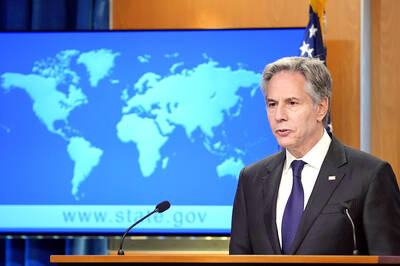
Beijing is continuing to commit genocide and crimes against humanity against Uyghurs and other Muslim minorities in its western Xinjiang province, U.S. Secretary of State Antony Blinken said in a report published on Monday, ahead of his planned visit to China this week. The State Department’s annual human rights report, which documents abuses recorded all over the world during the previous calendar year, repeated language from previous years on the treatment of Muslims in Xinjiang, but the publication raises the issue ahead of delicate talks, including on the war in Ukraine and global trade, between the top U.S. diplomat and Chinese


 RSS
RSS