


Dozens of teenagers dressed in blue Hindustan Times T-shirts are the latest soldiers in a media war stirring on the streets of India's financial and entertainment capital.
The youngsters, who stop Mumbai citizens to ascertain what they would like to read every day, are preparing for the New Delhi-based paper's launch in Mumbai later in the summer.
They are in battle with the Daily News and Analysis, or DNA, which will also hit the newsstands in September and has put up more than 150 billboards in the city as well as fielding its own team of bright young market researchers.
Both newspapers are hoping to break the local domination by leading English-language daily Times of India and capture a growing pool of advertisers and readers in the city of almost 20 million people.
In an early counterattack, the Times of India's parent company Bennett Coleman on Monday launched the Mumbai Mirror, an English-language daily tabloid, to deflect the new competition.
The Mirror's inaugural 48-page edition carried a typical range of newspaper features including city, state, international, sports pages and 12 pages of classifieds. The lead story was of Bollywood legend Amitabh Bachchan's fallout with elder brother Ajitabh over financial issues, in a story titled "Brothers set for hatchet job."
A media scrap is intensifying nationwide because India's newspaper market is defying an international trend -- it's growing -- and advertisers are eager to tap a booming consumer market. Mumbai is at the center of the war.
Even as print media in the rest of the world goes through a rough patch, with US print readership down 8 percent last year, the Indian market is growing steadily and is expected to cover 20 percent of the 1 billion-plus population in the next three years.
Official data shows that the total number of newspapers sold, including in English, reached 142 million last year, compared with around 55 million in the US.
Priced at 2 rupees (US$0.05) an issue, newspapers are also the main source of news in India followed by television, with Internet lagging behind because of low penetration and high costs.
India has around 10 computers for every 1,000 people against 500 in the US and 200 in China. Sales of computers in China are around 13 million units annually, compared to 3 million in India.
"A low computer penetration in the country is helping the print media as Internet access and online news reading is still in the infant stage," says Prateesh Krishnan, an analyst at SBI Capital Markets.
A strong advertising market is the other key driver for the new entrants as print advertising rose 14 percent to 55 billion rupees (US$1.3 billion) last year, of which over 10 billion rupees was spent in Mumbai alone, the bulk grabbed by the Times of India.
The only competition for the Times of India in Mumbai is an afternoon tabloid called Mid-Day with a circulation of around one-third of its morning rival's 560,000 copies a day.
"The advertiser in Mumbai has been exploited with high prices by the Times, while advertisement in other publications gets a low response. So a second paper is essential for everyone's benefit," says Kumar Ketkar, veteran analyst and editor of the leading local Marathi-language regional daily, Loksatta. "So there is a market, there are advertisers ready to explore new avenues and there are readers."
DNA, the brainchild of former Times of India marketing chief Pradeep Guha, is aimed at dethroning his old employer.
"It is for the first time that Times of India is facing the heat," DNA marketing director Suresh Balakrishnan says.
"The size and scale of DNA has scared the Times and it is already reacting by rapidly changing its content," he claims.
Industry sources claim DNA, a 50-50 joint venture between television group Zee and the Bhaskar group, is armed with a war chest of six billion rupees (US$140 million), including a pre-launch advertising budget of 600 million rupees.
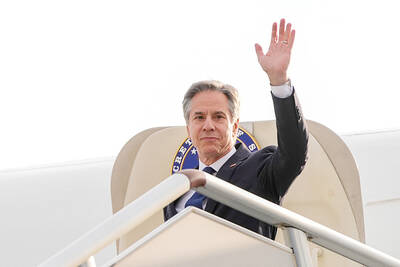
‘IN A DIFFERENT PLACE’: The envoy first visited Shanghai, where he attended a Chinese basketball playoff match, and is to meet top officials in Beijing tomorrow US Secretary of State Antony Blinken yesterday arrived in China on his second visit in a year as the US ramps up pressure on its rival over its support for Russia while also seeking to manage tensions with Beijing. The US diplomat tomorrow is to meet China’s top brass in Beijing, where he is also expected to plead for restraint as Taiwan inaugurates president-elect William Lai (賴清德), and to raise US concerns on Chinese trade practices. However, Blinken is also seeking to stabilize ties, with tensions between the world’s two largest economies easing since his previous visit in June last year. At the

UNSETTLING IMAGES: The scene took place in front of TV crews covering the Trump trial, with a CNN anchor calling it an ‘emotional and unbelievably disturbing moment’ A man who doused himself in an accelerant and set himself on fire outside the courthouse where former US president Donald Trump is on trial has died, police said yesterday. The New York City Police Department (NYPD) said the man was declared dead by staff at an area hospital. The man was in Collect Pond Park at about 1:30pm on Friday when he took out pamphlets espousing conspiracy theories, tossed them around, then doused himself in an accelerant and set himself on fire, officials and witnesses said. A large number of police officers were nearby when it happened. Some officers and bystanders rushed
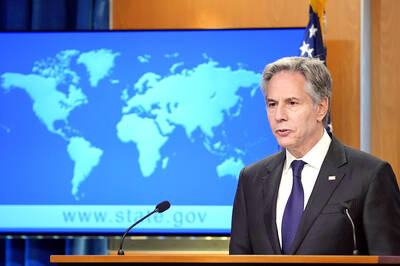
Beijing is continuing to commit genocide and crimes against humanity against Uyghurs and other Muslim minorities in its western Xinjiang province, U.S. Secretary of State Antony Blinken said in a report published on Monday, ahead of his planned visit to China this week. The State Department’s annual human rights report, which documents abuses recorded all over the world during the previous calendar year, repeated language from previous years on the treatment of Muslims in Xinjiang, but the publication raises the issue ahead of delicate talks, including on the war in Ukraine and global trade, between the top U.S. diplomat and Chinese
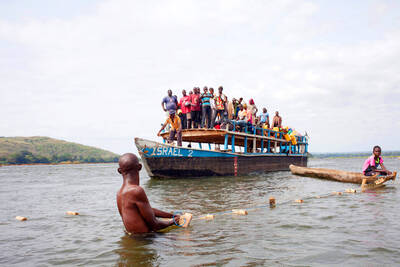
RIVER TRAGEDY: Local fishers and residents helped rescue people after the vessel capsized, while motorbike taxis evacuated some of the injured At least 58 people going to a funeral died after their overloaded river boat capsized in the Central African Republic’s (CAR) capital, Bangui, the head of civil protection said on Saturday. “We were able to extract 58 lifeless bodies,” Thomas Djimasse told Radio Guira. “We don’t know the total number of people who are underwater. According to witnesses and videos on social media, the wooden boat was carrying more than 300 people — some standing and others perched on wooden structures — when it sank on the Mpoko River on Friday. The vessel was heading to the funeral of a village chief in


 RSS
RSS