


French President Jacques Chirac and other mainstream political leaders in France are facing a grave crisis after the resounding rejection of the EU constitutional treaty in Sunday's referendum.
Chirac is no doubt confronted with one of the most serious challenges of his career, for the defeat of the treaty created unflattering headlines around the world and provoked uncertainty in the EU.
Observers at home and abroad have been quick to point out the president's heavy reponsibility in the debacle.
To begin with, it was Chirac's decision to take the treaty to the voters rather than put it before the parliament, where it would have had easy passage. Deeply unpopular with French voters, Chirac stubbornly clung to his even more unpopular prime minister, Jean-Pierre Raffarin, although it was clear that a more politically skilled and less confrontational head of government might have been a more effective spokesman for the treaty.
Also, the French president, usually a very able and resourceful campaigner, led a mediocre campaign for the treaty, misreading his electorate and underestimating the depth of discontent in the country. Rather than address specific fears and worries, Chirac attempted to discredit those opposing the treaty as un-European, a serious error of judgment that only made opponents of the constitution more determined.
"What a monumental disavowal," wrote the left-wing daily Liberation. "The defeat of the [treaty] is above all his."
"After a reign of 10 years, the emperor is without clothes," said the financial newspaper Les Echos.
The 72-year-old Chirac has made it a habit to pick himself up after stinging defeats, and he has already galvanized his supporters to call on the French to "rally around" him to face the political crisis.
However, it seems clear that, unless he is able to work a miracle, his career will end in 2007 with his second term, and he will leave French politics under the cloud of having led France to the sidelines of Europe.
Clearly, the "no" delivered by the French voters to the treaty was what former Socialist prime minister Laurent Fabius, who led opposition to the EU constitution, called "a left-wing no," a rejection targeting Chirac's and Europe's free-market, small-government tendencies.
However, France's left wing was also badly wounded by disagreement over the treaty, both in its leadership and its rank-and-file.
Fabius, the party's number two, defied Socialist Party leaders and formed an alliance with the Communists and other far-left groupings, while exit polls showed that half of the Socialist voters cast their ballots for the treaty and half against.
However, Fabius is not popular enough to become the spokesman for an alternative left-wing movement, and Socialist Party leader Francois Hollande looks to have been seriously weakened by the treaty defeat. He said yesterday that he would not step down, and called for "a profound debate" on the party's direction and strategy.
However, like Chirac, he has in all likelihood seen his presidential ambitions for 2007 dashed by the treaty's defeat and may not be able to withstand pressure to resign if he cannot heal the party's deep division.
If this debacle had a winner, it was the ambitious, media-savvy former interior and finance minister Nicolas Sarkozy. With Chirac weakened and the left wing in tatters, he remains the only serious presidential candidate for 2007. Although he campaigned for the treaty, he appears to have been largely untouched by the referendum fall-out.
While he supports the free-market policies rejected by French voters on Sunday, his energy and his outspokenness appeal to a wide range of the French people, who have grown tired of the politics-as-usual embodied by current leaders.
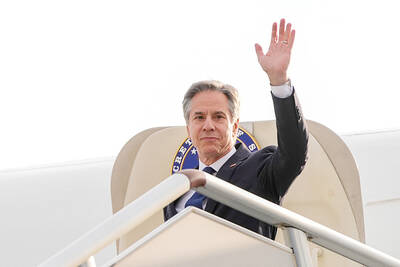
‘IN A DIFFERENT PLACE’: The envoy first visited Shanghai, where he attended a Chinese basketball playoff match, and is to meet top officials in Beijing tomorrow US Secretary of State Antony Blinken yesterday arrived in China on his second visit in a year as the US ramps up pressure on its rival over its support for Russia while also seeking to manage tensions with Beijing. The US diplomat tomorrow is to meet China’s top brass in Beijing, where he is also expected to plead for restraint as Taiwan inaugurates president-elect William Lai (賴清德), and to raise US concerns on Chinese trade practices. However, Blinken is also seeking to stabilize ties, with tensions between the world’s two largest economies easing since his previous visit in June last year. At the
Nearly half of China’s major cities are suffering “moderate to severe” levels of subsidence, putting millions of people at risk of flooding, especially as sea levels rise, according to a study of nationwide satellite data released yesterday. The authors of the paper, published by the journal Science, found that 45 percent of China’s urban land was sinking faster than 3mm per year, with 16 percent at more than 10mm per year, driven not only by declining water tables, but also the sheer weight of the built environment. With China’s urban population already in excess of 900 million people, “even a small portion

UNSETTLING IMAGES: The scene took place in front of TV crews covering the Trump trial, with a CNN anchor calling it an ‘emotional and unbelievably disturbing moment’ A man who doused himself in an accelerant and set himself on fire outside the courthouse where former US president Donald Trump is on trial has died, police said yesterday. The New York City Police Department (NYPD) said the man was declared dead by staff at an area hospital. The man was in Collect Pond Park at about 1:30pm on Friday when he took out pamphlets espousing conspiracy theories, tossed them around, then doused himself in an accelerant and set himself on fire, officials and witnesses said. A large number of police officers were nearby when it happened. Some officers and bystanders rushed

Beijing is continuing to commit genocide and crimes against humanity against Uyghurs and other Muslim minorities in its western Xinjiang province, U.S. Secretary of State Antony Blinken said in a report published on Monday, ahead of his planned visit to China this week. The State Department’s annual human rights report, which documents abuses recorded all over the world during the previous calendar year, repeated language from previous years on the treatment of Muslims in Xinjiang, but the publication raises the issue ahead of delicate talks, including on the war in Ukraine and global trade, between the top U.S. diplomat and Chinese


 RSS
RSS