


The black-masked guard behind the gate of the regional police office sauntered over with his Kalashnikov projecting the embodiment of force, but his just-visible brown eyes softened when he fondly remembered his time training in the US.
Behind him, dozens of military and police troops in buses streamed out of the heavily guarded Andijan police complex wearing new American-style helmets to maintain control in this eastern city, the scene of the worst violence since Uzbekistan's 1991 independence.
Uzbekistan has been a key ally in the US-led war on terror, providing a base for American troops for operations in neighboring Afghanistan.
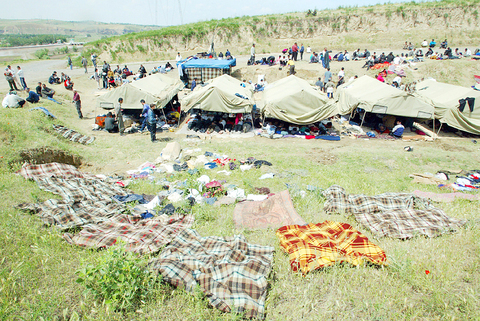
PHOTO: AP
But even before the Sept. 11, 2001 attacks, the US government provided training and equipment to Uzbek troops and police -- some of the same forces who opened fire without warning May 13 on about 2,000 demonstrators supporting armed militants who had seized government buildings and freed 23 businessmen jailed for alleged Islamic extremism.
Following the May 13 action, international groups renewed calls for the US and international community to reconsider assistance to Uzbekistan, where President Islam Karimov has rejected calls for an independent inquiry into the crackdown. The government claims 173 were killed, including 36 troops, but human rights groups allege that hundreds died.
Under US law, no unit of a foreign military can receive training if it is found to have committed a gross violation of human rights.
Uzbek officials won't name the exact units involved in the Andijan events for security reasons. But one police official who spoke on condition of anonymity said all the country's elite forces had been mobilized here, including regular army and special forces of all sorts.
At the Andijan police headquarters, the masked guard wearing blue-and-grey urban camouflage said he was an intelligence officer with the Kalkon unit, meaning "Shield." Seeing a foreign reporter, he briefly reminisced about training in the US, where lessons were first translated into Russian, but because not everyone could understand, an Uzbek speaker from Tashkent was later summoned.
Under a 2002 strategic partnership agreement between Washington and Tashkent, the US pledged to help equip Uzbek military units and train them in combating terrorism, drug trafficking, money laundering and other threats.
Karimov has used the language of anti-terrorism in explaining authorities' actions in Andijan, claiming the instigators were extremists bent on creating a Muslim state -- and refusing to acknowledge any peaceful protesters were present as seen by reporters.
Regular exercises
US and Uzbek soldiers have held regular training exercises since the 1990s, with American special forces troops heading to the mountains with their Uzbek counterparts for lessons on repelling incursions -- a main worry for Uzbekistan after several such attacks starting in the late 1990s by the al-Qaeda-allied Islamic Movement of Uzbekistan.
Much US assistance also focuses on worries about the spread of weapons of mass destruction across rugged, poorly controlled borders. Uzbekistan controls half of an island in the Aral Sea that was the site of a Soviet biological weapons research lab, and has some nuclear facilities.
Uzbek troops have also traveled to bases in the US for special forces, airborne and English-language programs.
Uzbekistan's human rights abuses have caused it to lose aid before. Last July, the US State Department withdrew most of its aid after failing to certify Tashkent had made progress to rectify its abuses.
But later that month, General John Abizaid, the top US commander in the region, flew to Tashkent to reassure the Uzbeks that the American military would maintain and even boost its cooperation -- aid that is separate from State Department assistance.
After the Andijan violence, Abizaid said the US military was scaling back operations at the Karshi-Khanabad base in southern Uzbekistan. But officers at the base told a visiting reporter that they hadn't noted any reduction in movement there.
The Uzbeks are now engaged in talks with Washington hoping to get compensation for use of the base, now rent-free for US troops.
Noting the base negotiations that could be a financial windfall for Uzbekistan, US-based Human Rights Watch expressed concern this week that Defense Department cooperation with the country continues, and that the European Union also gives some US$20.1 million in indirect assistance. Uzbek troops in Andijan were seen driving around in British Land Rovers.
"The US and the EU have to make clear that there will be real consequences for a cover-up if there is no independent investigation, and they have to set a deadline for it to take place," Holly Cartner, Europe and Central Asia director at Human Rights Watch, said in a statement.
The sentiment was echoed by the Brussels-based International Crisis Group think tank, which noted Thursday that despite the decline in US aid in recent years, there is a "widespread perception among Uzbeks that the US strongly backs an increasingly unpopular regime."
Regime abuses
"For too long [the international community] has ignored the abuses of the Karimov regime and the signs that trouble was brewing in the country," the group said in a report on the Andijan crackdown. "The failed policies of muted criticism -- and tacit support -- must be abandoned."
It's not clear if any immediate reconsideration of assistance is in the works. On Wednesday, US State Department spokesman Richard Boucher said Washington still is pressing for reforms and an open investigation into the Andijan violence, but that anti-terrorism cooperation with Uzbekistan would continue.
"It doesn't do any of us any good to abandon the effort against terrorism in this critical region," Boucher said. "So we will continue work with them in many areas, including the fight against terrorism."
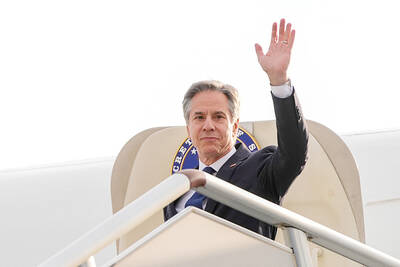
‘IN A DIFFERENT PLACE’: The envoy first visited Shanghai, where he attended a Chinese basketball playoff match, and is to meet top officials in Beijing tomorrow US Secretary of State Antony Blinken yesterday arrived in China on his second visit in a year as the US ramps up pressure on its rival over its support for Russia while also seeking to manage tensions with Beijing. The US diplomat tomorrow is to meet China’s top brass in Beijing, where he is also expected to plead for restraint as Taiwan inaugurates president-elect William Lai (賴清德), and to raise US concerns on Chinese trade practices. However, Blinken is also seeking to stabilize ties, with tensions between the world’s two largest economies easing since his previous visit in June last year. At the
Nearly half of China’s major cities are suffering “moderate to severe” levels of subsidence, putting millions of people at risk of flooding, especially as sea levels rise, according to a study of nationwide satellite data released yesterday. The authors of the paper, published by the journal Science, found that 45 percent of China’s urban land was sinking faster than 3mm per year, with 16 percent at more than 10mm per year, driven not only by declining water tables, but also the sheer weight of the built environment. With China’s urban population already in excess of 900 million people, “even a small portion

UNSETTLING IMAGES: The scene took place in front of TV crews covering the Trump trial, with a CNN anchor calling it an ‘emotional and unbelievably disturbing moment’ A man who doused himself in an accelerant and set himself on fire outside the courthouse where former US president Donald Trump is on trial has died, police said yesterday. The New York City Police Department (NYPD) said the man was declared dead by staff at an area hospital. The man was in Collect Pond Park at about 1:30pm on Friday when he took out pamphlets espousing conspiracy theories, tossed them around, then doused himself in an accelerant and set himself on fire, officials and witnesses said. A large number of police officers were nearby when it happened. Some officers and bystanders rushed

Beijing is continuing to commit genocide and crimes against humanity against Uyghurs and other Muslim minorities in its western Xinjiang province, U.S. Secretary of State Antony Blinken said in a report published on Monday, ahead of his planned visit to China this week. The State Department’s annual human rights report, which documents abuses recorded all over the world during the previous calendar year, repeated language from previous years on the treatment of Muslims in Xinjiang, but the publication raises the issue ahead of delicate talks, including on the war in Ukraine and global trade, between the top U.S. diplomat and Chinese


 RSS
RSS