


Two suicide attackers detonated car bombs in northern Iraq yesterday, killing at least five Iraqis and wounding 40, hospital and police officials said, as raging violence claimed more than 20 lives during the past 24 hours across Iraq.
The bombs exploded at an entrance to an Iraqi military base in Sinjar, about 120km northwest of Mosul, said a police official.
The bodies of least five Iraqis killed in the attack were brought to Sinjar Hospital, said a hospital official, and 40 people were wounded.
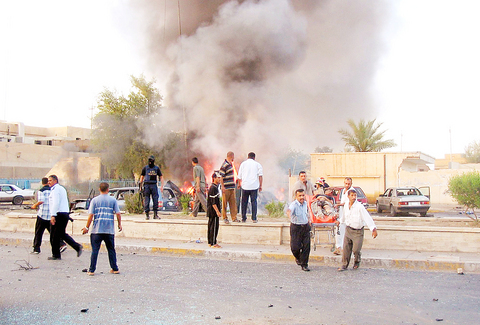
PHOTO: AP
More than 20 people have been killed across Iraq during the past 24 hours, all victims of a raging, increasingly sectarian insurgency that US-backed authorities are struggling to put down.
Yesterday, Japan's Foreign Ministry said in Tokyo that it is trying to verify if a dead Asian man pictured in Internet photos is a Japanese hostage in Iraq. Late Friday, the Japanese news agency reported a Web site claim by Sunni militant group Ansar al-Sunnah Army that Akihiko Saito had died and said the group had posted pictures of the bloodied victim. Saito, a security consultant, has been missing in Iraq since his convoy was ambushed early in May. He worked for Hart Security Ltd, a British security firm.
Ten Iraqis were killed and their bodies dumped in the volatile western border city of Qaim after returning from a pilgrimage to a holy site in neighboring Syria, police said yesterday. Relatives of five of the victims told police the group had been visiting the Sayda Zeinab Shiite Muslim shrine in Damascus and returned via the Waleed border crossing.
At a funeral yesterday for four of the victims in the predominantly Shiite Muslim city of Diwaniyah, 170km south of Baghdad, many of the 150 mourners chanted "revenge, revenge" as they followed four coffins draped in Iraq's red, white and black flags.
Violence continued throughout cities south of Baghdad in a region dubbed the Triangle of Death, where scores of bodies have been found in an apparent tit-for-tat wave of sectarian violence.
Two civilians were killed and three injured when clashes erupted late Friday between militants and Iraqi soldiers in Mahmoudiya, about 30km south of Baghdad.
Gunmen killed another five people Friday during a car exhibition in the nearby city of Latifiyah.
Ali said police have also found the bullet-riddled bodies of five Iraqis in a car on a road in the volatile Anbar province, before they were returned to their home city of Hillah, 95km south of Baghdad.
A suicide car bomb attack on a police patrol instead killed three civilians Friday in Tikrit, north of Baghdad. Six policemen were among 18 people wounded.
North of Baghdad in Kirkuk, Sheik Sabhan Khalaf al-Jibouri, a moderate Sunni Muslim tribal leader with close ties to Iraqi Kurds, was killed Friday in a hail of machine-gun fire.
In the capital, gunmen killed a western Baghdad tribal leader Samir Abdel Laith and real estate agent Sheik Samir Abdul-Razziq in separate drive-by shootings Friday in the western Jihad neighborhood.

‘CROSSING THE LINE’: China’s embassy in Seoul criticized US Forces Korea Commander General Xavier Brunson, asking if his ‘hostile’ remarks were authorized by Washington South Korea and the US are in talks over recent public remarks by the commander of US Forces Korea, Seoul’s presidential office said yesterday, after the comments drew sharp criticism from China. In a recent podcast interview, US Forces Korea Commander General Xavier Brunson described South Korea as “the dagger in the heart of Asia” from China’s east coast, prompting the Chinese embassy in Seoul to say that he had “truly crossed the line.” The interview came amid growing speculation that Washington might seek to expand the role of US Forces Korea in countering the growing regional influence of China, a key

SEEKING ORDER: Rodrigo Paz said that ‘anyone who wants to destroy the nation will have to deal with this president and the full force of the constitution’ Bolivian President Rodrigo Paz on Wednesday said that the nation was at a “breaking point” after nearly a month of protests that have caused shortages of food, fuel and medicine. Paz, who took office six months ago amid the worst economic crisis there in four decades, is battling a groundswell of fury over his policies. The political capital, La Paz, has been besieged by low-income workers and members of the indigenous majority calling for his resignation. “The country needs order and is reaching breaking point,” the 58-year-old said at a public event in La Paz, renewing his appeal for dialogue. On Tuesday, the Bolivian

Through the noise of rushing papers and whirring belts at a print factory in Kyoto, two creators watch their photo essay come to life in broadsheet form — part of an effort to win new audiences in the age of artificial intelligence (AI). Despite the decline of the publishing industry, self-publication and handmade “zine” magazines are growing in popularity in Japan, reflecting the nation’s enduring love of paper in the digital era. While speaking to Agence France-Presse at the plant, his hands black with ink, one of the creators, Kazuma Obara, said: “I think [paper] is a medium that engages all five

Australian researchers have trained lab-grown brain cells on a silicon computer chip to play the 1990s shooter game Doom and said they are just scratching the surface of what the neurons could be capable of doing. It is the science-fiction work of biotech boffins at Cortical Labs, who researched and developed the technology that harnesses the workings of the brain’s networking system. Each so-called “biological computer” contains about 200,000 living human brain cells, grown from stem cells that were harvested from blood donations. Having mastered the simple computer game Pong, where a paddle is moved up and down to send a ball


 RSS
RSS