


Indigenous groups from around the world agreed to a sweeping list of demands to their home countries and the UN to take their interests into account in the push to spread education and eradicate poverty.
The demands were adopted Friday at the end of a two-week forum in a colorful scene in a cavernous UN chamber: Turban-clad tribesmen from the Sahara mingled with Buddhist monks in saffron robes, who sat across from ethnic Quechua in conical hats draped with puffy pink and blue tassels.
The forum focused on two key UN development goals for 2015 -- cutting in half the number of people living in extreme poverty and achieving universal primary education. Reaching the goals will be high on the agenda at a summit of world leaders called by Secretary-General Kofi Annan in September.
Indigenous groups wanted to make sure that governments don't rob them of their culture and history -- or their right to speak their own language -- in efforts to achieve the goals. They also called for national and international action to address ongoing human rights violations against native peoples.
Participants in the forum hailed the demands as the strongest of their kind for indigenous groups.
"This mainstreams us into the UN system," said Ina Hume, a native of Bangladesh's Chittagong Hill Tracts, a mostly tribal region that borders India and Myanmar.
Indigenous groups also must confront challenges that may not occur to city dwellers -- isolation, lack of birth certificates or other documentation, and the insistence that they keep indigenous names or dress.
The relative ease with which the recommendations passed was a marked counterpoint to the failure of a conference occurring at the same time at the UN to toughen global controls on nuclear arms.
The only major dispute was whether to condemn the World Bank for a new policy on indigenous issues that would seek to consult with indigenous peoples rather than strive to get their consent. In the end, the final document largely avoided the issue and left out the most controversial language.
The conference began with UN Deputy Secretary-General Louise Frechette urging the 1,500 native leaders and activists to draw up concrete plans that would "point the way toward measurable improved standards of living and greater respect for human rights."
Officials acknowledged that with some estimate putting the number of indigenous people at over 200 million in more than 70 countries, more needs to be done to include indigenous peoples' organizations in efforts to alleviate poverty and improve education.
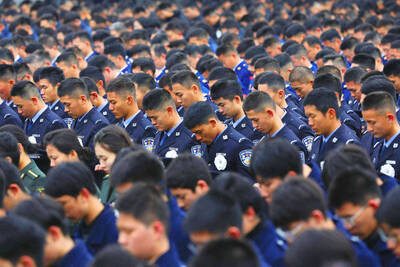
China yesterday held a low-key memorial ceremony for the 1937 Nanjing Massacre, with Chinese President Xi Jinping (習近平) not attending, despite a diplomatic crisis between Beijing and Tokyo over Taiwan. Beijing has raged at Tokyo since Japanese Prime Minister Sanae Takaichi last month said that a hypothetical Chinese attack on Taiwan could trigger a military response from Japan. China and Japan have long sparred over their painful history. China consistently reminds its people of the 1937 Nanjing Massacre, in which it says Japanese troops killed 300,000 people in what was then its capital. A post-World War II Allied tribunal put the death toll
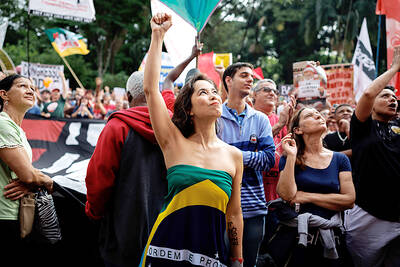
‘NO AMNESTY’: Tens of thousands of people joined the rally against a bill that would slash the former president’s prison term; President Lula has said he would veto the bill Tens of thousands of Brazilians on Sunday demonstrated against a bill that advanced in Congress this week that would reduce the time former president Jair Bolsonaro spends behind bars following his sentence of more than 27 years for attempting a coup. Protests took place in the capital, Brasilia, and in other major cities across the nation, including Sao Paulo, Florianopolis, Salvador and Recife. On Copacabana’s boardwalk in Rio de Janeiro, crowds composed of left-wing voters chanted “No amnesty” and “Out with Hugo Motta,” a reference to the speaker of the lower house, which approved the bill on Wednesday last week. It is
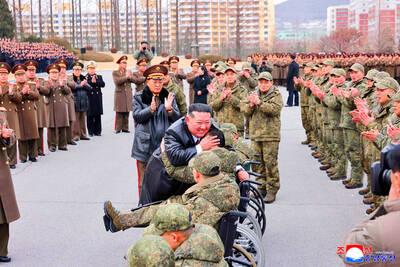
FALLEN: The nine soldiers who were killed while carrying out combat and engineering tasks in Russia were given the title of Hero of the Democratic People’s Republic of Korea North Korean leader Kim Jong-un attended a welcoming ceremony for an army engineering unit that had returned home after carrying out duties in Russia, North Korean state media KCNA reported on Saturday. In a speech carried by KCNA, Kim praised officers and soldiers of the 528th Regiment of Engineers of the Korean People’s Army (KPA) for “heroic” conduct and “mass heroism” in fulfilling orders issued by the ruling Workers’ Party of Korea during a 120-day overseas deployment. Video footage released by North Korea showed uniformed soldiers disembarking from an aircraft, Kim hugging a soldier seated in a wheelchair, and soldiers and officials

Cozy knits, sparkly bobbles and Santa hats were all the canine rage on Sunday, as hundreds of sausage dogs and their owners converged on central London for an annual parade and get-together. The dachshunds’ gathering in London’s Hyde Park came after a previous “Sausage Walk” planned for Halloween had to be postponed, because it had become so popular organizers needed to apply for an events licence. “It was going to be too much fun so they canceled it,” laughed Nicky Bailey, the owner of three sausage dogs: Una and her two 19-week-old puppies Ember and Finnegan, wearing matching red coats and silver


 RSS
RSS