


Police began efforts yesterday to identify the remains of a suspected suicide bomber who attacked a popular Muslim shrine near the official residence of Pakistan's prime minister, killing at least 20 people and wounding scores more, an official said.
The explosion ripped through a congregation of hundreds of mainly Shiite worshippers who had gathered Friday for the last day of a religious festival at the Bari Imam shrine.
The shrine is about a kilometer from the residence of Prime Minister Shaukat Aziz and the heavily guarded diplomatic enclave that houses the embassy of the US and other countries in the capital, Islamabad.
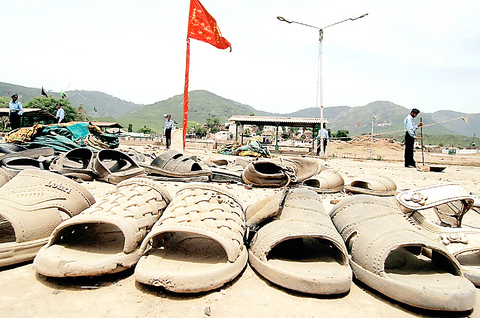
PHOTO: AFP
Thousands of Muslims, both Sunnis and minority Shiites, attended the five-day festival. The explosion left blood, body parts, shoes and pieces of clothing scattered over a wide area.
Police recovered the head of a man who appeared to be in his 20s and is believed to be the suicide attacker, said Information Minister Sheikh Rashid Ahmed.
"[Investigators] are trying to identify him. We will soon determine who he is," Ahmed told reporters.
He offered a reward of 500,000 rupees (US$8,400) for information that helps identify the attacker.
Yesterday newspapers published photographs of the suspect's head -- with an unshaven face, thin mustache and curly hair.
The bombing struck the congregation under a canvas shade as they awaited the arrival of Shiite leader Hamid Mosavi, a vehement critic of the US-led war on terrorism, who was about to deliver a sermon. Mosavi was not hurt, witnesses said.
A government official, Tariq Pirzada, said at least 18 people were killed and 86 others hurt in the explosion, the state-run Associated Press of Pakistan news agency reported.
Hundreds of Shiite worshippers, beating their chests and heads in mourning, clashed with police near the shrine afterward when officers charged the crowd with batons to clear the way for ambulances. Some chanted, "Down with America!"
Police stepped up security in Islamabad Saturday.
President General Pervez Musharraf condemned the deadliest attack in the capital for years, and appealed for his countrymen to unite against "religious terrorism, sectarianism and extremism."
UN Secretary-General Kofi Annan also condemned the bombing, and expressed outrage that civilians have been repeatedly targeted at their places of worship.
"Let me express the condolences of the US government for this tragic event," added US Assistant Secretary of State for South Asia Christina Rocca, who was in Islamabad for talks. "This was a horrible thing to have happened."
Sectarian attacks are common in Pakistan. Sunnis make up about 80 percent of its 150 million people, and Shiites about 17 percent. Most live peacefully together, but extremist elements on both sides have violent agendas.
The schism dates back to a Seventh-century dispute over who was the true heir to the Prophet Mohammed.

‘CROSSING THE LINE’: China’s embassy in Seoul criticized US Forces Korea Commander General Xavier Brunson, asking if his ‘hostile’ remarks were authorized by Washington South Korea and the US are in talks over recent public remarks by the commander of US Forces Korea, Seoul’s presidential office said yesterday, after the comments drew sharp criticism from China. In a recent podcast interview, US Forces Korea Commander General Xavier Brunson described South Korea as “the dagger in the heart of Asia” from China’s east coast, prompting the Chinese embassy in Seoul to say that he had “truly crossed the line.” The interview came amid growing speculation that Washington might seek to expand the role of US Forces Korea in countering the growing regional influence of China, a key

SEEKING ORDER: Rodrigo Paz said that ‘anyone who wants to destroy the nation will have to deal with this president and the full force of the constitution’ Bolivian President Rodrigo Paz on Wednesday said that the nation was at a “breaking point” after nearly a month of protests that have caused shortages of food, fuel and medicine. Paz, who took office six months ago amid the worst economic crisis there in four decades, is battling a groundswell of fury over his policies. The political capital, La Paz, has been besieged by low-income workers and members of the indigenous majority calling for his resignation. “The country needs order and is reaching breaking point,” the 58-year-old said at a public event in La Paz, renewing his appeal for dialogue. On Tuesday, the Bolivian

Through the noise of rushing papers and whirring belts at a print factory in Kyoto, two creators watch their photo essay come to life in broadsheet form — part of an effort to win new audiences in the age of artificial intelligence (AI). Despite the decline of the publishing industry, self-publication and handmade “zine” magazines are growing in popularity in Japan, reflecting the nation’s enduring love of paper in the digital era. While speaking to Agence France-Presse at the plant, his hands black with ink, one of the creators, Kazuma Obara, said: “I think [paper] is a medium that engages all five

Australian researchers have trained lab-grown brain cells on a silicon computer chip to play the 1990s shooter game Doom and said they are just scratching the surface of what the neurons could be capable of doing. It is the science-fiction work of biotech boffins at Cortical Labs, who researched and developed the technology that harnesses the workings of the brain’s networking system. Each so-called “biological computer” contains about 200,000 living human brain cells, grown from stem cells that were harvested from blood donations. Having mastered the simple computer game Pong, where a paddle is moved up and down to send a ball


 RSS
RSS