


In the back of a theater here, two gray-haired women perched on the edge of their seats, nodding their heads, clapping their hands silently. On the stage, Beate Sirota Gordon, a snowy-haired American grandmother, implored Japanese women to rise in defense of the Japanese Constitution's equal rights clause, which she said was fundamental to their rights as women.
She should know. At age 22, she wrote it.
"Japanese women should keep fighting for their rights," Beate-san, as she is known here, said to applause from the sold-out crowd.
For half a century, Gordon and the 24 other Americans who drafted Japan's Constitution in six intense days in 1946 kept a pact of silence sworn to Gen. Douglas MacArthur, the postwar US occupation commander. That broke down about a decade ago, and since then Gordon has left the comfort of her Manhattan apartment once or twice a year for a lecture tour in Japan.
But now Gordon finds herself, at 81, at the front of a drive by Japanese women to protect "her" Article 24, which proclaims "the essential equality of the sexes."
Last year, a constitutional panel of Japan's ruling Liberal Democratic Party denounced the women's rights article as promoting "egoism in postwar Japan, leading to the collapse of family and community."
"I never thought they would attack it," said Gordon, who only a few years ago was lionized in A String of Pearls, a Japanese play about the writing of the Constitution, as seen through her eyes.
Conservatives blame the "American-imposed" clause for a variety of social ills, including a plunging marriage rate, an anemic birthrate and increasing delinquency in the schools. The clause seems safe for now, but only because the conservatives decided in April to concentrate on winning parliamentary approval to change Article 9, which prohibits Japan from using war to settle disputes.
"It is a threat and the women realize that, and that is why they are so vociferous," Gordon said, referring to the reception she received on a punishing eight-city, 12-event speaking and interview tour through Japan in April.
Beate's Gift, a movie about the legacy of the equal rights amendment, recently opened in theaters around Japan. Hurried through production to parry conservative arguments, the movie splices interviews with successful professional women with Gordon's account of writing the equal rights article.
"There are now women governors, women mayors, women who are in the media, filmmakers, writers, presidents of companies," Gordon said at the movie's April 30 debut. "There are women who don't know what has gone on before. Knowing how different it was 60 years ago will encourage them to go on and protect these rights."
A rare witness to history, Beate-san arrived in Japan at age 5 in 1929, traveling with her parents, Jewish emigres, on a ship from Vladivostok, Russia. Her father, a pianist, was embarking on what became 16 years of teaching and giving concerts in Japan. Her first memory is arriving at Yokohama Harbor, looking at the dock crowded with people with black hair and black eyes, and asking, "Mama, are they all brothers and sisters?"
But within a decade she had acculturated, learning fluent Japanese through her contact with the stream of artists and intellectuals coming to the house. But she retained an outsider's eye.
"I saw the women walking behind the men in the street," she recalled. "I saw how the mothers prepared the food when the husband came home with his friends from the office. She would serve them dinner, without even talking, then go into the kitchen with the children."
As a teenager, she recalled, Japanese girl friends would "prepare for marriage, learning flower arranging, but would not even meet their future husbands."
The outbreak of war caught her at Mills College in Oakland, California, and her parents at home in Tokyo. She spent the war years making American government radio broadcasts beamed to Japan and researching Japan for Time magazine. After the war she raced to Tokyo to track down her parents, who had been detained in a mountain village. As one of a handful of Caucasians with a strong command of Japanese, she became the translator for the Constitution writers.
In her memoir, The Only Woman in the Room, she recounts how in the grueling days of debates as the Constitution took form, almost all of the clauses that emerged from her Underwood typewriter ended up in the trash basket.
"Colonel Kades said, `My God, you have given Japanese women more rights than in the American Constitution,"' she recalled, referring to Lieutenant Colonel Charles Kades, head of the constitutional steering committee. "I said, `Colonel Kades, that's not very difficult to do, because women are not in the American Constitution.'"

US President Donald Trump on Friday said Washington was “locked and loaded” to respond if Iran killed protesters, prompting Tehran to warn that intervention would destabilize the region. Protesters and security forces on Thursday clashed in several Iranian cities, with six people reported killed, the first deaths since the unrest escalated. Shopkeepers in Tehran on Sunday last week went on strike over high prices and economic stagnation, actions that have since spread into a protest movement that has swept into other parts of the country. If Iran “violently kills peaceful protesters, which is their custom, the United States of America will come to
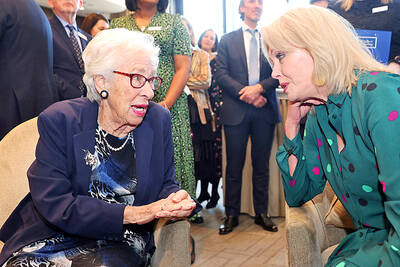
Auschwitz survivor Eva Schloss, the stepsister of teenage diarist Anne Frank and a tireless educator about the horrors of the Holocaust, has died. She was 96. The Anne Frank Trust UK, of which Schloss was honorary president, said she died on Saturday in London, where she lived. Britain’s King Charles III said he was “privileged and proud” to have known Schloss, who cofounded the charitable trust to help young people challenge prejudice. “The horrors that she endured as a young woman are impossible to comprehend and yet she devoted the rest of her life to overcoming hatred and prejudice, promoting kindness, courage, understanding

‘DISRESPECTFUL’: Katie Miller, the wife of Trump’s most influential adviser, drew ire by posting an image of Greenland in the colors of the US flag, captioning it ‘SOON’ US President Donald Trump on Sunday doubled down on his claim that Greenland should become part of the US, despite calls by the Danish prime minister to stop “threatening” the territory. Washington’s military intervention in Venezuela has reignited fears for Greenland, which Trump has repeatedly said he wants to annex, given its strategic location in the arctic. While aboard Air Force One en route to Washington, Trump reiterated the goal. “We need Greenland from the standpoint of national security, and Denmark is not going to be able to do it,” he said in response to a reporter’s question. “We’ll worry about Greenland in
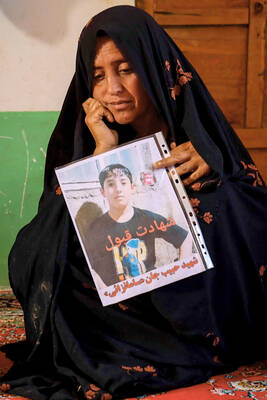
PERILOUS JOURNEY: Over just a matter of days last month, about 1,600 Afghans who were at risk of perishing due to the cold weather were rescued in the mountains Habibullah set off from his home in western Afghanistan determined to find work in Iran, only for the 15-year-old to freeze to death while walking across the mountainous frontier. “He was forced to go, to bring food for the family,” his mother, Mah Jan, said at her mud home in Ghunjan village. “We have no food to eat, we have no clothes to wear. The house in which I live has no electricity, no water. I have no proper window, nothing to burn for heating,” she added, clutching a photograph of her son. Habibullah was one of at least 18 migrants who died


 RSS
RSS