


A Japanese researcher has identified a new tectonic plate lying beneath the Tokyo region, a discovery that could have major implications for the government's disaster prevention policies in the quake-prone capital, according to a news report yesterday.
Shinji Toda, a geology expert at a public research institute, says there is a 25km thick, 10,000km2 slab lying just below Tokyo Bay that was previously thought to be an extension of the Philippine Plate but is actually a separate tectonic plate, according to Kyodo News agency.
Toda, chief researcher at the National Institute of Advanced Industrial Science and Technology in Tsukuba city, studied data from 150,000 shallow earthquakes of at least magnitude-2 on the Richter scale that occurred between 1979 and last year. A three-dimensional distribution of their epicenters revealed the new plate, Kyodo said.
Phone calls to Toda's research center went unanswered yesterday.
Toda's findings would mean that a fourth plate is pressing up against a juncture, where the Philippine, Pacific and Eurasian plates already meet.
That discovery, if confirmed, may force the government to have to review its disaster prevention policies in the Japanese capital, which experts agree is overdue for a major earthquake.
Since the late 1970s, the government has strengthened its monitoring of seismic activity and regularly conducts drills and assessment studies in anticipation of Tokyo's next "big one."
In February, a Cabinet Office committee estimated that about 11,000 people would die and Japan as a whole would suffer about ?112 trillion (US$1.06 trillion) in economic damage if a major earthquake were to strike the capital, which is home to about 35 million people or about one-fourth of Japan's population.
Earlier this year, the world's largest reinsurance company, Munich Re, said Tokyo topped its world list of urban areas that could suffer catastrophic losses in lives and property from earthquakes, flooding, tsunamis or terrorism.
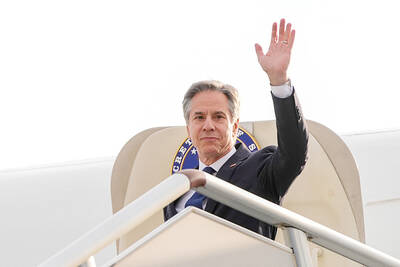
‘IN A DIFFERENT PLACE’: The envoy first visited Shanghai, where he attended a Chinese basketball playoff match, and is to meet top officials in Beijing tomorrow US Secretary of State Antony Blinken yesterday arrived in China on his second visit in a year as the US ramps up pressure on its rival over its support for Russia while also seeking to manage tensions with Beijing. The US diplomat tomorrow is to meet China’s top brass in Beijing, where he is also expected to plead for restraint as Taiwan inaugurates president-elect William Lai (賴清德), and to raise US concerns on Chinese trade practices. However, Blinken is also seeking to stabilize ties, with tensions between the world’s two largest economies easing since his previous visit in June last year. At the

UNSETTLING IMAGES: The scene took place in front of TV crews covering the Trump trial, with a CNN anchor calling it an ‘emotional and unbelievably disturbing moment’ A man who doused himself in an accelerant and set himself on fire outside the courthouse where former US president Donald Trump is on trial has died, police said yesterday. The New York City Police Department (NYPD) said the man was declared dead by staff at an area hospital. The man was in Collect Pond Park at about 1:30pm on Friday when he took out pamphlets espousing conspiracy theories, tossed them around, then doused himself in an accelerant and set himself on fire, officials and witnesses said. A large number of police officers were nearby when it happened. Some officers and bystanders rushed
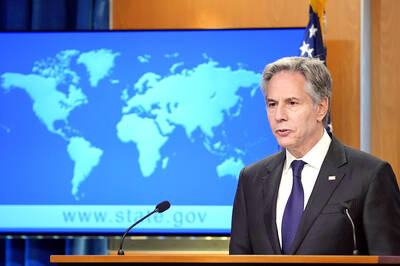
Beijing is continuing to commit genocide and crimes against humanity against Uyghurs and other Muslim minorities in its western Xinjiang province, U.S. Secretary of State Antony Blinken said in a report published on Monday, ahead of his planned visit to China this week. The State Department’s annual human rights report, which documents abuses recorded all over the world during the previous calendar year, repeated language from previous years on the treatment of Muslims in Xinjiang, but the publication raises the issue ahead of delicate talks, including on the war in Ukraine and global trade, between the top U.S. diplomat and Chinese
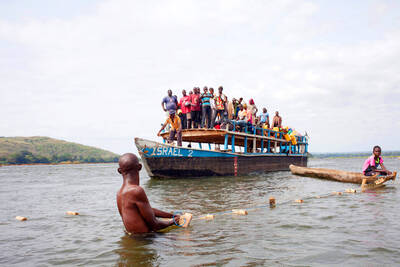
RIVER TRAGEDY: Local fishers and residents helped rescue people after the vessel capsized, while motorbike taxis evacuated some of the injured At least 58 people going to a funeral died after their overloaded river boat capsized in the Central African Republic’s (CAR) capital, Bangui, the head of civil protection said on Saturday. “We were able to extract 58 lifeless bodies,” Thomas Djimasse told Radio Guira. “We don’t know the total number of people who are underwater. According to witnesses and videos on social media, the wooden boat was carrying more than 300 people — some standing and others perched on wooden structures — when it sank on the Mpoko River on Friday. The vessel was heading to the funeral of a village chief in


 RSS
RSS