


China's environmental watchdog has singled out nine major pollution cases involving dozens of companies, and in a rare move has warned local authorities not to interfere.
The State Environmental Protection Agency, which has a weak track record on enforcement, named industries operating in 10 regions or cities, mainly involving paper, calcium carbide, coking coal and iron alloy production, that it said were causing severe pollution.
Local authorities who fail to penalize the polluters will be punished, Lu Xinyuan, director of the agency's Environment Supervision Bureau, said in comments seen yesterday on SEPA's Web site.

PHOTO: AP
"We shall resort to legal, administrative, economic and other means to tackle the issues," Lu said.
With laxly regulated industries fouling the air and water even in remote rural regions, China is one of the world's most polluted countries. One of the cases Lu cited involved calcium carbide, iron alloy and coking factories spread throughout a region straddling the borders of four north-central provinces: Inner Mongolia, Ningxia, Shanxi Shaanxi.
The environmental watchdog has recently stepped up efforts to improve enforcement and it has been backed by government plans to nearly double the amount Beijing spends on environmental protection through 2006-2010, to 1.3 trillion yuan (US$157 billion).
The agency recently ordered the suspension of 30 construction projects, including two at Three Gorges Dam, for violations. Although some were allowed to continue, analysts believe the environment agency will get tough with polluters. Hundreds of companies face a May 31 deadline to meet environmental standards or face closure.
"What I see in SEPA is a new resolve," said Khalid Malik, who is the UN Development Program's chief representative in China. Officials increasingly are being judged by their success in improving the environment and boosting local economies, he said. Officials set on creating jobs and generating tax revenues or reaping kickbacks often disregard requirements for environmental impact assessments and allow companies to continue operating despite blatant violations.
"Of course, money and commerce are supreme driving factors," Malik said.
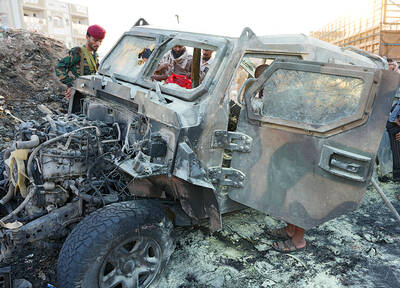
‘TERRORIST ATTACK’: The convoy of Brigadier General Hamdi Shukri resulted in the ‘martyrdom of five of our armed forces,’ the Presidential Leadership Council said A blast targeting the convoy of a Saudi Arabian-backed armed group killed five in Yemen’s southern city of Aden and injured the commander of the government-allied unit, officials said on Wednesday. “The treacherous terrorist attack targeting the convoy of Brigadier General Hamdi Shukri, commander of the Second Giants Brigade, resulted in the martyrdom of five of our armed forces heroes and the injury of three others,” Yemen’s Saudi Arabia-backed Presidential Leadership Council said in a statement published by Yemeni news agency Saba. A security source told reporters that a car bomb on the side of the road in the Ja’awla area in
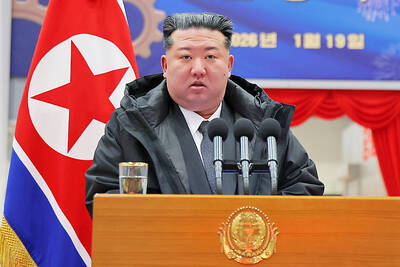
‘SHOCK TACTIC’: The dismissal of Yang mirrors past cases such as Jang Song-thaek, Kim’s uncle, who was executed after being accused of plotting to overthrow his nephew North Korean leader Kim Jong-un has fired his vice premier, compared him to a goat and railed against “incompetent” officials, state media reported yesterday, in a rare and very public broadside against apparatchiks at the opening of a critical factory. Vice Premier Yang Sung-ho was sacked “on the spot,” the state-run Korean Central News Agency said, in a speech in which Kim attacked “irresponsible, rude and incompetent leading officials.” “Please, comrade vice premier, resign by yourself when you can do it on your own before it is too late,” Kim reportedly said. “He is ineligible for an important duty. Put simply, it was
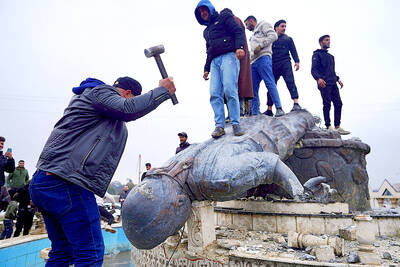
Syrian President Ahmed al-Sharaa on Sunday announced a deal with the chief of Kurdish-led forces that includes a ceasefire, after government troops advanced across Kurdish-held areas of the country’s north and east. Syrian Kurdish leader Mazloum Abdi said he had agreed to the deal to avoid a broader war. He made the decision after deadly clashes in the Syrian city of Raqa on Sunday between Kurdish-led forces and local fighters loyal to Damascus, and fighting this month between the Kurds and government forces. The agreement would also see the Kurdish administration and forces integrate into the state after months of stalled negotiations on
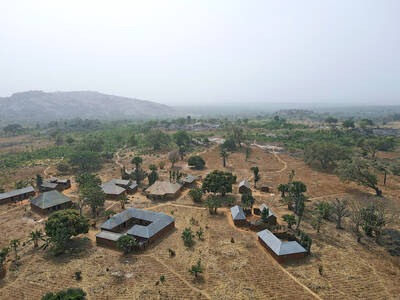
CHURCH ABDUCTIONS: Remarks by police and other officials were ‘intended to prevent unnecessary panic while facts were being confirmed,’ a spokesman said Nigerian police on Tuesday made an about-turn, saying that gunmen had abducted dozens of people during Sunday mass in northern Kaduna State after dismissing the initial reports. A senior Christian clergy and a village head had on Monday told reporters that more than 160 people were snatched from several churches on Sunday. A security report prepared for the UN said that more than 100 people had been kidnapped at multiple churches. The chief of police of Kaduna State and two senior government officials had initially issued denials, saying security officers had visited the scene of the alleged crimes and found no proof of


 RSS
RSS