


High in the snow-capped Hindu Kush, visitors stream in to see the new governor. A huddle of turbaned men carry plastic sunflowers in a gold vase, nodding respectfully. Mountain farmers come wrapped in wool blankets. The British ambassador flies in from Kabul.
By morning's end the office is filled with 25 bouquets of fake flowers and a calf is tethered outside; nothing unusual in a culture that prizes deference to authority, save for one difference: the new boss is a woman.
Habiba Sarobi is Afghanistan's first female governor, a major advance in a society where, only four years ago under the Taliban, women were denied everything from lessons to lipstick and forced to wear the all-covering burka.
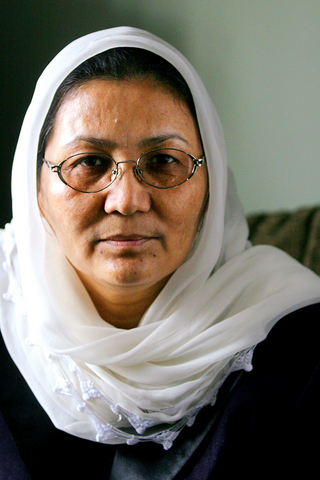
PHOTO: AP
It is not a job for the faint hearted. Afghan governors are stereotypically gruff, bearded men with a penchant for fighting, sweet tea and smoke-filled-room politics. Sarobi, a mild-mannered mother, comes to work with a suitcase and her secretary.
Formerly the Minister for Women's Affairs, she said she had turned down an ambassadorial job to demand the governor's post from President Hamid Karzai.
"He was surprised," she said.
"His first question was, `Do you think the people will accept you?' I said, `Definitely, yes.'"
After an uncertain start, she seems to be right. Before she arrived, 300 local men staged a protest in the town center, bussed in by the disgruntled outgoing governor, according to coalition officials.
A snowstorm foiled her first attempt to reach Bamiyan; the plane circled overhead before returning to Kabul. When she finally landed a week later, a male interior ministry official marched out first and took the official salute.
"You might have thought he was the new governor," said an aid worker who was there. "It didn't sound a good note."
But since then, support has grown rapidly. A thousand men gave her a standing ovation at a game of buzkashi, Afghanistan's perilous national sport. In the following days, delegations of well-wishers flooded in from around the province, including 50 villagers from Shaidan, a five-hour walk away.
"Women have a long history as leaders in Islam," declared the villagers' spokesman, Niamatullah Siddiqi. "We are proud to have you overseeing our community."
Nobody expects an overnight revolution. The obscurantist edicts of the Taliban are an unhappy memory: Afghan women can vote, work and go to school; a quarter of all seats in September's parliamentary vote are reserved for women; in Kabul, increasing numbers are shedding their burka.
But civil rights do not necessarily mean human rights. Despite billions of dollars in aid, health and education facilities remain dire.
For example, giving birth in Badakhshan province claims the life of one in every 15 mothers. This is the highest maternal mortality rate in the world.
In the deeply conservative south, most women spend their lives hemmed in by high walls and overprotective men. Forced marriages and domestic violence are rife across the country. Last week a woman in Badakhshan was stoned to death for adultery, the second such killing since the Taliban's overthrow in 2001.
Sarobi, more no-nonsense manager than fiery feminist, did little to shift attitudes during her two-year ministerial stint, according to several aid workers and diplomats.
"Her tenure was more about implementing aid projects than making policies," a British official said.
Sarobi says she was scuppered by conservative Cabinet colleagues, who even blocked a decree condemning forced marriage.
"I tried my best, but it was not enough for the women of Afghanistan," she admitted. "They said it was our culture and tradition."
In Bamiyan, Sarobi's popularity stems from a solid political pedigree -- her uncle is a former vice-president -- and partly from the liberalism of her fellow Hazara, one of Afghanistan's more tolerant tribes.
After the Taliban seized power in 1996, she fled to Pakistan so her daughter could continue school. She also detested the obligatory burka, but found the ankle-length cloak a useful disguise when, years later, she slipped back across the border to establish a clandestine network of girls' schools.
"It was a necessary precaution. That way, nobody could recognize me," she said.
Afghanistan's most spectacular memorial to the Taliban's crude fanaticism lies etched into a sandstone cliff across the valley from her office. Two empty chambers where giant Buddha statues stood until the Islamists blew them up in 2001.
Bamiyan lies in a sweeping valley along the Silk Route, so harnessing its tourist potential is one of Sarobi's main projects for reconstruction. But the challenge is great.
Some of the main tourist sites -- particularly the forbidden City of Screams, an ancient citadel sacked by Genghis Khan -- are littered with mines. There is no electricity, no proper hotels, and the 240km drive from Kabul takes eight hours on a good day.
On her first day at work, Sarobi says, she found that 95 percent of her staff were "not professionally capable." There were no women.
Even the former governor, Muhammad Rahim Aliyaar, has lent his support, at least for now.
"It's too early to judge whether a woman can succeed. That will take six months or a year," he said. "But I believe that most people are behind her, and so am I."

‘IN A DIFFERENT PLACE’: The envoy first visited Shanghai, where he attended a Chinese basketball playoff match, and is to meet top officials in Beijing tomorrow US Secretary of State Antony Blinken yesterday arrived in China on his second visit in a year as the US ramps up pressure on its rival over its support for Russia while also seeking to manage tensions with Beijing. The US diplomat tomorrow is to meet China’s top brass in Beijing, where he is also expected to plead for restraint as Taiwan inaugurates president-elect William Lai (賴清德), and to raise US concerns on Chinese trade practices. However, Blinken is also seeking to stabilize ties, with tensions between the world’s two largest economies easing since his previous visit in June last year. At the
Nearly half of China’s major cities are suffering “moderate to severe” levels of subsidence, putting millions of people at risk of flooding, especially as sea levels rise, according to a study of nationwide satellite data released yesterday. The authors of the paper, published by the journal Science, found that 45 percent of China’s urban land was sinking faster than 3mm per year, with 16 percent at more than 10mm per year, driven not only by declining water tables, but also the sheer weight of the built environment. With China’s urban population already in excess of 900 million people, “even a small portion

UNSETTLING IMAGES: The scene took place in front of TV crews covering the Trump trial, with a CNN anchor calling it an ‘emotional and unbelievably disturbing moment’ A man who doused himself in an accelerant and set himself on fire outside the courthouse where former US president Donald Trump is on trial has died, police said yesterday. The New York City Police Department (NYPD) said the man was declared dead by staff at an area hospital. The man was in Collect Pond Park at about 1:30pm on Friday when he took out pamphlets espousing conspiracy theories, tossed them around, then doused himself in an accelerant and set himself on fire, officials and witnesses said. A large number of police officers were nearby when it happened. Some officers and bystanders rushed

Beijing is continuing to commit genocide and crimes against humanity against Uyghurs and other Muslim minorities in its western Xinjiang province, U.S. Secretary of State Antony Blinken said in a report published on Monday, ahead of his planned visit to China this week. The State Department’s annual human rights report, which documents abuses recorded all over the world during the previous calendar year, repeated language from previous years on the treatment of Muslims in Xinjiang, but the publication raises the issue ahead of delicate talks, including on the war in Ukraine and global trade, between the top U.S. diplomat and Chinese


 RSS
RSS