


Walk into Lori Devins' downtown shop and it's clear this isn't a typical Christian retail store. First of all, Extreme Christian Clothing features T-shirts. Then, there are the shirts' in-your-face messages.
Along with ones saying "Got Jesus?" and "Fear God" are shirts declaring, "Satan Sucks," "My God can kick your god's butt" and "To Hell with the Devil."
"Our shirts are a little extreme, but I think God is spreading the word and having the youngsters shout out their faith," Devins said. "I think teenagers want to evoke a response."
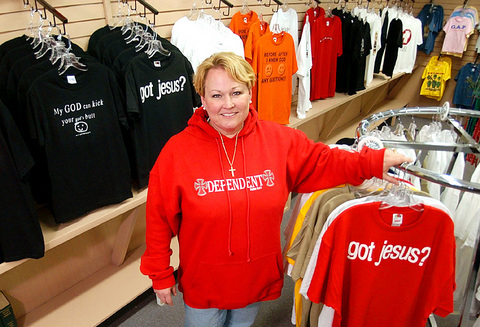
PHOTO: AP
For the most part, religious retailers focus on books and Bibles; apparel is a small part of sales. Devins turned around that concept with edgy T-shirts and is finding a niche market here and at a similar store she owns in Topeka.
"There aren't too many stores that are breaking out like hers that are focusing on clothing and apparel with the shock value," said Pete Wagg, owner of Never Say Die in Fernley, Nevada, which designs religious T-shirts, including one with a skull and "Never Say Die."
"A store like Lori's is unique in that it's geared for youth and geared with such a strong message," said Wagg, who sells to Devins.
Overall, religious retailing is a growth business in the US. CBA International, the trade association for Christian bookstores and retailers, reported sales by member suppliers at US$4.2 billion in 2002.
A CBA sampling of retail Christian stores showed 57 percent of sales in 2002 were Bibles and books, while apparel accounted for about 2 percent of sales.
Strongly worded religious apparel is a growing trend, said Catherine Stellin, vice president of The Intelligence Group in Los Angeles, which forecasts trends. She said Devins "is ahead of the curve" with her stores.
Teens and those in their early 20s see consumerism as a way to express convictions, she said.
"There is a little bit of shock value to this because this is a generation that feels very strong in their convictions," Stellin said. "So if they believe in something, they are going to shout it out. Subtlety is not their strong point."
Noting trends typically start on the coasts, Stellin said, "I wouldn't be surprised if it worked its way to the Midwest because the core values of religion are much stronger in the Midwest and South."
Chris Rainey, director of marketing for Kerusso, of Berryville, Arkansas, said his company's sales of various religious apparel, including T-shirts, increased by 70 percent in the fourth quarter of last year over the same period a year before.
"There has been such a rise in spiritual interest across the country, especially the youth looking for ways to express their faith and values," he said. "They are wearing T-shirts both as a fashion statement and a faith statement."
For Devins, a wife and mother of four, selling religious items is about more than just making a quick buck.
"I couldn't feel any other way than doing this is doing the work of the Lord. He filled us with this purpose to do this," she said.
In January, she opened her first store in a Topeka strip mall, and by last month, her second store was operating in Lawrence.
Aside from T-shirts, there are ball caps with slogans such as "G.A.P. God Answers Prayers," plus hoodies, jewelry, bumper stickers, skateboards and even fortune cookies with Bible verses.
Not every young person prefers the provocative proverbs.
University of Kansas senior Chad Miller and girlfriend Jenny Shoemaker eyed T-shirts hanging from racks as they looked around the store. Seeing the "Satan Sucks" shirt, Miller said, "That's a little extreme for me."
Asked his preference, he selected one with the word "Jesus" enclosed in thorns shaped like a fish.
Some people worry about extreme epigrams, including Craig Detweiler, a Biola University professor in La Mirada, California, who wrote a book about finding God in pop culture.
"My concern with the T-shirts is that may be good for rallying the faithful, but offensive to those outside that circle," Detweiler said. "Did Jesus build bridges or burn them? Did Jesus ever say they shall know us by our T-shirts?"
But extreme clothing has appeal, said Abe Hernandez, a founder of a chain of five C28 stores in southern California and a line of wholesale clothing that includes T-shirts sporting "King Kong Wasn't My Grandpa."
"Kids want to be bold about who Jesus is in their life and that is why we are here. Edgy sells well," Hernandez said.
Wearers often want to make a point, said Kelton Cobb, professor of theology and ethics at Hartford Seminary in Connecticut.
"If I wear it, I'm not only saying that I'm a religious believer but that I'm also a cool and clever religious believer," Cobb said.
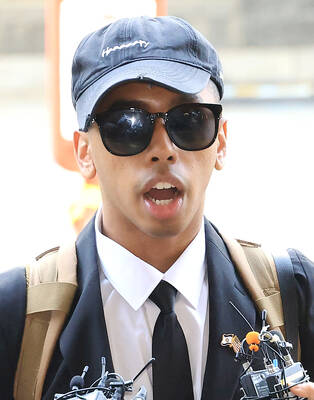
A US YouTuber who caused outrage for filming himself kissing a statue commemorating Korean wartime sex slaves has been sentenced to six months in prison, a court in Seoul said yesterday. Johnny Somali, 25, gained notoriety several years ago for recording himself doing a series of provocative stunts in South Korea and Japan, and streaming them on platforms such as YouTube and Twitch. South Korean authorities indicted Somali — whose real name is Ramsey Khalid Ismael — in 2024 on public order violations and obstruction of business, and banned him from leaving the country. “The court has sentenced him to six months in

Former Lima mayor Rafael Lopez Aliaga, a Peruvian presidential hopeful, gathered hundreds of supporters in Lima on Tuesday and gave authorities 24 hours to annul the first round of the country’s election over allegations of fraud. Lopez Aliaga is locked in a tight three-way race with two other candidates for second place in Sunday’s vote. The election runner-up wins a ticket to June’s presidential run-off against front-runner Keiko Fujimori. “I am giving them 24 hours to declare this electoral fraud null and void,” said Lopez Aliaga, surrounded by a crowd of several hundred supporters. “If it is not declared null and void tomorrow,
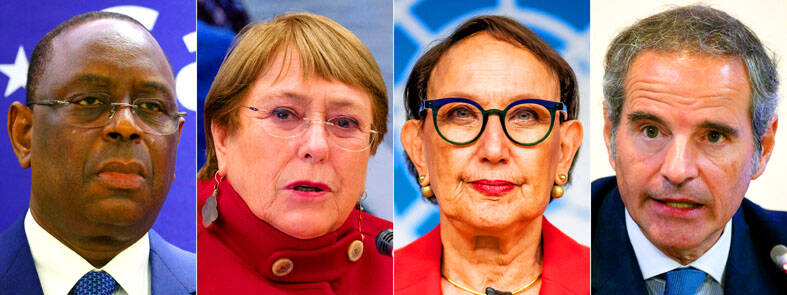
Four contenders are squaring up to succeed Antonio Guterres as secretary-general of the UN, which faces unprecedented global instability, wars and its own crushing budget crisis. Chile’s Michelle Bachelet, Argentina’s Rafael Grossi, Costa Rica’s Rebeca Grynspan and Senegal’s Macky Sall are each to face grillings by 193 member states and non-governmental organizations for three hours today and tomorrow. It is only the second time the UN has held a public question-and-answer, a format created in 2016 to boost transparency. Ultimately the five permanent members of the UN’s top body, the Security Council, hold the power, wielding vetoes over who leads the

A humanoid robot that won a half-marathon race for robots in Beijing on Sunday ran faster than the human world record in a show of China’s technological leaps. The winner from Honor, a Chinese smartphone maker, completed the 21km race in 50 minutes and 26 seconds, said a WeChat post by the Beijing Economic-Technological Development Area, also known as Beijing E-Town, where the race began. That was faster than the human world record holder, Ugandan Jacob Kiplimo, who finished the same distance in about 57 minutes in March at the Lisbon road race. The performance by the robot marked a significant step forward


 RSS
RSS