


The 81-year-old Pole still bears the scars from eight years in Josef Stalin's labor camps -- a fingertip crushed in a Siberian coal mine, headaches from a mine explosion, and the anger that boils up each time he remembers.
"I am an old man ... I feel it very strongly," Tadeusz Olizarowicz says. "It all has a negative effect on my emotions and my health."
As the world prepares to mark the 60th anniversary of the end of World War II on May 8-9, the mood in Poland and other former communist republics is less than celebratory. Here, the feeling is that the end of the war simply replaced one horror -- Hitler's -- with another -- Stalin's.
Poland was forced into the Soviet-dominated Warsaw Pact, while the Baltic countries -- Estonia, Latvia and Lithuania -- were incorporated into the Soviet Union. They didn't regain their freedom until the collapse of communism in eastern Europe 15 years ago.
The lingering bitterness has led Presidents Arnold Ruutel of Estonia and Valdas Adamkus of Lithuania to refuse invitations to Moscow for the May 9 celebrations, though Presidents Vaira Vike-Freiberga of Latvia and Aleksandar Kwasniewski of Poland will attend.
That Olizarowicz had already been thrown into a Nazi camp didn't help him with the Soviets. Today, he remembers the Nazis and Soviets as "equally bad."
"If you did something bad in the German camp, a guard would take out a gun and kill you immediately," he recalled. "But in a Soviet camp, they would starve you to death so the death was longer and more painful and then they would shoot you and finish you off with a sickle."
Olizarowicz's "crime" was serving in Poland's Home Army, the clandestine force that fought the Nazis, and which the Soviets feared would remain a rallying point for resistance. Convicted in 1947 of "anti-Soviet activity," he was among nearly 800,000 Poles, Latvians, Lithuanians and Estonians shipped to labor camps.
During the train ride in cramped cattle cars, Soviet guards would count their prisoners by hitting them. They fed them only salty dried fish while denying them water on hot summer days. In a camp in Minsk, in Belarus, where he spent a year laying bricks before being taken to Siberia, Olizarowicz saw guards slashing the corpses of inmates to make sure they were dead.
Today, resentment is stoked by the perceived unwillingness of today's Russian authorities to acknowledge the suffering.
Kwasniewski, while saying he'll go to Moscow to commemorate the downfall of Nazi Germany, has repeatedly called on Russia to give an "honest assessment" of Soviet actions in Poland.
Russian celebrations treat the war as an untarnished triumph that began with the German invasion of the Soviet Union in 1941 and which cost 27 million Soviet lives. Little mention is made of what came before -- a Soviet-German pact that carved up Poland between the two powers.
The most contentious issue is the massacre of 22,000 Polish officers, priests and intellectuals in Katyn Forest in 1940. Stalin was bent on decapitating the Polish establishment while claiming the Nazis did it.
In 1990, in one of the Soviet Union's last acts before it dissolved, the Kremlin accepted responsibility but insisted it was a war crime, not an act of genocide.
Anti-Soviet sentiment simmers in other countries such as the Czech Republic, Slovakia and Hungary. But the issue of sending representatives to Moscow has provoked little controversy there.
President Vladimir Putin's government recently angered Poles by telling them to be grateful for the Yalta treaty, the 1945 Allied deal that set the stage for the continent's Cold War division and the consignment of Poland to the Soviet sphere.
Polish and Lithuanian leaders helped mediate an end to Ukraine's presidential election crisis in December -- talks which resulted in the defeat of the Moscow's preferred candidate. To Poles, the struggle mirrored their own efforts in the 1980s to throw off Soviet domination.
Sixty years after what the Russians call "The Great Patriotic War," it's still a highly sensitive issue, said Fyodor Lukyanov, editor of Russia in Global Affairs, a foreign affairs magazine. It is "considered a sacred page in our history," he said, and, "every attempt to raise questions about the role of the Soviet Union in this war provokes emotional feelings."

‘IN A DIFFERENT PLACE’: The envoy first visited Shanghai, where he attended a Chinese basketball playoff match, and is to meet top officials in Beijing tomorrow US Secretary of State Antony Blinken yesterday arrived in China on his second visit in a year as the US ramps up pressure on its rival over its support for Russia while also seeking to manage tensions with Beijing. The US diplomat tomorrow is to meet China’s top brass in Beijing, where he is also expected to plead for restraint as Taiwan inaugurates president-elect William Lai (賴清德), and to raise US concerns on Chinese trade practices. However, Blinken is also seeking to stabilize ties, with tensions between the world’s two largest economies easing since his previous visit in June last year. At the
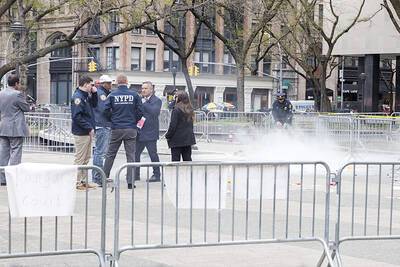
UNSETTLING IMAGES: The scene took place in front of TV crews covering the Trump trial, with a CNN anchor calling it an ‘emotional and unbelievably disturbing moment’ A man who doused himself in an accelerant and set himself on fire outside the courthouse where former US president Donald Trump is on trial has died, police said yesterday. The New York City Police Department (NYPD) said the man was declared dead by staff at an area hospital. The man was in Collect Pond Park at about 1:30pm on Friday when he took out pamphlets espousing conspiracy theories, tossed them around, then doused himself in an accelerant and set himself on fire, officials and witnesses said. A large number of police officers were nearby when it happened. Some officers and bystanders rushed
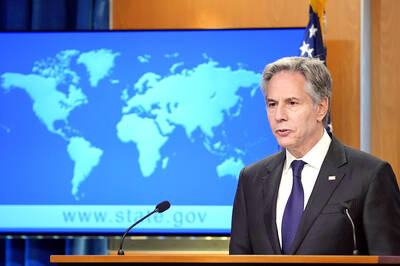
Beijing is continuing to commit genocide and crimes against humanity against Uyghurs and other Muslim minorities in its western Xinjiang province, U.S. Secretary of State Antony Blinken said in a report published on Monday, ahead of his planned visit to China this week. The State Department’s annual human rights report, which documents abuses recorded all over the world during the previous calendar year, repeated language from previous years on the treatment of Muslims in Xinjiang, but the publication raises the issue ahead of delicate talks, including on the war in Ukraine and global trade, between the top U.S. diplomat and Chinese
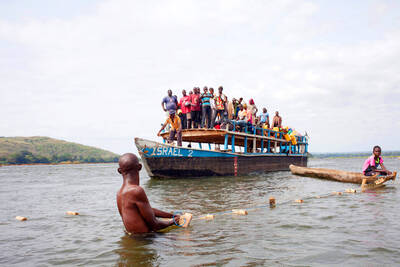
RIVER TRAGEDY: Local fishers and residents helped rescue people after the vessel capsized, while motorbike taxis evacuated some of the injured At least 58 people going to a funeral died after their overloaded river boat capsized in the Central African Republic’s (CAR) capital, Bangui, the head of civil protection said on Saturday. “We were able to extract 58 lifeless bodies,” Thomas Djimasse told Radio Guira. “We don’t know the total number of people who are underwater. According to witnesses and videos on social media, the wooden boat was carrying more than 300 people — some standing and others perched on wooden structures — when it sank on the Mpoko River on Friday. The vessel was heading to the funeral of a village chief in


 RSS
RSS