


A pair of car bombs exploded near government offices in the Iraqi capital yesterday, killing 11 and wounding over 20 as insurgent attacks against the nation's nascent security forces left at least eight others dead countrywide.
The near-simultaneous explosions in a southeastern Baghdad neighborhood targeted one of the ministry's satellite offices, killing at least 11, an Interior Ministry official said, speaking on condition of anonymity.
At least 20 people injured in the blast were taken to Yarmouk Teaching Hospital, doctors and witnesses said. Hospital staff said four policemen were among the wounded in the bombings, which shook central Baghdad and sent two plumes of smoke boiling into the sky.
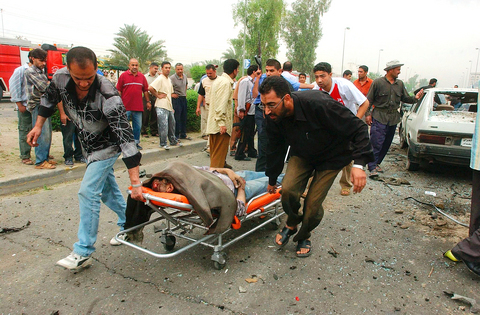
PHOTO: EPA
Insurgents kept up attacks yesterday against Iraq's security services, forces which the US military says must be able to impose a level of calm in the country before US troops can depart.
Gunmen hit police patroling near the central Iraq city of Baqubah, killing one officer and wounding three, Lieutenant Colonel Muthafar al-Jubori said.
In the capital, attackers shot 1st Lieutenant Firas Hussein in the head and torso as he made his way to work at Iraq's intelligence service, police Major Mousa Abdul Karim said.
In Kirkuk, seven gunmen riding in two vehicles fired on the police station just south of Kirkuk shortly after dawn yesterday, killing five police officers and one civilian, police Brigadier Sarhat Qadir said.
Militant group Ansar al-Sunnah claimed responsibility for the attack, saying in an Internet posting that its "knights of Islam" attacked "renegade policemen doing their morning training." The claim couldn't be independently verified.
Ansar al-Sunnah also said it had teamed up with Abu Musab al-Zarqawi's al-Qaeda in Iraq group for a day-earlier attack in Kirkuk -- an unusual mention of cooperation among Iraq's disparate and sometimes competing militant groups.
The Web posting, which couldn't be independently corroborated, said the Wednesday explosive device that killed 12 police was composed of three bombs buried under a decoy device -- a lure to draw policemen to the blast site.
In Tikrit, Saddam Hussein's hometown 130km north of Baghdad, a car bomb exploded outside a US military installation, injuring nine civilians and setting nearby houses ablaze, police Lieutenant Colonel Amer Ahmed said.
The US military said one US soldier and two Iraqi troops suffered injuries in the bomb blast -- but maintained there were no civilian casualties.
On Wednesday, an American was shown at gunpoint on a videotape aired by al-Jazeera television, two days after he was kidnapped from a water treatment plant near Baghdad. The station said he pleaded for his life and urged US troops to withdraw from Iraq.
In LaPorte, Indiana, a yellow ribbon was tied Wednesday around a tree outside Jeffrey Ake's one-story brick house, and an American flag fluttered on a pole from the home. The US Embassy said the man on the video appeared to be Ake, a contract worker who was kidnapped around noon Monday.
Ake -- the 47-year-old president and CEO of Equipment Express, a company that manufacturers bottled water equipment -- is the latest of more than 200 foreigners seized in Iraq in the past year.
The al-Jazeera tape showed a man sitting behind a desk with at least three assailants -- two hooded and one off-camera -- pointing assault rifles at him. Ake, wearing an open-collar shirt with rolled-up shirt sleeves, was sitting or kneeling behind a wooden desk and holding what appeared to be a passport.

‘CROSSING THE LINE’: China’s embassy in Seoul criticized US Forces Korea Commander General Xavier Brunson, asking if his ‘hostile’ remarks were authorized by Washington South Korea and the US are in talks over recent public remarks by the commander of US Forces Korea, Seoul’s presidential office said yesterday, after the comments drew sharp criticism from China. In a recent podcast interview, US Forces Korea Commander General Xavier Brunson described South Korea as “the dagger in the heart of Asia” from China’s east coast, prompting the Chinese embassy in Seoul to say that he had “truly crossed the line.” The interview came amid growing speculation that Washington might seek to expand the role of US Forces Korea in countering the growing regional influence of China, a key

SEEKING ORDER: Rodrigo Paz said that ‘anyone who wants to destroy the nation will have to deal with this president and the full force of the constitution’ Bolivian President Rodrigo Paz on Wednesday said that the nation was at a “breaking point” after nearly a month of protests that have caused shortages of food, fuel and medicine. Paz, who took office six months ago amid the worst economic crisis there in four decades, is battling a groundswell of fury over his policies. The political capital, La Paz, has been besieged by low-income workers and members of the indigenous majority calling for his resignation. “The country needs order and is reaching breaking point,” the 58-year-old said at a public event in La Paz, renewing his appeal for dialogue. On Tuesday, the Bolivian

Through the noise of rushing papers and whirring belts at a print factory in Kyoto, two creators watch their photo essay come to life in broadsheet form — part of an effort to win new audiences in the age of artificial intelligence (AI). Despite the decline of the publishing industry, self-publication and handmade “zine” magazines are growing in popularity in Japan, reflecting the nation’s enduring love of paper in the digital era. While speaking to Agence France-Presse at the plant, his hands black with ink, one of the creators, Kazuma Obara, said: “I think [paper] is a medium that engages all five

Australian researchers have trained lab-grown brain cells on a silicon computer chip to play the 1990s shooter game Doom and said they are just scratching the surface of what the neurons could be capable of doing. It is the science-fiction work of biotech boffins at Cortical Labs, who researched and developed the technology that harnesses the workings of the brain’s networking system. Each so-called “biological computer” contains about 200,000 living human brain cells, grown from stem cells that were harvested from blood donations. Having mastered the simple computer game Pong, where a paddle is moved up and down to send a ball


 RSS
RSS