


The elderly survivors of the Buchenwald concentration camp laid flowers and observed a moment of silence for victims of the Nazis, 60 years after US troops liberated the camp.
Flags from some 30 nations hung in the cold drizzle on Sunday, representing the nations from which the camp's 240,000 prisoners came between 1937 and 1945.
About 56,000 died -- either worked to death, shot or killed in medical experiments.

PHOTO: EPA
German Chancellor Gerhard Schroeder and US veterans came to the camp memorial outside Weimar for the commemoration, which kindled vivid memories for the survivors, most of them now in their 70s and 80s.
Georg Sterner, a Hungarian Jew, recalled looking out from Barracks No. 37 when the first US tank crashed through the barbed-wire perimeter fence on the morning of April 11, 1945.
"We were hanging out of the windows," said Sterner, who was 17 then. "It came slowly, slowly. It stopped between the trees. It revved the engine ... made a lunge, and broke through."
Inside, shocked soldiers from the US 3rd Army found some 21,000 starving survivors and piles of corpses, some only partially burned in the crematorium ovens as the Nazi SS and their helpers fled the camp.
"It was so incredible -- stacks of bodies, the smell, the total shock and confusion, people walking around by the thousands," said Jerry Hontas, who arrived the next day as a 21-year-old Army medic.
"We were so shocked that we couldn't talk to each other for days," said Hontas, of Boca Raton, Florida. "We had no concept of this kind of insane cruelty."
On Sunday, some survivors came in wheelchairs. Others wore replicas of their striped inmate's uniforms and their old prisoner numbers. Schroeder recalled that Weimar stands for Germany's classical cultural heritage -- Johann Wolfgang Goethe, the most revered German author and playwright, had his home there -- and said the Nazis had turned it into "coldness and cruelty."
"I bow before you, the victims and their families," he said at Weimar National Theater, addressing Buchenwald survivors in the audience.
Though Buchenwald was not expressly built for mass killing as Auschwitz was, the concentration camp was just as much part of the Nazis' effort to wipe out anyone deemed un-German.
Sunday's ceremony was meant as a remembrance of victims of Nazi camps in Germany, which were successively freed as Allied troops advanced before the Nazi surrender in World War II in May 1945.
Thuringia, the state where Weimar is located, was a Nazi Party bastion even before Adolf Hitler came to power in 1933 and he often visited the city.
With an eye on recent electoral successes by Germany's extreme-right fringe, Schroeder said Germany must remain vigilant against racism and anti-Semitism.
"We remember what happened, and we remind others of it, because we must not forget," Thuringia Governor Dieter Althaus said at the theater. "Because if we forget, we risk that it will repeat itself."
Buchenwald was part of the Nazi Holocaust in which 6 million European Jews died. But there also were many non-Jewish victims -- political prisoners from Germany and other European countries, Soviet prisoners of war and Jehovah's Witnesses.
As Nazi control dissolved in April 1945, Buchenwald inmates rose up and took revenge on their captors just before US soldiers came.
"One of the first things I saw was bodies hanging in the trees, because the inmates had captured some of the guards," said Jack Garwood, now a retired engineer in Naples, Florida, who was among the first soldiers to arrive.
The Americans brought Weimar residents to the site to see what happened just 8km from their town.
"They were very stoic, very unemotional," Hontas recalled. "I remember only one woman dabbing her eyes."
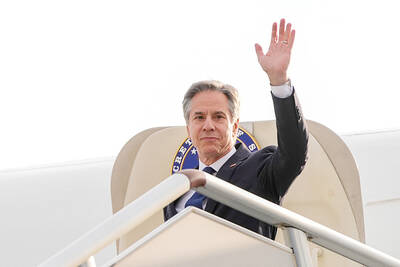
‘IN A DIFFERENT PLACE’: The envoy first visited Shanghai, where he attended a Chinese basketball playoff match, and is to meet top officials in Beijing tomorrow US Secretary of State Antony Blinken yesterday arrived in China on his second visit in a year as the US ramps up pressure on its rival over its support for Russia while also seeking to manage tensions with Beijing. The US diplomat tomorrow is to meet China’s top brass in Beijing, where he is also expected to plead for restraint as Taiwan inaugurates president-elect William Lai (賴清德), and to raise US concerns on Chinese trade practices. However, Blinken is also seeking to stabilize ties, with tensions between the world’s two largest economies easing since his previous visit in June last year. At the
Nearly half of China’s major cities are suffering “moderate to severe” levels of subsidence, putting millions of people at risk of flooding, especially as sea levels rise, according to a study of nationwide satellite data released yesterday. The authors of the paper, published by the journal Science, found that 45 percent of China’s urban land was sinking faster than 3mm per year, with 16 percent at more than 10mm per year, driven not only by declining water tables, but also the sheer weight of the built environment. With China’s urban population already in excess of 900 million people, “even a small portion

UNSETTLING IMAGES: The scene took place in front of TV crews covering the Trump trial, with a CNN anchor calling it an ‘emotional and unbelievably disturbing moment’ A man who doused himself in an accelerant and set himself on fire outside the courthouse where former US president Donald Trump is on trial has died, police said yesterday. The New York City Police Department (NYPD) said the man was declared dead by staff at an area hospital. The man was in Collect Pond Park at about 1:30pm on Friday when he took out pamphlets espousing conspiracy theories, tossed them around, then doused himself in an accelerant and set himself on fire, officials and witnesses said. A large number of police officers were nearby when it happened. Some officers and bystanders rushed

Beijing is continuing to commit genocide and crimes against humanity against Uyghurs and other Muslim minorities in its western Xinjiang province, U.S. Secretary of State Antony Blinken said in a report published on Monday, ahead of his planned visit to China this week. The State Department’s annual human rights report, which documents abuses recorded all over the world during the previous calendar year, repeated language from previous years on the treatment of Muslims in Xinjiang, but the publication raises the issue ahead of delicate talks, including on the war in Ukraine and global trade, between the top U.S. diplomat and Chinese


 RSS
RSS