


In the most sweeping re-examination of the US-Japan security alliance in years, Japan and the US are negotiating a military realignment that could move some or all of the nearly 20,000 Marines off the crowded island of Okinawa, close underused bases and meld an army command in Washington state with a camp just south of Tokyo.
But something even more fundamental may be at stake.
Washington appears to be trying to use the talks to nudge Japan out from under the US security blanket and make Tokyo a much more active player in global strategic operations.
"The United States wants Japan to assume a role very much like the one it has vis-a-vis the British," said Tetsuo Maeda, professor of arms reduction and security at Tokyo International University. "The Self Defense Forces would be regularly deployed overseas for military operations if this kind of realignment were realized."
It would not be an easy transition if the realignment is approved.
America's force of 50,000-plus troops in Japan dates back decades and has long been hailed as the key to stability in the Asian-Pacific region and a model of co-operation. In exchange for the security the US troops provide, Japan pays a whopping US$5 billion, an arrangement unparalleled anywhere else in the world.
But amid calls in Japan for the US to streamline its presence, and Washington's shifting focus from maintaining bases abroad to fine-tuning its deployments to respond quickly to specific flare-ups, topics are on the table that were long seen as virtually taboo.
Officially, there has been little comment.
"We are working very hard right now," Lieutenant General Bruce Wright, said recently in his first news conference since assuming command of the US Forces Japan in February. He said details of the talks will likely emerge this summer, though no deadline has been announced.
Few expect Japan to see the kind of drastic restructuring and downsizing that the US forces in South Korea and Germany are going through. Wright stressed he did not expect a great change -- up or down -- in the overall number of troops here.
Their footprint may change substantially, however.
Wright acknowledged topics being discussed include relocation of Marine Corps Air Station Futenma, a major cause of friction on Okinawa; possible joint use of Yokota Air Base on Tokyo's western outskirts where US Forces are headquartered; and integration of command functions for the army's 1st Corps at Fort Lewis in Washington state with Camp Zama, just south of Tokyo.
According to reports in the Japanese media, based on anonymous government leaks, the idea has even been floated of moving the biggest contingent of marines based permanently outside the US from southern Okinawa to Japan's other extreme, the northern island of Hokkaido.
Reports have also speculated that the fighter wing of the USS Kittyhawk's battle group may be uprooted and sent south.
Ahead of a set of meetings in Hawaii this weekend, Defense Agency chief Yoshinori Ono said the future of unused or underused facilities would be discussed. But officials on both sides refuse to comment on specifics, saying only that a broad range of proposals are being considered and no final decisions have been made.
Wright said whatever changes come out of the talks will not weaken the US' military readiness in Asia.
He said his objective was to safeguard the credibility and deterrent power of the alliance and bolster "interoperability" with the Japanese.
"Interoperability" -- the focus on joint operations -- underscores a change in the way Tokyo and Washington are viewing their military relationship.
Still, Tokyo appears undecided on just how far it should go, and for good reason: Because of their country's disastrous pre-1945 experiment with expansionism, many Japanese remain deeply suspicious of any attempts to rebuild the military. Japan's neighbors, who suffered under Japanese colonialism, are also wary of the direction the talks are taking.
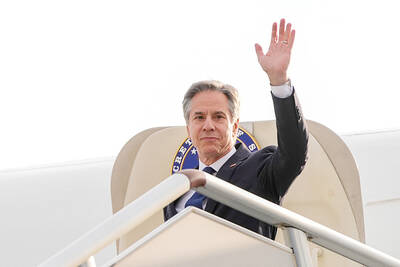
‘IN A DIFFERENT PLACE’: The envoy first visited Shanghai, where he attended a Chinese basketball playoff match, and is to meet top officials in Beijing tomorrow US Secretary of State Antony Blinken yesterday arrived in China on his second visit in a year as the US ramps up pressure on its rival over its support for Russia while also seeking to manage tensions with Beijing. The US diplomat tomorrow is to meet China’s top brass in Beijing, where he is also expected to plead for restraint as Taiwan inaugurates president-elect William Lai (賴清德), and to raise US concerns on Chinese trade practices. However, Blinken is also seeking to stabilize ties, with tensions between the world’s two largest economies easing since his previous visit in June last year. At the

UNSETTLING IMAGES: The scene took place in front of TV crews covering the Trump trial, with a CNN anchor calling it an ‘emotional and unbelievably disturbing moment’ A man who doused himself in an accelerant and set himself on fire outside the courthouse where former US president Donald Trump is on trial has died, police said yesterday. The New York City Police Department (NYPD) said the man was declared dead by staff at an area hospital. The man was in Collect Pond Park at about 1:30pm on Friday when he took out pamphlets espousing conspiracy theories, tossed them around, then doused himself in an accelerant and set himself on fire, officials and witnesses said. A large number of police officers were nearby when it happened. Some officers and bystanders rushed
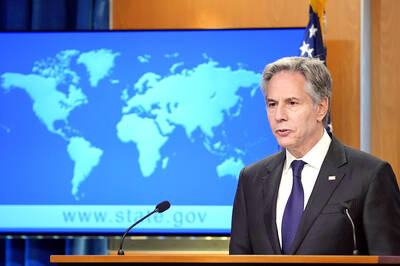
Beijing is continuing to commit genocide and crimes against humanity against Uyghurs and other Muslim minorities in its western Xinjiang province, U.S. Secretary of State Antony Blinken said in a report published on Monday, ahead of his planned visit to China this week. The State Department’s annual human rights report, which documents abuses recorded all over the world during the previous calendar year, repeated language from previous years on the treatment of Muslims in Xinjiang, but the publication raises the issue ahead of delicate talks, including on the war in Ukraine and global trade, between the top U.S. diplomat and Chinese
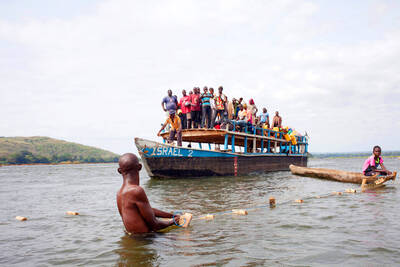
RIVER TRAGEDY: Local fishers and residents helped rescue people after the vessel capsized, while motorbike taxis evacuated some of the injured At least 58 people going to a funeral died after their overloaded river boat capsized in the Central African Republic’s (CAR) capital, Bangui, the head of civil protection said on Saturday. “We were able to extract 58 lifeless bodies,” Thomas Djimasse told Radio Guira. “We don’t know the total number of people who are underwater. According to witnesses and videos on social media, the wooden boat was carrying more than 300 people — some standing and others perched on wooden structures — when it sank on the Mpoko River on Friday. The vessel was heading to the funeral of a village chief in


 RSS
RSS