


Arab leaders open a two-day summit in the Algerian capital yesterday to discuss a 17-point agenda, including a resolution to revive a plan for peace with Israel that the Jewish state rejected three years ago.
Only 14 Arab heads of state or rulers out of the 22-member Arab League are expected to attend the summit which coincides with the 60th anniversary of the pan-Arab organisation.
Several leaders, including Jordan's King Abdullah, Yemeni President Ali Abdullah Saleh and his embattled pro-Lebanese counterpart Emile Lahoud, will skip the summit.
Several foreign dignitaries are also expected to be present at the opening ceremony, including UN Secretary General Kofi Annan, French Foreign Minister Michel Barnier and the EU's foreign policy chief Javier Solana.
Spanish Prime Minister Jose Luis Rodriguez Zapatero will address the summit to garner Arab support for his plan to create an "alliance of civilizations" to defeat terrorism and bring Western and Arab nations closer together.
Jordan succeeded in putting back on the table an Arab plan to normalize ties with Israel in return for an Israeli pullout of all Arab land, which Saudi Arabia had initially proposed at the 2002 Beirut summit.
"Jordan presented a document aiming at reactivating, promoting and marketing the Arab initiative for peace, by submitting a precise and concise form," Arab League spokesman Hossam Zaki told reporters.
"This document was examined by the delegates who introduced a few additions in a way to please everybody and this is what was adopted," he said, referring to objections that had been made in the run-up to the summit.
The three-point draft offers Israel the chance to normalize ties with the Arab countries in exchange for a total pullout from land it conquered in 1967 and later annexed.
It also insists that an independent Palestinian state and a solution to guarantee the rights of Palestinian refugees were essential to peace with Israel.
"Based on the Arab peace initiative, Arab countries will therefore consider the Arab-Israeli conflict over and will set up normal ties with Israel within the framework of a comprehensive peace," a copy obtained by reporters said.
The Arab offer comes a month after a landmark summit between Palestinian leader Mahmud Abbas and Israeli Prime Minister Ariel Sharon during which they agreed to a truce.
The political transition in Iraq following January's historic legislative elections and the continued presence of foreign troops in the embattled country will also be addressed at the summit.
The Syrian troop redeployment in Lebanon is not on the official agenda but Arab leaders are expected to voice solidarity with Damascus, which is facing heavy international pressure to end its domination over Lebanon.
The deadly civil war in Sudan's western Darfur region and the conflict in Somalia are also on the agenda.
Arab leaders are also expected to agree on setting up a pan-Arab parliament and dicuss how best they should push ahead with a pledge they took last year to speed up democratic reforms.

‘IN A DIFFERENT PLACE’: The envoy first visited Shanghai, where he attended a Chinese basketball playoff match, and is to meet top officials in Beijing tomorrow US Secretary of State Antony Blinken yesterday arrived in China on his second visit in a year as the US ramps up pressure on its rival over its support for Russia while also seeking to manage tensions with Beijing. The US diplomat tomorrow is to meet China’s top brass in Beijing, where he is also expected to plead for restraint as Taiwan inaugurates president-elect William Lai (賴清德), and to raise US concerns on Chinese trade practices. However, Blinken is also seeking to stabilize ties, with tensions between the world’s two largest economies easing since his previous visit in June last year. At the

UNSETTLING IMAGES: The scene took place in front of TV crews covering the Trump trial, with a CNN anchor calling it an ‘emotional and unbelievably disturbing moment’ A man who doused himself in an accelerant and set himself on fire outside the courthouse where former US president Donald Trump is on trial has died, police said yesterday. The New York City Police Department (NYPD) said the man was declared dead by staff at an area hospital. The man was in Collect Pond Park at about 1:30pm on Friday when he took out pamphlets espousing conspiracy theories, tossed them around, then doused himself in an accelerant and set himself on fire, officials and witnesses said. A large number of police officers were nearby when it happened. Some officers and bystanders rushed

Beijing is continuing to commit genocide and crimes against humanity against Uyghurs and other Muslim minorities in its western Xinjiang province, U.S. Secretary of State Antony Blinken said in a report published on Monday, ahead of his planned visit to China this week. The State Department’s annual human rights report, which documents abuses recorded all over the world during the previous calendar year, repeated language from previous years on the treatment of Muslims in Xinjiang, but the publication raises the issue ahead of delicate talks, including on the war in Ukraine and global trade, between the top U.S. diplomat and Chinese
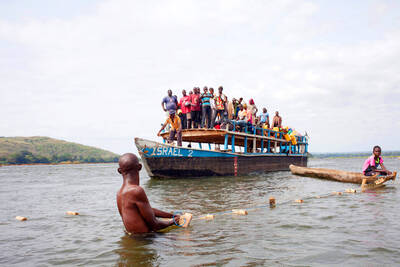
RIVER TRAGEDY: Local fishers and residents helped rescue people after the vessel capsized, while motorbike taxis evacuated some of the injured At least 58 people going to a funeral died after their overloaded river boat capsized in the Central African Republic’s (CAR) capital, Bangui, the head of civil protection said on Saturday. “We were able to extract 58 lifeless bodies,” Thomas Djimasse told Radio Guira. “We don’t know the total number of people who are underwater. According to witnesses and videos on social media, the wooden boat was carrying more than 300 people — some standing and others perched on wooden structures — when it sank on the Mpoko River on Friday. The vessel was heading to the funeral of a village chief in


 RSS
RSS