


UN Secretary General Kofi Annan threw down the gauntlet to world leaders on Monday, pressing them to adopt the most wide-ranging reforms since the UN was founded 60 years ago.
Annan called for an expanded Security Council, fixed rules for when nations could go to war, strengthened human rights and boosted development and trade, as well as an overhaul of the UN bureaucracy.
"This hall has heard enough high-sounding declarations to last us for some decades to come," Annan said in a speech to the UN General Assembly to present his 63-page report, which he called the biggest UN reforms in history.
"We all know what the problems are and we all know what we have promised to achieve. What is need now is not more declarations or promises, but action -- action to fulfil the promises already made," he said.
Annan wants the major changes to be agreed at a summit of world leaders at UN headquarters in September, which will mark the UN's 60th anniversary.
"What I am proposing amounts to a comprehensive strategy," he said, urging member states to adopt the package as a whole and steer clear of "a la carte" picking and choosing.
But he now must convince the UN's 191 member states to support his program, and some nations on Monday were already raising concerns about certain parts of the reform package.
One of the most sensitive ideas is to expand the Security Council, with Annan offering two models. One option would add six new members to its five permanent powers: Britain, China, France, Russia and the US.
The other would add a third tier of semi-permanent members to the council, the top UN body for international peace and security.
Annan said the council should adopt a resolution setting guidelines to determine when military action can be authorised, an issue in the spotlight since the US invaded Iraq.
He has said that the deep divisions over the war threatened to undermine the international system of security in place since the UN was established in the wake of World War II.
"The United Nations must be brought fully into line with today's realities," Annan said, maintaining that an expanded council would be more representative.
On terrorism, Annan put forward a long-elusive definition that said no cause could justify non-state entities killing or harming civilians in an attempt to influence government policies and actions.
The proposal takes aim at insistence from many Arab nations that attacks on civilians to fight "state-sponsored terrorism" by Israel are acceptable, which has long been a stumbling block to agreeing a definition of terrorism.
On development, he pressed nations to honor their commitments to provide 0.7 percent of GDP for development aid and called for full debt relief for the world's poorest, debt-ridden countries.
Yet he said developing nations must take concrete steps to fight AIDS and cut poverty in half, part of an ambitious set of agreed targets known as the Millennium Development Goals to be met by 2015.
Annan also proposed replacing the UN Commission on Human Rights, long criticized for protecting offending nations, with a human rights council elected by the 191 UN member countries.
Brazil, Germany, India and Japan, which have launched a joint campaign to get four permanent council seats, quickly said in a joint statement that member states would back the first council reform model with more permanent members.
In a telephone conversation with Annan, US President George W. Bush told the UN chief his speech on UN reforms "had some constructive ideas" and that he looked forward to working with Annan on it, said White House spokesman Scott McCellan.
But earlier, the US cast doubt on a council resolution that would set rules for authorizing military force.
"Frankly, we're sceptical that any kind of resolution on the use of force would be helpful," said deputy state department spokesman Adam Ereli.
Algeria, currently the lone Arab member of the Security Council, said Annan's language on terrorism needed more consideration.
Algeria's UN ambassador Abdallah Baali said it needed to be made clear "that terrorism and the right to resist foreign occupation should not be confused."
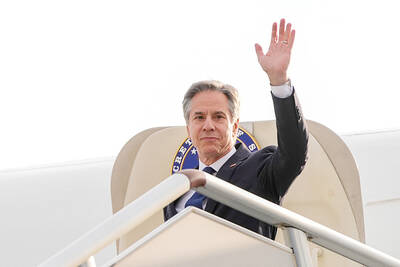
‘IN A DIFFERENT PLACE’: The envoy first visited Shanghai, where he attended a Chinese basketball playoff match, and is to meet top officials in Beijing tomorrow US Secretary of State Antony Blinken yesterday arrived in China on his second visit in a year as the US ramps up pressure on its rival over its support for Russia while also seeking to manage tensions with Beijing. The US diplomat tomorrow is to meet China’s top brass in Beijing, where he is also expected to plead for restraint as Taiwan inaugurates president-elect William Lai (賴清德), and to raise US concerns on Chinese trade practices. However, Blinken is also seeking to stabilize ties, with tensions between the world’s two largest economies easing since his previous visit in June last year. At the

UNSETTLING IMAGES: The scene took place in front of TV crews covering the Trump trial, with a CNN anchor calling it an ‘emotional and unbelievably disturbing moment’ A man who doused himself in an accelerant and set himself on fire outside the courthouse where former US president Donald Trump is on trial has died, police said yesterday. The New York City Police Department (NYPD) said the man was declared dead by staff at an area hospital. The man was in Collect Pond Park at about 1:30pm on Friday when he took out pamphlets espousing conspiracy theories, tossed them around, then doused himself in an accelerant and set himself on fire, officials and witnesses said. A large number of police officers were nearby when it happened. Some officers and bystanders rushed

Beijing is continuing to commit genocide and crimes against humanity against Uyghurs and other Muslim minorities in its western Xinjiang province, U.S. Secretary of State Antony Blinken said in a report published on Monday, ahead of his planned visit to China this week. The State Department’s annual human rights report, which documents abuses recorded all over the world during the previous calendar year, repeated language from previous years on the treatment of Muslims in Xinjiang, but the publication raises the issue ahead of delicate talks, including on the war in Ukraine and global trade, between the top U.S. diplomat and Chinese
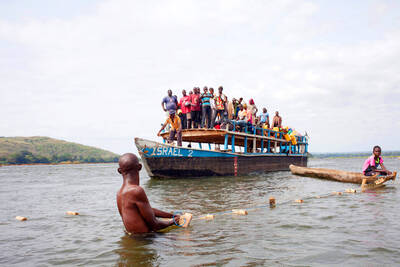
RIVER TRAGEDY: Local fishers and residents helped rescue people after the vessel capsized, while motorbike taxis evacuated some of the injured At least 58 people going to a funeral died after their overloaded river boat capsized in the Central African Republic’s (CAR) capital, Bangui, the head of civil protection said on Saturday. “We were able to extract 58 lifeless bodies,” Thomas Djimasse told Radio Guira. “We don’t know the total number of people who are underwater. According to witnesses and videos on social media, the wooden boat was carrying more than 300 people — some standing and others perched on wooden structures — when it sank on the Mpoko River on Friday. The vessel was heading to the funeral of a village chief in


 RSS
RSS