


In the tightly packed crowds of Lebanon's biggest protest ever, young and old threw a party: Children streamed in from schools, men and women snapped souvenir cellphone photos and demonstrators directed barbed jokes at Syria.
"Papa don't preach, I'm in trouble deep," one sign jabbed, with a picture of Syrian President Bashar Assad looking ruefully at his father, former president Hafez Assad.
It was the broadest-based rally the opposition has held in its series of protests demanding Syria remove its forces from Lebanon and end its domination of the country. Druse rolled in from the mountains east and southeast of Beirut, Christians from the heartland in the northeast -- and Sunni Muslims turned out big from the north.
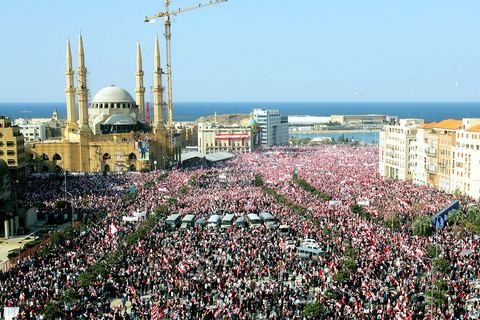
PHOTO: AP
In the crowd, blond women with sleeveless tops and plunging necklines mixed with conservative Muslim women in headscarves and modest robes. Protesters who came in from Lebanon's different regions could be picked out by their distinctive accents.
A powerful turnout was key for the opposition movement, whose credibility was on the line after the Shiite Muslim guerrilla group Hezbollah last week brought out a half-million people in support of Syria and after the Lebanese government brought back pro-Syrian Prime Minister Omar Karami, whose resignation had been the opposition's most concrete accomplishment.
And by all accounts, the opposition showed its pull on the street. More than 1 million people joined the rally, according to Lebanon's leading LBC TV station and some police officials. An Associated Press estimate put the number at over 800,000.
The coastal highway from northern Lebanon was turned into a one-way street, jammed with cars and buses bringing protesters. Flags fluttered from windows plastered with pictures of slain former Prime Minister Rafik Hariri, with children leaning their heads out of windows to chant. Some people were stuck in their cars for up to six hours, others left their vehicles to walk.
Some even raced on speedboats to the seaside Martyrs Square.
Along with TV ads, the opposition sent out a flurry of e-mails and telephone text messages calling on people to show up. One message pointed to Karami's claim that the Hezbollah rally showed the government has the support of the majority.
"Prove him wrong by being at Martyrs' Square," the call flashed across cell phones and computers.
Everywhere in Martyrs' Square were the red and white bars and green cedar tree emblem of the Lebanese flags. Men and women painted their faces with the colors -- some with the cedar right over their noses. Bandanas, scarves, aprons and armbands bore the colors. And thousands waved flags, clambering over the minarets and scaffoldings of Mohammed al-Amin Mosque or up nearby buildings.
Children wearing backpacks came from schools, some brought by their parents. Thousands of people spilled over into nearby Riad Solh Square, where Hezbollah held its rally last week.
Lebanese soldiers stood idly watching the protest, taking no action to stop the demonstrators -- unlike in some previous opposition protests.
"It was as if they were part of the protesters," opposition legislator Marwan Hamadeh said.

Through the noise of rushing papers and whirring belts at a print factory in Kyoto, two creators watch their photo essay come to life in broadsheet form — part of an effort to win new audiences in the age of artificial intelligence (AI). Despite the decline of the publishing industry, self-publication and handmade “zine” magazines are growing in popularity in Japan, reflecting the nation’s enduring love of paper in the digital era. While speaking to Agence France-Presse at the plant, his hands black with ink, one of the creators, Kazuma Obara, said: “I think [paper] is a medium that engages all five
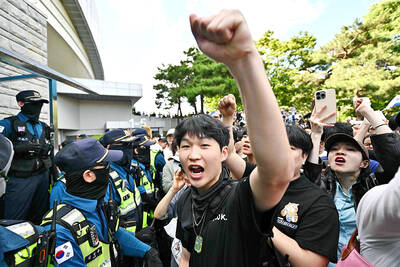
‘ABSURD MISTAKE’: The election commission said that there had been a failure to anticipate turnout after 14 polling stations ran short of ballot papers South Korean riot police yesterday cleared protesters from a Seoul polling station after a 35-hour blockade sparked by a shortage of ballot papers during local elections earlier this week. Wednesday’s election was the first nationwide vote since South Korean President Lee Jae-myung took office following the ouster of Yoon Suk-yeol over his short-lived martial law declaration. Lee’s ruling Democratic Party swept most races, but failed to flip the crucial Seoul mayoral seat. The South Korean National Election Commission apologized, blaming a failure to anticipate turnout after 14 polling stations in Seoul ran short of ballot papers. Some polling stations stayed open until 10pm to

Australian researchers have trained lab-grown brain cells on a silicon computer chip to play the 1990s shooter game Doom and said they are just scratching the surface of what the neurons could be capable of doing. It is the science-fiction work of biotech boffins at Cortical Labs, who researched and developed the technology that harnesses the workings of the brain’s networking system. Each so-called “biological computer” contains about 200,000 living human brain cells, grown from stem cells that were harvested from blood donations. Having mastered the simple computer game Pong, where a paddle is moved up and down to send a ball

France experienced its hottest spring on record, the French weather service said on Tuesday, after an exceptional early heat wave that also broke highs for the season in England and Wales. Meteo-France said the average nationwide temperature over March to May was 13.8°C — about 1.7°C above the norm, and surpassing records set in 2011 and 2020. “The warmest spring since records began in 1900,” it said in a bulletin. All three months were warmer than average, but the onset of an “unprecedented heatwave” late last month pushed the mercury to highs typically seen at the height of the summer. “Our country had never


 RSS
RSS