


The British Parliament remained deadlocked yesterday over Prime Minister Tony Blair's proposed anti-terrorism law, as authorities prepared to release on bail eight foreign terrorist suspects locked up for three years without charge.
The government wants new powers to place suspects under house arrest and impose curfews and travel bans after Britain's highest court ruled that an emergency law passed after the Sept. 11 attacks is illegal.
An Algerian was released on strict bail conditions late Thursday and eight more men, including Muslim cleric Abu Qatada, are expected to be released under similar terms yesterday. But the power to impose the bail orders expires on Monday, and the government is pushing hard to get new legislation through Parliament before then.
Lawmakers failed to reach agreement by yesterday morning on the Prevention of Terrorism Bill, despite debating through the night -- an often fractious, rowdy session that saw the legislation bounce between the House of Commons and the House of Lords.
"It is absolutely vital that we get this legislation," said Home Office Minister Hazel Blears.
But opposition parties, who say the new legislation is flawed and infringes on civil liberties, continued to demand the law expire within a year of passage and said the government must act on stronger evidence than merely the suspicions of intelligence services.
"If the government believed in civil liberties in this country, it would consent to a sunset clause," said Conservative Party lawmaker Dominic Grieve, referring to an amendment that would force the bill to expire in 12 months. "I am left with the unpleasant feeling that the government has been playing the cheapest form of politics in this matter."
Blair already has the backing of the House of Commons, where he has a majority. But the House of Lords, where the Conservatives are the largest grouping, again overturned the government's proposals in votes early Friday. The bill will bounce back and forth between the chambers, being amended and re-amended, until one side gives ground.
The government wants new powers to impose control orders on suspects without trial -- including restrictions on using the Internet or telephone, curfews, house arrest and electronic tagging.
It says the law would be used sparingly and only against suspects who could not be tried in court because evidence against them would be too sensitive to reveal publicly.
If the Prevention of Terrorism Bill were to pass, the government would have to request that a judge impose an order for house arrest. But in emergencies, it has reserved the right for a minister to impose the lesser controls, as long as a judge is consulted within seven days.
Blair wants the new powers on the books by Monday, when the law allowing the indefinite detention of foreign terror suspects without trial expires.
A special commission on Thursday granted bail to an Algerian national held under the law for three years. The man, identified only as "A," faces strict bail conditions, including powers for police to search his family home. Eight others are due to be freed on similar bail terms including Qatada, described by several Western governments as Osama bin Laden's "spiritual ambassador in Europe."
On Monday, even the power to hold the men on bail runs out, and the government says it must have the new measures proposed in the Prevention of Terrorism Bill to control their activities.
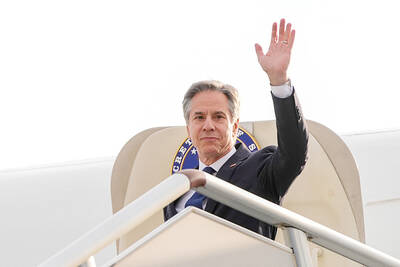
‘IN A DIFFERENT PLACE’: The envoy first visited Shanghai, where he attended a Chinese basketball playoff match, and is to meet top officials in Beijing tomorrow US Secretary of State Antony Blinken yesterday arrived in China on his second visit in a year as the US ramps up pressure on its rival over its support for Russia while also seeking to manage tensions with Beijing. The US diplomat tomorrow is to meet China’s top brass in Beijing, where he is also expected to plead for restraint as Taiwan inaugurates president-elect William Lai (賴清德), and to raise US concerns on Chinese trade practices. However, Blinken is also seeking to stabilize ties, with tensions between the world’s two largest economies easing since his previous visit in June last year. At the

UNSETTLING IMAGES: The scene took place in front of TV crews covering the Trump trial, with a CNN anchor calling it an ‘emotional and unbelievably disturbing moment’ A man who doused himself in an accelerant and set himself on fire outside the courthouse where former US president Donald Trump is on trial has died, police said yesterday. The New York City Police Department (NYPD) said the man was declared dead by staff at an area hospital. The man was in Collect Pond Park at about 1:30pm on Friday when he took out pamphlets espousing conspiracy theories, tossed them around, then doused himself in an accelerant and set himself on fire, officials and witnesses said. A large number of police officers were nearby when it happened. Some officers and bystanders rushed

Beijing is continuing to commit genocide and crimes against humanity against Uyghurs and other Muslim minorities in its western Xinjiang province, U.S. Secretary of State Antony Blinken said in a report published on Monday, ahead of his planned visit to China this week. The State Department’s annual human rights report, which documents abuses recorded all over the world during the previous calendar year, repeated language from previous years on the treatment of Muslims in Xinjiang, but the publication raises the issue ahead of delicate talks, including on the war in Ukraine and global trade, between the top U.S. diplomat and Chinese
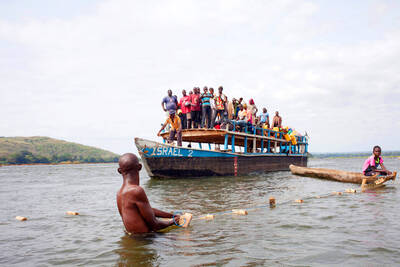
RIVER TRAGEDY: Local fishers and residents helped rescue people after the vessel capsized, while motorbike taxis evacuated some of the injured At least 58 people going to a funeral died after their overloaded river boat capsized in the Central African Republic’s (CAR) capital, Bangui, the head of civil protection said on Saturday. “We were able to extract 58 lifeless bodies,” Thomas Djimasse told Radio Guira. “We don’t know the total number of people who are underwater. According to witnesses and videos on social media, the wooden boat was carrying more than 300 people — some standing and others perched on wooden structures — when it sank on the Mpoko River on Friday. The vessel was heading to the funeral of a village chief in


 RSS
RSS