


Iraqi insurgents set off bombs and fired rocket-propelled grenades and automatic weapons at military convoys, checkpoints and police patrols in a spate of violence that killed 33 people and wounded dozens.
The terror group al-Qaeda in Iraq, led by Abu Musab al-Zarqawi, claimed responsibility for much of the bloodshed on Monday.
As the attacks persisted, so did negotiations to form Iraq's first democratically elected government. Iraqi Kurds said they were close to a deal with the Shiite clergy-backed United Iraqi Alliance to secure many of their territorial demands and ensure the country's secular character after its National Assembly convenes March 16.
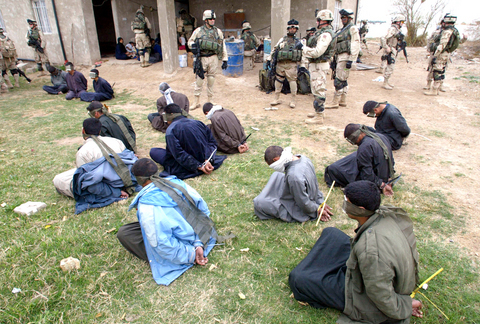
PHOTO: AFP
The dominant Shiite Muslim alliance, however, said although it agreed that Kurdish leader Jalal Talabani would become Iraq's president, it was still talking about other conditions set by the Kurds for their support in the 275-member legislative body.
The Shiite alliance controls 140 seats and need the 75 seats won by the Kurds in the Jan. 30 elections to muster the necessary two-thirds majority to elect a president and later seat their choice for prime minister, Ibrahim al-Jaafari.
An alliance official said interim Prime Minister Ayad Allawi, whose party won 40 seats, refused an offer for a Cabinet post. Allawi's office could not be reached for comment.
"Iraqis defied the terrorists and they went to the polling stations in order to see their elected representatives meet and debate the future of the country," interim Deputy Prime Minister Barham Saleh, a Kurd, said of the decision to convene the assembly.
The wave of violence came as Dutch troops ended their mission in the southern city of Samawa and turned command of the area over to the British, along with responsibility for 550 Japanese soldiers. The Dutch government last year decided to pull out its final 350 troops, despite requests from Britain and the US.
Another ally, Bulgaria, demanded Monday that the US investigate what appeared to be a friendly fire incident Friday that killed one of the 460 Bulgarian soldiers in Iraq. Although Bulgaria's defense minister said the death would not lead to a withdrawal, his government must decide this month whether to keep troops in Iraq past July.
Al-Qaeda in Iraq purportedly claimed responsibility in an Internet statement for much of the bloodshed that killed 15 people Monday in and around Baqubah, 55km northeast of Baghdad. The assaults included a car bomb, three roadside bombs and small arms attacks on three checkpoints, one of them just south of Baqubah in Muradiyah, said police Colonel Mudhafar al-Jubbori.
A car bomb also killed 12 people in Balad, southeast of Baqubah.
In Baghdad, gunmen killed two police officers and wounded a third, while two civilians were killed when a roadside bomb targeting a joint US-Iraqi military convoy exploded in the Baghdad neighborhood of Amiriyah.
In Baghdad's Doura district, gunmen killed Mahmood Khudier, a former Iraqi army officer, while a man was killed in a mortar attack.

SPEAKING OUT: After Siranudh Scott’s allegations surfaced, celebrities and public figures took to social media to share their own experiences of sexual misconduct and abuse A high-profile alleged sexual abuse case within a wealthy Thai beer brewing family has prompted a wave of painful accounts from survivors of unconnected abuse in the conservative nation. Siranudh Scott, a member of the billionaire Thai family that founded the ubiquitous Singha beer brand, posted an emotional video this month accusing his elder brother Sunit of repeatedly abusing him when he was a teenager. Sunit, who is in his 30s, later denied the allegations in a video posted online, but Singha parent Boonrawd dismissed him from his executive role with the company on Tuesday last week. “I felt I needed to speak

SEEKING ORDER: Rodrigo Paz said that ‘anyone who wants to destroy the nation will have to deal with this president and the full force of the constitution’ Bolivian President Rodrigo Paz on Wednesday said that the nation was at a “breaking point” after nearly a month of protests that have caused shortages of food, fuel and medicine. Paz, who took office six months ago amid the worst economic crisis there in four decades, is battling a groundswell of fury over his policies. The political capital, La Paz, has been besieged by low-income workers and members of the indigenous majority calling for his resignation. “The country needs order and is reaching breaking point,” the 58-year-old said at a public event in La Paz, renewing his appeal for dialogue. On Tuesday, the Bolivian
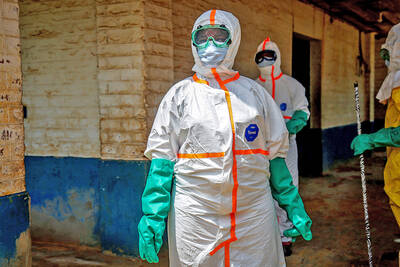
COMMUNITY CONFLICT: Concerns about disease spread from corpses has run up against friends and families’ desire to bury their dead as infection spreads in the area Angry residents of a town at the epicenter of the Ebola outbreak in the Democratic Republic of the Congo (DR Congo) attacked and burned a tent that was part of a health center where people are being treated for the virus, the staff there said Saturday. It was the second such attack in the region in a week. No one was hurt in the attack, according to reports but as patients ran out to escape the fire, 18 people with suspected Ebola infections fled the facility and are unaccounted for, a hospital director said. Angry residents arrived at the clinic in the

Forecasters in Europe yesterday warned of exceptional heat as record temperatures driven by a “heat dome” push temperatures well above seasonal norms across the continent. The surge follows a record-breaking Monday, with France logging its hottest day in the month of May on record, its weather agency said, and the UK also posting unprecedented highs. A so-called “heat dome” of warm air from northern Africa trapped under a high-pressure system over western Europe is behind the high temperatures not usually seen until high summer. Restrictions on outdoor work were imposed in parts of Italy, beaches in southwest France filled earlier than usual and


 RSS
RSS