


A year after the Madrid bombings that shook Europe, questions remain in Washington over to what extent the US and its European allies are on the same page in the "war on terror."
While publicly praising cooperation, US officials are still concerned about what they call cultural and legal hurdles to boosting intelligence-sharing, prosecutions and other assistance with Europe.
More fundamental is a trans-Atlantic perception gap. If Washington has given the terrorist threat paramount attention since the Sept. 11, 2001 attacks, much of Europe sees it as just one serious problem among many.
"Addressing the factors that reduce long-term CT [counterterrorism] effectiveness in Europe will be a long-term process," Cofer Black, then State Department counterterrorism coordinator, said last year.
"Differing legal cultural and historical traditions and practices will complicate and slow progress," Black told a Senate subcommittee three weeks after the Madrid train attacks that killed nearly 200 people.
A Pew Research Center poll conducted shortly after the Madrid bombings showed 57 percent of French thought the US was exaggerating the terrorist danger.
Forty-nine percent of Germans and even one-third of Britons agreed.
If US officials hoped the carnage in the Spanish capital would fire up Europe to redouble cooperation, they were disappointed.
For various historical reasons, and still smarting from the US decision to invade Iraq in March 2003, many European officials shy away from referring to the fight against terrorism as a "war."
They also worry that the US focus on terrorism has eclipsed efforts to deal with a host of other pressing global issues such as poverty, malnutrition, disease and education.
US officials and analysts have not seen any quantum leap in European willingness to share data on stolen passports, implement biometric indicators on visas or take major steps to protect their own cities.
"In terms of new policy and new initiatives and international cooperation on monitoring travel and that sort of thing, from what I understand there hasn't been the big new burst of energy we would have hoped for," said Michael O'Hanlon of the Brookings Institution.
The Americans recognize the Europeans have lived longer with terrorism, even if they have not experienced a Sept. 11.
They appreciate moves such as the 2003 EU-US extradition treaty and the naming of a EU counterterrorism czar. But fears persist that European laws and customs are preventing a full crackdown on the terrorist support networks on the continent.
William Pope, the State Department deputy counterterrorism coordinator, cited inadequate anti-terror legislation, loopholes in asylum laws, open borders and strict standards of evidence that made detaining suspects more difficult.
"We are concerned that some European states have at times demonstrated an inability to prosecute successfully or hold many of the terrorists brought before their courts," Pope told US Congress last September.
He also acknowledged "differing perspectives" on the line between legitimate political groups and terror sponsors. For instance, Washington has long branded the militant Islamic organization Hezbollah as a backer of terrorism, while the EU has balked.
With US President George W. Bush pledging to repair trans-Atlantic ties frayed by the Iraq war, his administration has taken a less martial tone in its campaign against al-Qaeda and other groups.
Bush did not use the word terrorism in his inaugural address in January, and officials have stressed the importance of "soft power" such as development aid or relief assistance as a component of the anti-terror drive.
"I think there is a tendency in Europe to say the United States is simplistic about this. It doesn't take into account the many other things the president has done," a senior US official said. "There is clearly an obligation on the part of the US government to be talking to European publics, to be trying to convey a better understanding, a better perception, of the way we are approaching these things."
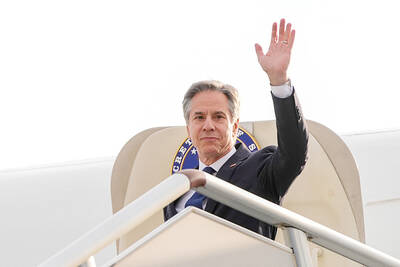
‘IN A DIFFERENT PLACE’: The envoy first visited Shanghai, where he attended a Chinese basketball playoff match, and is to meet top officials in Beijing tomorrow US Secretary of State Antony Blinken yesterday arrived in China on his second visit in a year as the US ramps up pressure on its rival over its support for Russia while also seeking to manage tensions with Beijing. The US diplomat tomorrow is to meet China’s top brass in Beijing, where he is also expected to plead for restraint as Taiwan inaugurates president-elect William Lai (賴清德), and to raise US concerns on Chinese trade practices. However, Blinken is also seeking to stabilize ties, with tensions between the world’s two largest economies easing since his previous visit in June last year. At the

UNSETTLING IMAGES: The scene took place in front of TV crews covering the Trump trial, with a CNN anchor calling it an ‘emotional and unbelievably disturbing moment’ A man who doused himself in an accelerant and set himself on fire outside the courthouse where former US president Donald Trump is on trial has died, police said yesterday. The New York City Police Department (NYPD) said the man was declared dead by staff at an area hospital. The man was in Collect Pond Park at about 1:30pm on Friday when he took out pamphlets espousing conspiracy theories, tossed them around, then doused himself in an accelerant and set himself on fire, officials and witnesses said. A large number of police officers were nearby when it happened. Some officers and bystanders rushed

Beijing is continuing to commit genocide and crimes against humanity against Uyghurs and other Muslim minorities in its western Xinjiang province, U.S. Secretary of State Antony Blinken said in a report published on Monday, ahead of his planned visit to China this week. The State Department’s annual human rights report, which documents abuses recorded all over the world during the previous calendar year, repeated language from previous years on the treatment of Muslims in Xinjiang, but the publication raises the issue ahead of delicate talks, including on the war in Ukraine and global trade, between the top U.S. diplomat and Chinese

RIVER TRAGEDY: Local fishers and residents helped rescue people after the vessel capsized, while motorbike taxis evacuated some of the injured At least 58 people going to a funeral died after their overloaded river boat capsized in the Central African Republic’s (CAR) capital, Bangui, the head of civil protection said on Saturday. “We were able to extract 58 lifeless bodies,” Thomas Djimasse told Radio Guira. “We don’t know the total number of people who are underwater. According to witnesses and videos on social media, the wooden boat was carrying more than 300 people — some standing and others perched on wooden structures — when it sank on the Mpoko River on Friday. The vessel was heading to the funeral of a village chief in


 RSS
RSS