


Private security staff are to be used to monitor Britain's controversial new anti-terrorist control orders in an attempt to save money, according to preparations being made to implement the policy by the Home Office.
Senior civil servants have been asked to assess the likely impact of the control orders which are being rushed through parliament.
Their report discloses that private security staff are to monitor the day-to-day surveillance of the terror suspects through electronic tagging.
The Home Office says the control orders will be cheaper than the ?40,000 annual cost of holding a terror suspect in a high-security prison such as Belmarsh in London.
But to save further money "where possible the monitoring of the orders will be contracted out to private companies as per existing arrangements with companies like Securicor and Group 4."
The disclosure of the likely involvement of private security firms comes as the Home Secretary Charles Clarke faces a make or break week to get his prevention of terrorism bill onto the statute book.
The existing powers allowing terror suspects to be detained in Belmarsh lapse on Monday.
Close aides last night denied claims that Clarke would announce fresh concessions to avoid an embarrassing defeat later today when the detailed operation of the bill comes under renewed attack from a cross-party alliance of peers in the House of Lords.
Instead he will wait and see what shape the bill is in when it returns to the Commons on Wednesday and what concessions -- if any -- he needs to make to head off a revolt even more dangerous than the one that ended with last week's narrow 14-vote governing Labor party majority.
The official Home Office assessment of the emergency anti-terrorist legislation prepared by senior civil servants also admits that only 10 to 20 terror suspects are expected to be issued with control orders each year.
"The figures for those expected to be subject to a control order are not expected to be substantial," the report says.
That conclusion appears to conflict with warnings from Tony Blair who spoke of hundreds of potential terrorists in a recent radio interview.
The former London Metropolitan Police commissioner, John Stevens, also said Sunday that at least 100 -- and probably nearer 200 -- al-Qaida trained fighters were "walking the streets of Britain" and potentially able to carry out devastating terror attacks.
Writing in the News of the World, Lord Stevens said that "the main opposition to the bill is from people who simply haven't understood the brutal reality of the world we live in."
The opposition Liberal Democrat home affairs spokesman, Mark Oaten, accused ministers of sending out contradictory messages about the scope of the legislation.
The Home Office report estimates it costs between ?100,000 and ?250,000 a year to keep 20 terror suspects under surveillance for a year, including the cost of tracking their bank accounts.
But it makes no assessment of the costs of imposing a full "house arrest" on a terror suspect, perhaps reflecting Clarke's determination to keep such powers in reserve.
Securicor and Group 4 are already contracted by the government to run the electronic tagging systems monitoring the movements of sex offenders and criminals released on parole from prison.
Harry Fletcher, of NAPO, the probation officers union, said if the government was right and "these people were amongst the most dangerous in the country, the monitoring should be the responsibility of the state and not private security companies. The information that will be available to these people will be highly sensitive.
"To have private companies in the intelligence loop could compromise that process. The people who currently monitor electronic tags are predominantly low paid with minimal training. Do we really want national security in these hands?"
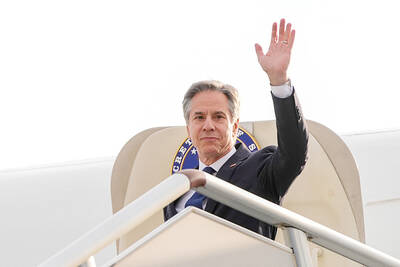
‘IN A DIFFERENT PLACE’: The envoy first visited Shanghai, where he attended a Chinese basketball playoff match, and is to meet top officials in Beijing tomorrow US Secretary of State Antony Blinken yesterday arrived in China on his second visit in a year as the US ramps up pressure on its rival over its support for Russia while also seeking to manage tensions with Beijing. The US diplomat tomorrow is to meet China’s top brass in Beijing, where he is also expected to plead for restraint as Taiwan inaugurates president-elect William Lai (賴清德), and to raise US concerns on Chinese trade practices. However, Blinken is also seeking to stabilize ties, with tensions between the world’s two largest economies easing since his previous visit in June last year. At the
Nearly half of China’s major cities are suffering “moderate to severe” levels of subsidence, putting millions of people at risk of flooding, especially as sea levels rise, according to a study of nationwide satellite data released yesterday. The authors of the paper, published by the journal Science, found that 45 percent of China’s urban land was sinking faster than 3mm per year, with 16 percent at more than 10mm per year, driven not only by declining water tables, but also the sheer weight of the built environment. With China’s urban population already in excess of 900 million people, “even a small portion

UNSETTLING IMAGES: The scene took place in front of TV crews covering the Trump trial, with a CNN anchor calling it an ‘emotional and unbelievably disturbing moment’ A man who doused himself in an accelerant and set himself on fire outside the courthouse where former US president Donald Trump is on trial has died, police said yesterday. The New York City Police Department (NYPD) said the man was declared dead by staff at an area hospital. The man was in Collect Pond Park at about 1:30pm on Friday when he took out pamphlets espousing conspiracy theories, tossed them around, then doused himself in an accelerant and set himself on fire, officials and witnesses said. A large number of police officers were nearby when it happened. Some officers and bystanders rushed

Beijing is continuing to commit genocide and crimes against humanity against Uyghurs and other Muslim minorities in its western Xinjiang province, U.S. Secretary of State Antony Blinken said in a report published on Monday, ahead of his planned visit to China this week. The State Department’s annual human rights report, which documents abuses recorded all over the world during the previous calendar year, repeated language from previous years on the treatment of Muslims in Xinjiang, but the publication raises the issue ahead of delicate talks, including on the war in Ukraine and global trade, between the top U.S. diplomat and Chinese


 RSS
RSS