


The US and other members of the UN nuclear watchdog agency on Wednesday intensified the pressure on Iran, accusing it of numerous failures to abide by its promise to suspend all of its uranium enrichment activities.
In a toughly worded statement to the trimonthly board meeting of the International Atomic Energy Agency, based in Vienna, the US representative, Jackie Sanders, excoriated Iran for what she called its willingness "to cynically manipulate the nuclear nonproliferation regime in the pursuit of nuclear weapons."
She called on the agency to report what she called "Iran's noncompliance" to the Security Council, a move that has been advocated by the US for two years but resisted by most other countries, including members of the EU.
In more moderate terms, Britain, France and Germany -- the "European Union three" that are striving to negotiate a permanent suspension of nuclear activity that is suspected of being weapons-related -- issued a statement expressed "serious concern" and "deep regret" over what they described as violations of Iran's promise to suspend its uranium enrichment and to provide a full account of all its nuclear activities.
While stepping up pressure in Vienna, the Bush administration also indicated a readiness to work with the Europeans trying to use incentives to persuade Iran to end its suspected nuclear weapons program.
Secretary of State Condoleezza Rice returned to Washington on Wednesday after conferring with top European diplomats in London, where aides said they discussed European proposals for incentives.
US and European officials say the incentives center on trade preferences and the sale of commercial aircraft and aircraft spare parts.
After returning from London, Rice conferred with US President George W. Bush and others about the Iran negotiations, according to Scott McClellan, the White House spokesman.
He added that "the president has been looking at ways that we can help and do our part to make sure we're doing everything we can to support those efforts."
A decision on a possible US endorsement of the European offer of incentives may be made in several days or perhaps next week, European and US officials said. A European diplomat familiar with the broad outlines of the talks in London said Europeans were "relieved that the United States is considering concrete measures, which is a step forward."
The statements in Vienna on Wednesday came in response to an interim report on Iran a day earlier by the agency's deputy director-general, Pierre Goldschmidt, who listed several areas where Iran had continued to block inspections of its nuclear sites and refused to turn over information about its program.
"Dr. Goldschmidt's recitation of events since November provides us with a startling list of Iranian attempts to hide and mislead, and delay the work of IAEA inspectors," Sanders said during a closed meeting. A text of her remarks was later released to reporters.
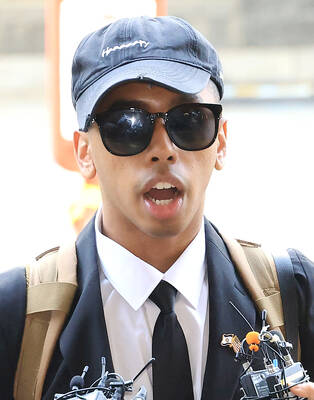
A US YouTuber who caused outrage for filming himself kissing a statue commemorating Korean wartime sex slaves has been sentenced to six months in prison, a court in Seoul said yesterday. Johnny Somali, 25, gained notoriety several years ago for recording himself doing a series of provocative stunts in South Korea and Japan, and streaming them on platforms such as YouTube and Twitch. South Korean authorities indicted Somali — whose real name is Ramsey Khalid Ismael — in 2024 on public order violations and obstruction of business, and banned him from leaving the country. “The court has sentenced him to six months in
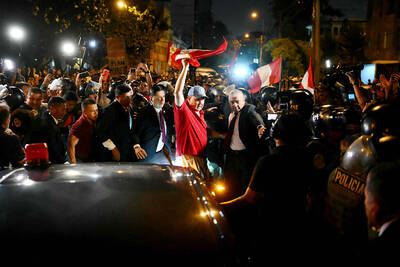
Former Lima mayor Rafael Lopez Aliaga, a Peruvian presidential hopeful, gathered hundreds of supporters in Lima on Tuesday and gave authorities 24 hours to annul the first round of the country’s election over allegations of fraud. Lopez Aliaga is locked in a tight three-way race with two other candidates for second place in Sunday’s vote. The election runner-up wins a ticket to June’s presidential run-off against front-runner Keiko Fujimori. “I am giving them 24 hours to declare this electoral fraud null and void,” said Lopez Aliaga, surrounded by a crowd of several hundred supporters. “If it is not declared null and void tomorrow,

PAPAL RETORT: Pope Leo told reporters that he has ‘no fear, neither of the Trump administration nor speaking out loudly about the message of the Gospel’ US President Donald Trump has feuded with Pope Leo XIV over the Iran conflict — setting off an unholy row that could have serious political implications for the Republican leader back in the US. Trump has drawn barbs even from some allies over the attacks on the US-born pontiff, who has criticized the Trump administration over its immigration crackdown, the intervention in Venezuela and the Iran war. The president risks alienating the religious right in November’s crucial US midterm elections. So far the unprecedented clash between the leader of the most powerful military on Earth and the head of the world’s 1.4 billion

A 16-year-old boy has been charged with murder and aggravated sexual abuse in Florida in the death of his 18-year-old stepsister on a Carnival Cruise ship, the US Department of Justice said on Monday. Timothy Hudson was initially charged in February and subsequently indicted on March 10, but the breadth of the case was not known until a seal was lifted on Friday last week, weeks after US District Judge Beth Bloom in Miami said that he would be prosecuted as an adult at the request of the government. Anna Kepner had been traveling on the Carnival Horizon ship in November last


 RSS
RSS