


Israel's foreign minister is hoping for peace with Lebanon in the wake of the popular protest in Beirut demanding that Syria leave after decades of occupation, while others warn that a Syrian exit could destabilize the country.
On Tuesday, a top Lebanese opposition leader poured cold water on Israeli enthusiasm, saying flatly that there will be no Israel-Lebanon peace treaty. Everyone agreed that Israel, with its long history of meddling in Lebanese affairs, should stay on the sidelines.
Israel withdrew its troops from southern Lebanon in 2000 after an 18-year presence. It started with a full-scale invasion and an attempt to install a pro-Israel government -- foiled when Israel's ally, president-elect Bashir Gemayel, was killed in a blast in his headquarters in 1982, attributed by most to Syria.
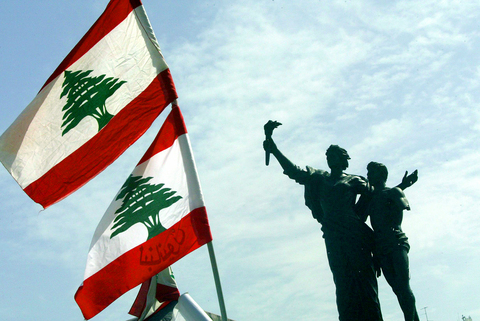
PHOTO: AFP
Israel remained mired in Lebanon in a bloody guerrilla war that still traumatizes the Jewish state.
With the anti-Syria protests in Beirut, some Israelis are turning optimistic about their northern neighbor again.
"This is a most important development, its something we have been hoping for," Foreign Minister Silvan Shalom told Army Radio.
Shalom and other Israeli officials expressed unequivocal support for the Lebanese opposition and what their protest could mean for Israel.
"I think there is a real wish by the Lebanese people to free themselves from Syrian occupation. I hope freedom from Syrian occupation will give them freedom and independence and the possibility of maybe holding a dialogue with the state of Israel," Shalom told Army Radio in a telephone interview during a visit to Budapest.
"We have no dispute with Lebanon, no dispute about territory, no economic dispute. The only reason that they are not at peace with us is because they were occupied by the Syrians," he said.
Lebanese opposition groups are being careful to identify with pan-Arab goals and are wary of being identified with the US, much less Israel.
Opposition leader Walid Jumblatt told al-Jazeera television station he prefers a truce with Israel rather than a peace treaty.
"Peace with Israel harms Lebanon. We don't want that," he said.
Syrian President Bashar Assad this week linked a Syrian withdrawal from Lebanon to guarantees of an Israeli-Syrian peace deal.
"It [a withdrawal from Lebanon] will only happen if we obtain serious guarantees. In one word: peace," he told the Italian newspaper La Repubblica.
Prime Minister Ariel Sharon has repeatedly demanded that Syria -- Israel's arch-enemy -- leave Lebanon, in contrast to some previous Israeli leaders, including the late Yitzhak Rabin, who had acquiesced to the Syrian presence as a guarantor of stability in the fractious country.
In failed Middle East talks in the 1990s, it was understood that an Israeli-Syrian peace deal would have to precede an agreement between Israel and Lebanon. Israel already has peace accords with its two other neighbors, Jordan and Egypt.
Syria insists that in exchange for peace, Israel leave the Golan Heights, a strategic plateau it captured in the 1967 Mideast war.
Sharon has brushed aside Assad's recent peace overtures, apparently because he is unwilling to pay the territorial price at a time when he is set to leave Gaza and parts of the West Bank.

Through the noise of rushing papers and whirring belts at a print factory in Kyoto, two creators watch their photo essay come to life in broadsheet form — part of an effort to win new audiences in the age of artificial intelligence (AI). Despite the decline of the publishing industry, self-publication and handmade “zine” magazines are growing in popularity in Japan, reflecting the nation’s enduring love of paper in the digital era. While speaking to Agence France-Presse at the plant, his hands black with ink, one of the creators, Kazuma Obara, said: “I think [paper] is a medium that engages all five

‘CROSSING THE LINE’: China’s embassy in Seoul criticized US Forces Korea Commander General Xavier Brunson, asking if his ‘hostile’ remarks were authorized by Washington South Korea and the US are in talks over recent public remarks by the commander of US Forces Korea, Seoul’s presidential office said yesterday, after the comments drew sharp criticism from China. In a recent podcast interview, US Forces Korea Commander General Xavier Brunson described South Korea as “the dagger in the heart of Asia” from China’s east coast, prompting the Chinese embassy in Seoul to say that he had “truly crossed the line.” The interview came amid growing speculation that Washington might seek to expand the role of US Forces Korea in countering the growing regional influence of China, a key

Australian researchers have trained lab-grown brain cells on a silicon computer chip to play the 1990s shooter game Doom and said they are just scratching the surface of what the neurons could be capable of doing. It is the science-fiction work of biotech boffins at Cortical Labs, who researched and developed the technology that harnesses the workings of the brain’s networking system. Each so-called “biological computer” contains about 200,000 living human brain cells, grown from stem cells that were harvested from blood donations. Having mastered the simple computer game Pong, where a paddle is moved up and down to send a ball
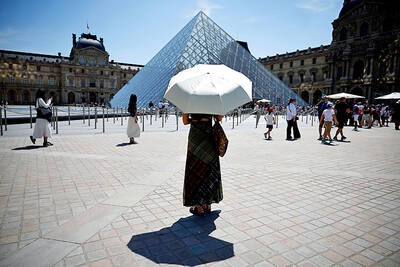
France experienced its hottest spring on record, the French weather service said on Tuesday, after an exceptional early heat wave that also broke highs for the season in England and Wales. Meteo-France said the average nationwide temperature over March to May was 13.8°C — about 1.7°C above the norm, and surpassing records set in 2011 and 2020. “The warmest spring since records began in 1900,” it said in a bulletin. All three months were warmer than average, but the onset of an “unprecedented heatwave” late last month pushed the mercury to highs typically seen at the height of the summer. “Our country had never


 RSS
RSS