


Scientists fighting the ravages of AIDS in the Third World have shown convincingly that a short and relatively inexpensive combination of HIV drugs could reduce mother-to-baby transmission rates in Africa far more effectively than the single pill now used.
But the cost of the drug combinations could still prove prohibitive in some of the most impoverished parts of the world.
Scientists have long been searching for an alternative to the AIDS drug now widely used in the Third World, nevirapine. Nevirapine is cheap and highly effective at preventing babies from contracting the AIDS virus from their mothers. But up to two-thirds of women become resistant to the drug.
The drug combinations appear to have an extremely low rate of resistance, offering an relatively inexpensive and easy-to-take alternative for many women.
"This is very promising for low-income countries," said one of the researchers, Dr. Francois Dabis of Victor Segalen University in Bordeaux, France.
However, the drug combination would likely cost more than double the usual US$8 for a single dose of nevirapine for mother and newborn. As it is now, some countries cannot even afford nevirapine.
"It's important not to be rapidly overoptimistic," said Dr. Mary Fowler, a US Centers for Disease Control and Prevention specialist in mother-to-baby HIV transmission. "The translation from trials to programs is incredibly challenging."
The findings were presented in Boston on Thursday at the 12th Annual Retrovirus Conference, the world's chief scientific meeting on AIDS.
In impoverished lands, nevirapine is widely given in single doses to infected pregnant women in labor and then to their newborns.
In the US, the complete three-drug HIV cocktail has cut mother-to-baby transmission rates to around 2 percent. But patients in the US are given longer treatments, and drugs that are far more effective and expensive than those tested in Africa.
The African studies -- one in the Ivory Coast, one in Botswana -- reduced rates at four to six weeks after birth to about 5 percent, the lowest ever recorded in Africa. Nevirapine in single doses typically reduces that rate from around 35 percent to 12 percent.
The World Health Organization is expected to consider broadening its guidelines soon in light of research on such new regimens. Its recommendations now include single-dose nevirapine and an AZT-nevirapine regimen.
"For a minimum additional cost, we may get many benefits," said Dr. James McIntyre, an AIDS researcher in South Africa.
However, researchers cautioned that single-dose nevirapine will still be needed in many places.
About 40 million people worldwide are infected with HIV. About 65 percent live in sub-Saharan Africa.
About 3 million people died in the epidemic last year.

‘IN A DIFFERENT PLACE’: The envoy first visited Shanghai, where he attended a Chinese basketball playoff match, and is to meet top officials in Beijing tomorrow US Secretary of State Antony Blinken yesterday arrived in China on his second visit in a year as the US ramps up pressure on its rival over its support for Russia while also seeking to manage tensions with Beijing. The US diplomat tomorrow is to meet China’s top brass in Beijing, where he is also expected to plead for restraint as Taiwan inaugurates president-elect William Lai (賴清德), and to raise US concerns on Chinese trade practices. However, Blinken is also seeking to stabilize ties, with tensions between the world’s two largest economies easing since his previous visit in June last year. At the

UNSETTLING IMAGES: The scene took place in front of TV crews covering the Trump trial, with a CNN anchor calling it an ‘emotional and unbelievably disturbing moment’ A man who doused himself in an accelerant and set himself on fire outside the courthouse where former US president Donald Trump is on trial has died, police said yesterday. The New York City Police Department (NYPD) said the man was declared dead by staff at an area hospital. The man was in Collect Pond Park at about 1:30pm on Friday when he took out pamphlets espousing conspiracy theories, tossed them around, then doused himself in an accelerant and set himself on fire, officials and witnesses said. A large number of police officers were nearby when it happened. Some officers and bystanders rushed

Beijing is continuing to commit genocide and crimes against humanity against Uyghurs and other Muslim minorities in its western Xinjiang province, U.S. Secretary of State Antony Blinken said in a report published on Monday, ahead of his planned visit to China this week. The State Department’s annual human rights report, which documents abuses recorded all over the world during the previous calendar year, repeated language from previous years on the treatment of Muslims in Xinjiang, but the publication raises the issue ahead of delicate talks, including on the war in Ukraine and global trade, between the top U.S. diplomat and Chinese
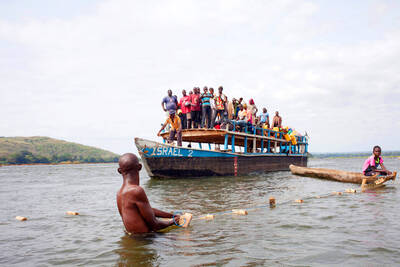
RIVER TRAGEDY: Local fishers and residents helped rescue people after the vessel capsized, while motorbike taxis evacuated some of the injured At least 58 people going to a funeral died after their overloaded river boat capsized in the Central African Republic’s (CAR) capital, Bangui, the head of civil protection said on Saturday. “We were able to extract 58 lifeless bodies,” Thomas Djimasse told Radio Guira. “We don’t know the total number of people who are underwater. According to witnesses and videos on social media, the wooden boat was carrying more than 300 people — some standing and others perched on wooden structures — when it sank on the Mpoko River on Friday. The vessel was heading to the funeral of a village chief in


 RSS
RSS