


Not even the dead can draw out the living in Baghdad, where fear of suicide bombers keeps many mourners away from funerals. But there are some things the most cautious Baghdad resident cannot avoid: school, shopping and traffic.
Baghdad's attackers are indiscriminate: They hit Sunni and Shiite Muslims alike. People worry that by emerging from their homes even to pay their last respects to the dead, they risk becoming the next victim.

PHOTO: AP
Last Saturday, a suicide bomber walked into a tent where 50 people were holding a funeral outside a Sunni mosque in Baghdad and blew himself up, killing at least three people and wounding 10. He was one of eight suicide bombers on a day that saw more than 50 people killed around Baghdad.
Even buying bread is a risk. Gunmen opened fire Thursday on a Baghdad bakery, killing two people and wounding a third.
"Bombing's become part of our daily life," said Hamdiya Jassem, a 24-year-old graduate student. "The worst thing is that you go out to work, or to university, and you don't know if you'll come back. All Iraqis have car phobia now."
Nearly two years after the US-led invasion, and almost a month after elections, Baghdad remains a terrifying place.
US and Iraqi authorities spoke of a post-election lull, attributing a drop in attacks to ramped-up security before the Jan. 30 vote. But that's all relative.
More than 40 people were killed on election day alone, while nearly 100 died last weekend.
Although exact figures are not available, attacks against Iraqis seem to have increased steadily as militant groups vow to undermine what the government and the US military see as progress.
When a suicide bomber hit on Feb. 8 and killed 21 people, militants led by Jordanian terror mastermind Abu Musab al-Zarqawi claimed responsibility for the attack and promised more.
"This is the beginning of the escalation we promised you," read a statement posted on the Internet. Its source could not be verified.
In a letter to Osama bin Laden found on a captured al-Qaeda courier last year, al-Zarqawi proposed starting a civil war between Iraq's Sunni and Shiite Muslims.
First the militants targeted Iraqi security forces -- who the US hopes will soon be able to take over much of the security burden. Then the insurgents set their sights on Saturday's Shiite Muslim holiday of Ashoura, a time of mourning for the country's largest religious group.
Suicide bombers walked into mosques, mortars hit processions and one man boarded a bus and set off explosives, killing everyone inside. That was the day the suicide bomber walked into the funeral, but those grieving inside were Sunni -- not the Shiites routinely targeted by the largely Sunni insurgency. The two main branches of Islam are often at odds.
It wasn't clear if the Sunni funeral was attacked by mistake. What is clear, though, is no Iraqi anywhere is safe.
Ikhlass Hussein carries her Koran whenever she goes shopping, so she can read the verses Muslims recite when they're about to die.
"I say, `I testify there is no God but Allah, and Mohammed is the prophet of God,'" she said..
The 31-year-old teacher can't shake the thought that she and her husband could be killed anytime.
"These thoughts are with us every day. We cannot forget them, because they've become just like food and water for us," she said.
Baghdad's markets, normally buzzing with people, are deserted these days. Vendors stand at their fruit and vegetable stalls waiting for customers who don't come. Pharmacies close early. Even the shopping district of Karada -- usually open late -- is shuttered by 4pm and the hawkers have packed away their piles of Levi's, Nikes, fake DVDs and Arabic music cassettes.
Women on the street are scarce and always accompanied by male relatives. Those restaurants that do open have only a handful of people.
There are places every resident of Baghdad knows to avoid: Haifa Street, scene of rancorous gunbattles and public executions; and Tahrir Square, where car bombs obliterate the swirling traffic circle of beaten-up cars and dusty money exchange stalls. Still, some things are unavoidable.
In Baghdad's traffic jams, everyone's a sitting duck. The car next to you could be carrying militants with weapons ready to shoot -- or, worse, a suicide bomber. Some militants wait for a US military convoy to pass and set off roadside bombs, killing or maiming any Iraqis who happen to be nearby.
Another concern are US military vehicles, which for fear of bombers carry signs warning drivers to keep away. The price for coming too close could be a bullet.
``There are no precautions that we can take to be safe, because the bombs can be in any time and in any place,'' said Rafid Abdul Jabar, a storekeeper.
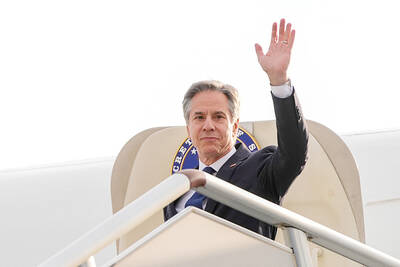
‘IN A DIFFERENT PLACE’: The envoy first visited Shanghai, where he attended a Chinese basketball playoff match, and is to meet top officials in Beijing tomorrow US Secretary of State Antony Blinken yesterday arrived in China on his second visit in a year as the US ramps up pressure on its rival over its support for Russia while also seeking to manage tensions with Beijing. The US diplomat tomorrow is to meet China’s top brass in Beijing, where he is also expected to plead for restraint as Taiwan inaugurates president-elect William Lai (賴清德), and to raise US concerns on Chinese trade practices. However, Blinken is also seeking to stabilize ties, with tensions between the world’s two largest economies easing since his previous visit in June last year. At the
Nearly half of China’s major cities are suffering “moderate to severe” levels of subsidence, putting millions of people at risk of flooding, especially as sea levels rise, according to a study of nationwide satellite data released yesterday. The authors of the paper, published by the journal Science, found that 45 percent of China’s urban land was sinking faster than 3mm per year, with 16 percent at more than 10mm per year, driven not only by declining water tables, but also the sheer weight of the built environment. With China’s urban population already in excess of 900 million people, “even a small portion

UNSETTLING IMAGES: The scene took place in front of TV crews covering the Trump trial, with a CNN anchor calling it an ‘emotional and unbelievably disturbing moment’ A man who doused himself in an accelerant and set himself on fire outside the courthouse where former US president Donald Trump is on trial has died, police said yesterday. The New York City Police Department (NYPD) said the man was declared dead by staff at an area hospital. The man was in Collect Pond Park at about 1:30pm on Friday when he took out pamphlets espousing conspiracy theories, tossed them around, then doused himself in an accelerant and set himself on fire, officials and witnesses said. A large number of police officers were nearby when it happened. Some officers and bystanders rushed

Beijing is continuing to commit genocide and crimes against humanity against Uyghurs and other Muslim minorities in its western Xinjiang province, U.S. Secretary of State Antony Blinken said in a report published on Monday, ahead of his planned visit to China this week. The State Department’s annual human rights report, which documents abuses recorded all over the world during the previous calendar year, repeated language from previous years on the treatment of Muslims in Xinjiang, but the publication raises the issue ahead of delicate talks, including on the war in Ukraine and global trade, between the top U.S. diplomat and Chinese


 RSS
RSS