

A court ordered the Japanese government yesterday to pay a record US$27 million dollars to compensate people in Okinawa who said they lost their hearing and suffered psychologically from noise from a US air base.
The Okinawa district court said, however, that it could not order, as the plaintiffs requested, that flights to and from the Kaneda base, the biggest US air base in East Asia, be banned between 7pm and 7am.
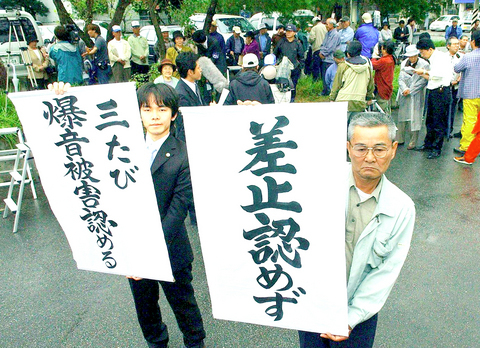
PHOTO: EPA
"The noise was beyond tolerance," presiding judge Kyoji Iida said in his ruling, according to the Japan Broadcasting Corp.
"The plaintiffs were suffering psychological damage, including difficulties in sleep," the judge said.
However, "The Japanese government cannot restrict activities of the US military unless there is a particular clause to do so in domestic law," Iida said.
The class suit was brought by 5,541 plaintiffs in the southern island of Okinawa, which hosts 65 percent of the US troops in Japan despite accounting for less than one percent of the country's land mass.
The ?2.8 billion (US$27 million dollars) in damages was the biggest ever in Japan in a noise pollution suit, according to Japanese media.
The plaintiffs, some of whom said they were diagnosed with hearing loss due to the flights, had been seeking ?16 billion.
Some of them marched in front of the court before the ruling carrying a big banner which read, "Give us our silent night back!"
"It was the worst ever ruling," said Toshio Ikemiyagi, a lawyer for the plaintiffs.
"I doubt the court understands the feeling of Okinawans. We want to appeal to a high court," he said.
Japan is pressing for the US to move at least some of its troops out of Okinawa, which was captured by US forces in 1945 in the bloodiest Pacific battle of World War II and returned in 1972.
The government allowed US military flights to continue even after the island's return.
Anti-US sentiment has been high due to a series of crimes by soldiers in Okinawa, including the 1995 gang-rape of a 12-year-old girl by three US Marines.
The US has approximately 40,500 troops based in Japan, a close US ally which is next to potential conflict areas such as the Korean Peninsula and the Taiwan Strait.

Thai police yesterday said that they arrested a senior Buddhist monk on suspicion of embezzling US$2.8 million intended for his monastery, alongside a suspected female accomplice he was having sex with. The case is the latest scandal to hit the clergy in Buddhist-majority Thailand after a sex and extortion case involving senior monks last year prompted public outrage and calls for greater scrutiny of temple finances. Phra Wachirayan Wi, the 66-year-old abbot of the 14th-century Wat Phutthaisawan in the ancient capital of Ayutthaya, was arrested on Thursday on charges including embezzlement and money laundering, lead police investigator Pattanasak Bupphasuwan said. A 47-year-old woman

SECRET FOOTAGE: A 17-year-old girl told British broadcaster Channel 4 that she had been approached by a man who covertly recorded her and their interaction Calls are growing louder in Europe for action against “pervert” smart glasses after secretly filmed footage of girls and women appeared online — with a petition in Britain demanding a ban on their sale. Anyone wearing smart glasses can take photos, film videos, listen to music, make phone calls, translate text or interact with an artificial intelligence (AI) assistant, with sales now hitting millions. The devices grabbed attention this summer after a marketing tie-up between Kylie Jenner, beauty mogul and member of the Kardashian dynasty, and tech giant Meta. Since smartphones are now embedded in daily life, “big tech” is
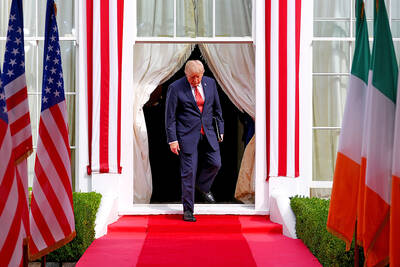
FROSTY RECEPTION: ‘I conveyed the strong view of the Irish people that the normalization of war and genocide can never be accepted,’ the Irish president said US President Donald Trump on Saturday said that he would “love to see” a united Ireland, wading into a politically sensitive subject as he embarked on a two-day Irish visit that blurs the lines between his presidency and personal business interests. After meeting Irish Prime Minister Micheal Martin in Dublin, Trump said reunification of the Republic of Ireland and Northern Ireland — split for more than a century — would be “a fantastic thing.” “It’s going to happen eventually. It may as well happen now,” he told reporters, adding that “the UK will have something to say about it, obviously.”
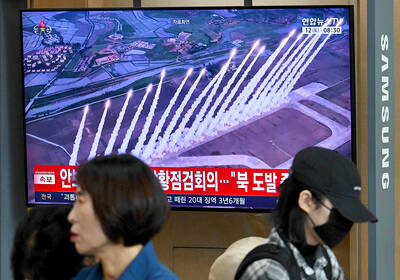
North Korea yesterday fired multiple ballistic missiles, Seoul said, a day after South Korea concluded five days of joint maritime drills with the US and Japan that were focused on the North. Pyongyang last month slammed plans for the so-called Freedom Edge joint exercises in international waters off South Korea as a “threat” to North Korea and other countries of the region. Yesterday, Seoul’s military detected “multiple short-range ballistic missiles launched from the Wonsan area toward the East Sea [the Sea of Japan],” the South Korean Joint Chiefs of Staff said in a statement. The missiles were detected at about


 RSS
RSS