


Iraqis from Nashville to London took part in their country's first democratic election in half a century, determined to shape the future of their homeland and praying for an end to the insurgency.
On the second day of voting for expatriates, Iraqis in the US drove hundreds of kilometers Saturday to reach the five cities with polling places: Nashville, Detroit, Chicago, Los Angeles and Washington.
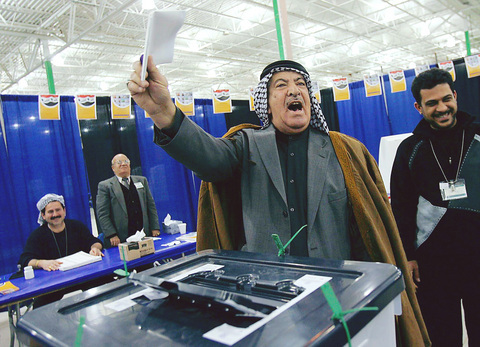
PHOTO: EPA
According to the International Organization for Migration, the Geneva-based body conducting the expatriate vote, 5,643 Iraqis voted on the first day of the Jan. 28-30 ballot in the US, about 22 percent of the total that registered.
Tens of thousands more are expected to vote in 13 other countries during balloting that ran through yesterday, the same day as elections in Iraq for the 275-member assembly that will draft Iraq's new constitution.
In Nashville, home to the largest Kurdish community in the US, about 20 Kurds celebrated by dancing and waving flags in the rain.
"It is celebration because for the first time they taste the freedom of this country," said George Khamou, of Little Rock, Arkansas, who watched the dancers. "This is really a big celebration for all of us here -- the Kurdish, the Arabs, the Christians, everybody. All we say now is all of us are Iraqis, because we are all the same."
Voters had their right index finger dipped in ink as a safeguard against voting fraud, then dropped paper ballots into boxes. To be eligible, voters must be born in Iraq or have an Iraqi father, and have turned 18 on or before Dec. 31 last year.
One busload of about 50 Iraqis traveled 835km from Lincoln, Nebraska, to cast their ballots Saturday in the Chicago area.
Arkan al-Hasnawi, 33, of LaCrosse, Wisconsin, has spent the last two weeks in Nashville staying with his family and brother Thaban, 38.
"It's a long time we've been waiting for vote," Arkan al-Hasnawi said. "Everybody is excited to vote, everybody should get that chance -- to vote for a new Iraq."
In Norway, a fleet of buses transporting about 4,000 Iraqis left Oslo bound for polling stations in Goteborg in southern Sweden, 320km away. More than 31,000 others living in Sweden also have registered to vote.
In Denmark, the line for the polling station in the Copenhagen suburb of Taastrup stretched for 700m, despite freezing temperatures. About 4,000 Iraqis voted in Denmark on Friday and another 5,000 cast ballots Saturday, organizers said.
Violence marred the voting at a polling station in Sydney, Australia. Protesters, identified by ballot organizers as Wahhabis -- followers of an austere brand of Sunni Islam suspected of having influence over militants in Iraq -- yelled insults at voters.
Some 50 people fought and scuffled after the protesters began taking photographs of the poll, being conducted in a neighborhood dominated by Iraqi Shiites, organizers said, forcing the polling station to close for an hour.
Many of Australia's estimated 80,000 Iraqis declined to register for the election, fearing that their votes would make relatives in Iraq terrorist targets.
People in other countries complained of low turnout. Less than a quarter of the estimated 1.2 million expatriate Iraqis eligible to vote worldwide had registered by the second day of the poll.
"It is a shame, for me it is very depressing," said Hashim Ali of the Iraqi Community Association in Britain, where 30,961 of the estimated 150,000 Iraqis eligible to vote had registered. "These are great days for Iraqi people. I feel let down by the Iraqi community in the UK."

Through the noise of rushing papers and whirring belts at a print factory in Kyoto, two creators watch their photo essay come to life in broadsheet form — part of an effort to win new audiences in the age of artificial intelligence (AI). Despite the decline of the publishing industry, self-publication and handmade “zine” magazines are growing in popularity in Japan, reflecting the nation’s enduring love of paper in the digital era. While speaking to Agence France-Presse at the plant, his hands black with ink, one of the creators, Kazuma Obara, said: “I think [paper] is a medium that engages all five

‘CROSSING THE LINE’: China’s embassy in Seoul criticized US Forces Korea Commander General Xavier Brunson, asking if his ‘hostile’ remarks were authorized by Washington South Korea and the US are in talks over recent public remarks by the commander of US Forces Korea, Seoul’s presidential office said yesterday, after the comments drew sharp criticism from China. In a recent podcast interview, US Forces Korea Commander General Xavier Brunson described South Korea as “the dagger in the heart of Asia” from China’s east coast, prompting the Chinese embassy in Seoul to say that he had “truly crossed the line.” The interview came amid growing speculation that Washington might seek to expand the role of US Forces Korea in countering the growing regional influence of China, a key

Australian researchers have trained lab-grown brain cells on a silicon computer chip to play the 1990s shooter game Doom and said they are just scratching the surface of what the neurons could be capable of doing. It is the science-fiction work of biotech boffins at Cortical Labs, who researched and developed the technology that harnesses the workings of the brain’s networking system. Each so-called “biological computer” contains about 200,000 living human brain cells, grown from stem cells that were harvested from blood donations. Having mastered the simple computer game Pong, where a paddle is moved up and down to send a ball

France experienced its hottest spring on record, the French weather service said on Tuesday, after an exceptional early heat wave that also broke highs for the season in England and Wales. Meteo-France said the average nationwide temperature over March to May was 13.8°C — about 1.7°C above the norm, and surpassing records set in 2011 and 2020. “The warmest spring since records began in 1900,” it said in a bulletin. All three months were warmer than average, but the onset of an “unprecedented heatwave” late last month pushed the mercury to highs typically seen at the height of the summer. “Our country had never


 RSS
RSS