


Israeli Prime Minister Ariel Sharon said yesterday he is "very satisfied" with Mahmoud Abbas' efforts to restore calm and that he is eager to resume negotiations with the Palestinian leader.
But in a small snag, the deployment of Palestinian police in southern Gaza, initially set for yesterday, was postponed for technical reasons, Israeli military officials said.
The deployment will take place today, a senior Palestinian security official said, while police trained in the Khan Younis refugee camp.
Despite the delay, optimism was running relatively high after Israeli and Palestinian officials held their first round of diplomatic talks Wednesday, and the sides looked toward the possibility of a Sharon-Abbas summit in the next two weeks.
"There is no doubt Abu Mazen has started to work," Sharon was quoted as saying in the Israeli newspaper Yediot Ahronot. Abbas is widely known as Abu Mazen.
"I am very satisfied with what I am hearing is happening on the Palestinian side and I am very interested in advancing processes with him," he said.
Meanwhile, in a race that pits Abbas' ruling Fatah party against his popular rival, the Islamic Hamas group, Palestinian voters in 10 Gaza towns began choosing mayors and councils in the first such election since 1976.
The Gaza vote follows a Dec. 23 election in 26 West Bank towns and villages, and a Jan. 9 presidential race in which Abbas was chosen to succeed Yasser Arafat, who died Nov. 11.
Hamas made a strong showing in the West Bank race -- taking over many councils from Fatah -- and was also expected to do well in Gaza, where the militant group is popular.
Hamas has recently shifted its focus toward politics, and agreed to halt its attacks, at least temporarily.
The developments signaled the possibility of a new era of relations between Israel and the Palestinians and among Palestinians themselves.
In the Yediot interview, Sharon said he would not stop all Israeli military operations for the time being, but would make gestures toward the new Palestinian leader. He did not elaborate.
"I intend to advance the chance for an opportunity for an agreement with the Palestinians, I intend to make gestures toward Abu Mazen and at the same time keep my eyes open and examine the situation on their side," Sharon said.
Israeli and Palestinian security officials met in Gaza twice on Wednesday to arrange the deployment in southern Gaza, which one Israeli government official called "complicated."
The official estimated it would take at least a week for Palestinian forces to deploy in the coastal area that has been one of the most volatile since fighting erupted in Sept. 2000.
In the southern Gaza town of Khan Younis, three police jeeps carrying armed police officers in full uniform drove down the main street.
Roadblock
The police trained for the deployment, setting up a roadblock on a main road, while a commander instructed them on how to conduct security checks.
Nearby, at another checkpoint, a Palestinian bulldozer cleared rubble so policemen would be able to take up their positions today.
The security commanders are ensuring the police know where they are to be posted and what their orders are ahead of the deployment, a senior security official said on condition of anonymity.
Palestinian police officers deployed in the northern Gaza Strip last Friday, leading to a halt in rocket fire on Israeli border towns.
This was an issue that led Israeli officials to consider conducting a broad military operation in the area.
In the first high-level diplomatic meeting in months, Israeli and Palestinian officials met Wednesday to discuss the terms for a Sharon-Abbas summit, a meeting that would signal another breakthrough in relations.
"These talks are promising in all aspects," Abbas said after the meeting.
Sharon aide Dov Weisglass and Palestinian Cabinet minister Saeb Erekat met in Jerusalem for two hours and agreed to hold another meeting next week.
Palestinian official Hassan Abu Libdeh, who attended the meeting, said a summit could be held within two weeks.
Sharon spokesman Raanan Gissin confirmed a summit is planned but said "our main concern is security -- that the Palestinians continue to take additional steps to end the violence, terrorism and incitement."
Summit Agenda
Palestinians want the summit agenda to focus on other issues, such as the release of Palestinian prisoners and stopping construction of the separation barrier Israel is building in the West Bank.
In a sign of renewed US involvement in the region, senior US envoy William Burns arrived in Ramallah yesterday to meet Abbas and Palestinian Prime Minister Ahmed Qureia.
Israeli media reported Burns would also meet Sharon later yesterday.
Burns met Wednesday with Israeli Vice Premier Shimon Peres. Although optimism is running high, the current lull in violence is fragile.
On Wednesday, Abbas expressed concern about an Israeli arrest raid in the West Bank town of Qalqiliya, where the army shot three men it said were wanted militants. Maher Abu Sneineh, 24, was killed and two were seriously wounded.
"They know that we are fully committed to calming things down and they have to be responsible," Abbas said. "They have to stop these operations so as not to ruin our efforts."
Martyrs' Brigade
In Gaza, masked Palestinians who said they represented the Al Aqsa Martyrs' Brigades threatened to renew attacks if Israel does not stop such operations within 24 hours.
Security officials said Abu Sneineh was planning a suicide bombing attack in which a female bomber would blow herself up in the Israeli city of Kfar Saba.

‘IN A DIFFERENT PLACE’: The envoy first visited Shanghai, where he attended a Chinese basketball playoff match, and is to meet top officials in Beijing tomorrow US Secretary of State Antony Blinken yesterday arrived in China on his second visit in a year as the US ramps up pressure on its rival over its support for Russia while also seeking to manage tensions with Beijing. The US diplomat tomorrow is to meet China’s top brass in Beijing, where he is also expected to plead for restraint as Taiwan inaugurates president-elect William Lai (賴清德), and to raise US concerns on Chinese trade practices. However, Blinken is also seeking to stabilize ties, with tensions between the world’s two largest economies easing since his previous visit in June last year. At the
Nearly half of China’s major cities are suffering “moderate to severe” levels of subsidence, putting millions of people at risk of flooding, especially as sea levels rise, according to a study of nationwide satellite data released yesterday. The authors of the paper, published by the journal Science, found that 45 percent of China’s urban land was sinking faster than 3mm per year, with 16 percent at more than 10mm per year, driven not only by declining water tables, but also the sheer weight of the built environment. With China’s urban population already in excess of 900 million people, “even a small portion

UNSETTLING IMAGES: The scene took place in front of TV crews covering the Trump trial, with a CNN anchor calling it an ‘emotional and unbelievably disturbing moment’ A man who doused himself in an accelerant and set himself on fire outside the courthouse where former US president Donald Trump is on trial has died, police said yesterday. The New York City Police Department (NYPD) said the man was declared dead by staff at an area hospital. The man was in Collect Pond Park at about 1:30pm on Friday when he took out pamphlets espousing conspiracy theories, tossed them around, then doused himself in an accelerant and set himself on fire, officials and witnesses said. A large number of police officers were nearby when it happened. Some officers and bystanders rushed
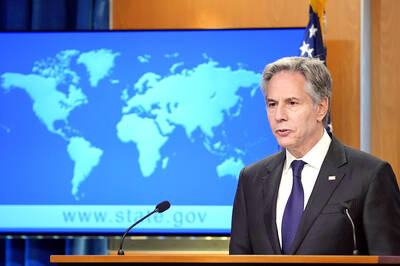
Beijing is continuing to commit genocide and crimes against humanity against Uyghurs and other Muslim minorities in its western Xinjiang province, U.S. Secretary of State Antony Blinken said in a report published on Monday, ahead of his planned visit to China this week. The State Department’s annual human rights report, which documents abuses recorded all over the world during the previous calendar year, repeated language from previous years on the treatment of Muslims in Xinjiang, but the publication raises the issue ahead of delicate talks, including on the war in Ukraine and global trade, between the top U.S. diplomat and Chinese


 RSS
RSS