


It was a memorial service that organizers hoped would be the perfect tribute to Zhao Ziyang, the former leader of China's Communist Party who died last week in Beijing.
In the corridor outside were grainy photos of Zhao with the likes of Deng Xiaoping and Henry Kissinger. There, in the overflow audience of more than 200 mourners, sat Li Lu and Liu Gang, two of the top student leaders during the Tiananmen Square demonstrations in 1989.
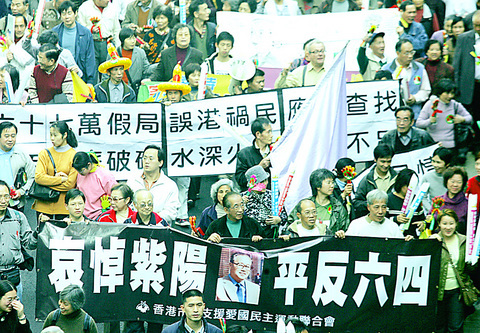
PHOTO: AFP
And there, too, were some of Zhao's former advisers, delivering testimonials in Mandarin about Zhao's commitment to economic and political reform.
It was the perfect tribute, perhaps, but for the location: the basement of a hotel in Flushing, Queens, rather than a huge square or grand hall in Beijing.
Zhao died last Monday at the age of 85, 15 years after he was purged and placed under house arrest on the orders of Deng for publicly supporting pro-democracy student protesters in Tiananmen Square.
He had been prime minister, general secretary of the Communist Party and a principal architect of the economic changes that transformed China in the 1980s.
Yet his death was barely mentioned by the official press.
Only in recent days has the Chinese government decided to conduct a low-profile funeral service, not the pomp of a full state memorial service usually expected to honor top officials.
Some Chinese are using memorial services outside the country as a substitute for expressing both their admiration for Zhao and their frustration with how political reform has lagged far behind economic reform.
And in the Western hemisphere, no memorial has had as many faces from China's turbulent political past, arguably, as the one that was conducted Friday at the Sheraton La Guardia East hotel in Flushing.
It was, on one hand, a reunion of sorts for some of China's leading intellectuals and dissidents who now live in the US.
But since many young Chinese have scant memories of Tiananmen and Zhao, the reunion may have also been a little bittersweet; the last chance for these dissidents to come together in so public, so political and so visceral a way.
"He's probably the only person you can call a national hero since 1949," said Li, a student leader who escaped China after the troops crushed the protesters, and now is a venture capitalist in Manhattan.
"We have to immortalize him if the nation has any hope of any revitalization," Li said.
Those dissidents who have made their way to America are now doing a variety of things, from pursuing doctorates in political science (like Wang Juntao, a former adviser to Zhao who is now at Columbia) to running businesses (like Gao Han, a writer who now owns an ice cream store in Bayside, Queens).
But many still communicate and follow the latest pro-democracy murmurings from China.
In fact, many "are still obsessed with political reform and want to keep the memory alive," said Merle Goldman, a research associate at Harvard's Fairbank Center for East Asian Research, and author of the coming book, From Comrade to Citizen: The Struggle for Political Rights in China.
So when Zhao died, the response among Chinese living abroad was immediate and dramatic.
Gao, for one, quickly set up a Web site in honor of Zhao (http://crdea.net/zzy) that has so far drawn more than 23,000 visitors who have contributed 4,000 testimonials.
About 60 percent of those visitors are from Hong Kong, while 20 percent are from the US and 10 percent are from China, Gao said.
Word spread quickly, as well, about Saturday's memorial, both through the Chinese-language news media in New York and the Internet.
And despite the snowstorm blanketing the city, the service attracted a standing-room-only crowd.
Sometimes, tensions flared. At one point, a woman who was trying to tell the mourners to take their seats confronted a man who she thought was an agent of the Chinese government sent to report on the proceedings.
"I know you are with the public security bureau! I can tell!" she said.
With the exception of Councilman John Liu of Queens, who made his remarks in English, the tributes were in Mandarin and often referred to the Tiananmen uprising.
And most of the speakers were older intellectuals like Yan Jiaqi and Chen Yizi, who either were advisers to Zhao or have long been associated with the democracy movement.
But there were also a few who said that they were from Taiwan, and admired Zhao, too.
For all the statements made during the service, and at a news conference afterwards, perhaps the most eloquent tribute to Zhao was on display at the front of the room.
Garlands of flowers draped a black-and-white photo of Zhao.
Next to the portrait was a simple Chinese idiom, Gao feng liang jie, which is used to describe an exemplary person who is believed to be noble, decent and principled, an aphorism that Chen, an economist, repeated in his remarks.
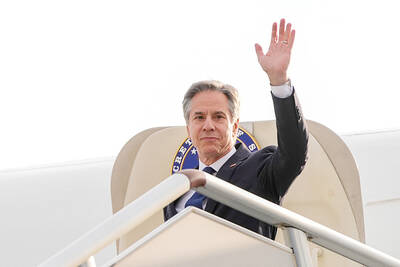
‘IN A DIFFERENT PLACE’: The envoy first visited Shanghai, where he attended a Chinese basketball playoff match, and is to meet top officials in Beijing tomorrow US Secretary of State Antony Blinken yesterday arrived in China on his second visit in a year as the US ramps up pressure on its rival over its support for Russia while also seeking to manage tensions with Beijing. The US diplomat tomorrow is to meet China’s top brass in Beijing, where he is also expected to plead for restraint as Taiwan inaugurates president-elect William Lai (賴清德), and to raise US concerns on Chinese trade practices. However, Blinken is also seeking to stabilize ties, with tensions between the world’s two largest economies easing since his previous visit in June last year. At the
Nearly half of China’s major cities are suffering “moderate to severe” levels of subsidence, putting millions of people at risk of flooding, especially as sea levels rise, according to a study of nationwide satellite data released yesterday. The authors of the paper, published by the journal Science, found that 45 percent of China’s urban land was sinking faster than 3mm per year, with 16 percent at more than 10mm per year, driven not only by declining water tables, but also the sheer weight of the built environment. With China’s urban population already in excess of 900 million people, “even a small portion

UNSETTLING IMAGES: The scene took place in front of TV crews covering the Trump trial, with a CNN anchor calling it an ‘emotional and unbelievably disturbing moment’ A man who doused himself in an accelerant and set himself on fire outside the courthouse where former US president Donald Trump is on trial has died, police said yesterday. The New York City Police Department (NYPD) said the man was declared dead by staff at an area hospital. The man was in Collect Pond Park at about 1:30pm on Friday when he took out pamphlets espousing conspiracy theories, tossed them around, then doused himself in an accelerant and set himself on fire, officials and witnesses said. A large number of police officers were nearby when it happened. Some officers and bystanders rushed

Beijing is continuing to commit genocide and crimes against humanity against Uyghurs and other Muslim minorities in its western Xinjiang province, U.S. Secretary of State Antony Blinken said in a report published on Monday, ahead of his planned visit to China this week. The State Department’s annual human rights report, which documents abuses recorded all over the world during the previous calendar year, repeated language from previous years on the treatment of Muslims in Xinjiang, but the publication raises the issue ahead of delicate talks, including on the war in Ukraine and global trade, between the top U.S. diplomat and Chinese


 RSS
RSS