


Nepal's government invoked anti-hoarding and price control laws to stem rises in food and fuel prices as a Maoist blockade of the capital entered a third day, state-run radio announced yesterday.
The indefinite blockade, to protest the disappearance of activists in army detention, halted most traffic on Kathmandu's main north and west arteries.
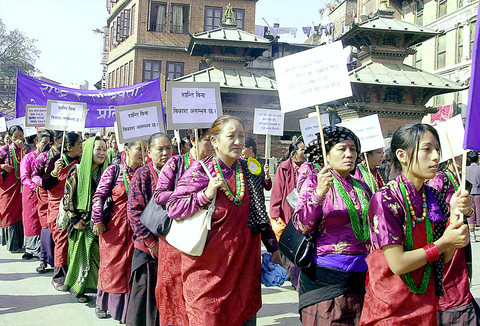
PHOTO: AFP
In response, the federal Cabinet late Friday appointed a 14-member committee, headed by the prime minister and including the finance and home ministers, to monitor food and fuel supplies at markets in the capital for the next two months to stem a growing black market, state-run radio said.
"The committee will make provisions of stocking up fuel and other essential items for at least two months and take records of supplies of those items in stock with businessmen," state-run radio said.
The capital region in the Kathmandu valley consists of three cities -- Kathmandu, Bhaktapur and Lalitpur -- with 1.5 million residents.
A third highway, the Mahendra which heads east from the capital to India, is partially blocked in southeastern Nepal, transport owners said, adding that most traffic to and from Kathmandu had been brought to a halt.
On Friday, two soldiers were killed and two injured while clearing mines planted to block the highway west of the capital, an army source said.
"The uncontrolled market has shot up consumer prices 25 to 70 percent within two days following the Maoist's blockade," said Nepal Consumer's Forum president Harendra Bahadur Shrestha.
Kathmandu residents facing their second rebel blockade in five months are hoarding food and oil in response, Shrestha said.
In August the Maoists staged a week-long blockade of the capital, spreading fear among the inhabitants and sending produce prices soaring.
"There is sufficient amount of food, petroleum products and other essential goods in stock for at least 10 weeks," Shrestha said.
The move by the rebels -- who are fighting to topple the monarchy and create a communist republic -- comes as King Gyanendra cancelled a scheduled 11-day visit to India on Thursday, citing the death of former Indian prime minister P.V. Narasimha Rao.
The government has set a Jan. 13 deadline for the Maoists to open negotiations. The king has said new elections would be held if they continued to resist talks.
Almost 450 people have been killed in insurgency-related violence in Nepal in the past three months, a human rights group said on Friday.
It has been the bloodiest period since the insurgency -- which has claimed more than 11,000 lives -- began in 1996, Subodh Pyakurel, president of the Informal Sector Service Center, said.
On Thursday UN Secretary General Kofi Annan called for an immediate end to the deadly fighting in Nepal and expressed concern at reports of human rights abuses.

South Korea’s air force yesterday apologized for a 2021 midair collision involving two fighter jets, a day after auditors said the pilots were taking selfies and filming during the flight and held them responsible for the accident. “We sincerely apologize to the public for the concern caused by the accident that occurred in 2021,” an air force spokesman told a news conference, adding that one of the pilots involved had been suspended from flying duties, received severe disciplinary action and has since left the military. The apology followed a report released on Wednesday by the South Korean Board of Audit and Inspection,

Indonesian police have arrested 13 people after shocking images of alleged abuse against small children at a daycare center went viral, sparking outrage across the nation, officials said on Monday. Police on Friday last week raided Little Aresha, a daycare center in Yogyakarta on Java island, following a report from a former employee. CCTV footage circulating on social media showed children, most younger than two, lying on the floor wearing only diapers, their hands and feet bound with rags. The police have confirmed that the footage is authentic. Police said they also found 20 children crammed into a room just 3m by 3m. “So

About 240 Indians claiming descent from a Biblical tribe landed at Tel Aviv airport on Thursday as part of a government operation to relocate them to Israel. The newcomers passed under a balloon arch in blue and white, the colors of the Israeli flag, as dozens of well-wishers welcomed them with a traditional Jewish song. They were the first “bnei Menashe” (“sons of Manasseh”) to arrive in Israel since the government in November last year announced funding for the immigration of about 6,000 members of the community from the states of Manipur and Mizoram in northeast India. The community claims to descend from

‘TROUBLING’: The firing of Phelan, who was an adviser to a nonprofit that supported the defense of Taiwan, was another example of ‘dysfunction’ under Trump, a US senator said US Secretary of the Navy John Phelan has been fired, a US official and a person familiar with the matter said on Wednesday, in another wartime shakeup at the Pentagon coming just weeks after US Secretary of Defense Pete Hegseth ousted the Army’s top general. The Pentagon announced his departure in a brief statement, saying he was leaving the administration “effective immediately,” but it did not provide a reason or say whether it was his decision to go. The sources, who spoke on condition of anonymity, said Phelan was dismissed in part because he was moving too slowly to implement reforms to


 RSS
RSS