


US military authorities said yesterday they had deployed new batteries of ground-to-air Patriot missiles in the southwestern city of Gwangju, a move that has triggered strong protests from activists there.
The deployment of two upgraded Patriot missile batteries in Gwangju, 187km southwest of Seoul, is part of a global redeployment program of US forces.
The 8th US Army had since late April been moving its 35th Air Defense Brigade from Fort Bliss, Texas and its two upgraded Patriot missile batteries to South Korea.
"The deployment of Patriot PAC-3 Air Defense Artillery Brigade was completed last week with the final load of equipment into Gwangju Air Base," the US Forces in Korea said in a statement.
The new missile brigade will be headquartered in the US air base at Osan, 35km south of Seoul, and its two missile batteries will be based in Gwangju.
The US forces will also retain their six existing Patriot missile batteries -- PAC-1 or PAC-2 batteries -- in South Korea under the command of the new brigade, US command officials said.
The deployment of new missiles has met angry protests from activists in Gwangju, formerly spelled Kwangju, and known for anti-US sentiment.
Activists and students in Gwangju have launched a campaign with a target to collect signatures from 100,000 people opposed to the missile deployment and have been holding rallies and street marches against the move.
The US Forces in Korea said in the statement the air defense brigade and Eighth US Army leadership "appreciate the cooperation of the Gwangju citizens" for the deployment.
"We also understand the need to be a good neighbor within the community and will work closely with the people of Gwangju to foster good communication, cultural awareness and mutual understanding," it said.
The deployment is part of Washington's force improvement program aimed to compensate for its plan to redeploy its forces in South Korea, under which one third of its 37,500 troops in the country will be pulled out in phases until September 2008.
The number of US troops to be withdrawn includes 3,600 already transferred to Iraq this year. The troops in Iraq will not return to South Korea.
The deployment of new missiles is part of an US$11 billion spending program aimed at compensating for the reduction in the number of troops, including high-speed vessels, attack helicopters and armored vehicles.
North Korea has angrily protested the missile deployment, claiming it is part of US preparations to launch a pre-emptive attack on the communist state.

A US YouTuber who caused outrage for filming himself kissing a statue commemorating Korean wartime sex slaves has been sentenced to six months in prison, a court in Seoul said yesterday. Johnny Somali, 25, gained notoriety several years ago for recording himself doing a series of provocative stunts in South Korea and Japan, and streaming them on platforms such as YouTube and Twitch. South Korean authorities indicted Somali — whose real name is Ramsey Khalid Ismael — in 2024 on public order violations and obstruction of business, and banned him from leaving the country. “The court has sentenced him to six months in
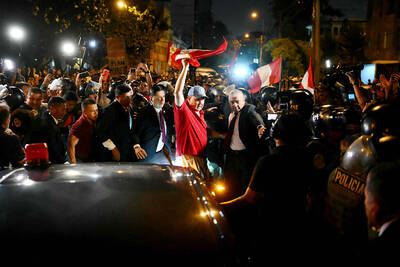
Former Lima mayor Rafael Lopez Aliaga, a Peruvian presidential hopeful, gathered hundreds of supporters in Lima on Tuesday and gave authorities 24 hours to annul the first round of the country’s election over allegations of fraud. Lopez Aliaga is locked in a tight three-way race with two other candidates for second place in Sunday’s vote. The election runner-up wins a ticket to June’s presidential run-off against front-runner Keiko Fujimori. “I am giving them 24 hours to declare this electoral fraud null and void,” said Lopez Aliaga, surrounded by a crowd of several hundred supporters. “If it is not declared null and void tomorrow,
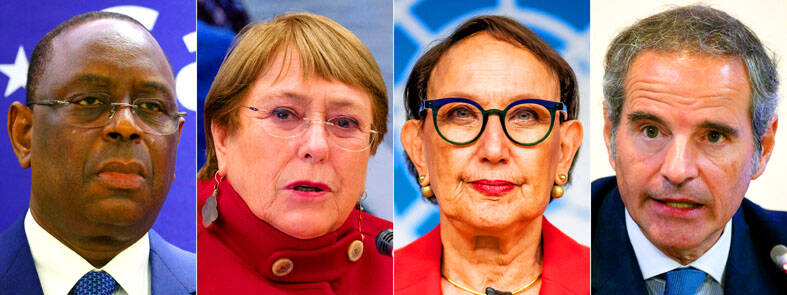
Four contenders are squaring up to succeed Antonio Guterres as secretary-general of the UN, which faces unprecedented global instability, wars and its own crushing budget crisis. Chile’s Michelle Bachelet, Argentina’s Rafael Grossi, Costa Rica’s Rebeca Grynspan and Senegal’s Macky Sall are each to face grillings by 193 member states and non-governmental organizations for three hours today and tomorrow. It is only the second time the UN has held a public question-and-answer, a format created in 2016 to boost transparency. Ultimately the five permanent members of the UN’s top body, the Security Council, hold the power, wielding vetoes over who leads the
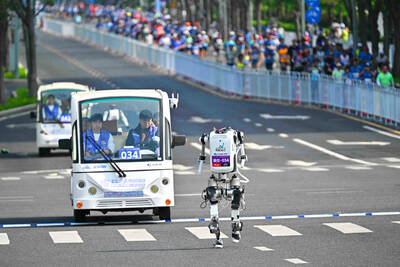
A humanoid robot that won a half-marathon race for robots in Beijing on Sunday ran faster than the human world record in a show of China’s technological leaps. The winner from Honor, a Chinese smartphone maker, completed the 21km race in 50 minutes and 26 seconds, said a WeChat post by the Beijing Economic-Technological Development Area, also known as Beijing E-Town, where the race began. That was faster than the human world record holder, Ugandan Jacob Kiplimo, who finished the same distance in about 57 minutes in March at the Lisbon road race. The performance by the robot marked a significant step forward


 RSS
RSS