


The man billed as Britain's answer to Oskar Schindler was finally honored by Britain on Wednesday, 60 years after he helped up to 10,000 Jews escape from Nazi Germany.
Frank Foley worked as an intelligence chief in the 1920s and 1930s at the British embassy in Berlin, where the current ambassador, Peter Torry, unveiled a plaque in his honor.
Publicly, Foley headed the embassy's visa section and had no diplomatic immunity. But secretly he was station chief in Germany for the forerunner of what is now British intelligence (MI6), gathering information on the Soviet Union and later Hitler's Nazi regime in the run-up to the second world war.
Once the pogroms against the Jews began in the early 1930s he "tore up the rule book", said Michael Smith, author of a book on Foley. He ignored strict regulations and issued thousands of visas to Jews trying to escape persecution. Smith says that the German authorities clearly knew who he was, "and it is a miracle that he still got away with as much as he did."
Ida Weiss, a 33-year-old Jewish woman, lived in Vienna but was refused a visa by the British embassy there. She traveled to Berlin after hearing a rumor that it was possible to get visas "under the counter."
"When she arrived in Berlin the queue of people waiting for visas completely encircled the Tiergarten office twice round," said her son Peter Weiss, a guest of honor at the unveiling ceremony.
Ida Weiss was penniless but Foley hid her in his home for three days while he got the paperwork, and bought her train ticket out.
"On the day she left for Belgium, Foley took her to the station to wave her off. The last thing he said to her was `God speed.' She never saw him again," Peter Weiss said.
After Foley's death in 1958. a grove of pine trees, each bought by a survivor, was dedicated to his memory in Israel, and in 1999 Israel awarded him the title "righteous amongst the gentiles," its highest honor for non-Jews.

Crowds in Bangladesh are flocking to snap photographs with an unlikely social media star — an albino buffalo with flowing blond hair nicknamed “Donald Trump” that is due to be sacrificed within days. Owner Zia Uddin Mridha, 38, said his brother named the 700kg bull over its flowing helmet of hair resembling the signature look of the US president. “My younger brother picked this name because of the buffalo’s extraordinary hair,” he said at his farm in Narayanganj, just outside the capital, Dhaka. Mridha said that a constant stream of curious visitors — social media fans, onlookers and children — have come throughout

The Bolivian government on Friday struck a deal with protesting miners, but was still grappling with blockades and demonstrations by other workers across La Paz. Other groups are still blocking access roads into the city, which is also the seat of the government. Police on Thursday prevented the miners from entering the main square by using tear gas, while the demonstrators hurled stones and explosives with slingshots. Protests against the policies of Bolivian President Rodrigo Paz have convulsed the Andean nation since early this month, and roadblocks were choking routes into La Paz throughout Friday, the national road authority said. Miners demanded that Paz
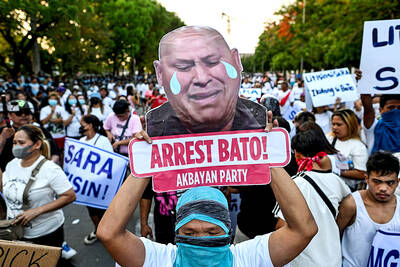
The Philippines said it has asked the country’s Supreme Court to allow it to arrest former Philippine president Rodrigo Duterte’s chief drug war enforcer to stand trial in an international tribunal. The International Criminal Court (ICC) last week unsealed an arrest warrant against Philippine Senator Ronald dela Rosa, accusing him along with Duterte and other “coperpetrators” of the “crime against humanity of murder.” Dela Rosa briefly sought refuge in the Philippine Senate last week while asking the Philippine Supreme Court to stop an ongoing attempt by government agents to arrest him. “By his own conduct, he has placed himself outside the protection of
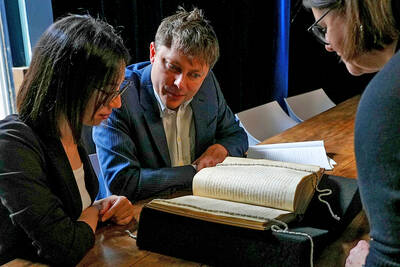
The researchers in Ireland looked at their computer screen, marveling at a medieval book tracked down in a Roman library. They flipped through its digitized pages and found their sought-after treasure: the oldest surviving English poem. “We were extremely surprised. We were speechless. We couldn’t believe our eyes when we first saw that,” said Elisabetta Magnanti, a visiting research fellow at Trinity College Dublin’s school of English. The poem was also within the main body of Latin text, she said, calling it “extraordinary.” Composed in Old English by a Northumbrian agricultural worker in the 7th century, Caedmon’s Hymn appears within some copies of


 RSS
RSS