


■ Australia
Sliding door stumps robbers
Three hooded bandits in eastern Australia bungled a robbery when they apparently mistook a restaurant's sliding door for a swinging one, police said yesterday. About 20 diners at Gabby's seafood restaurant in the coastal town of Gerringong watched as the trio repeatedly tried to kick the glass door open Saturday night, but they failed to enter and later fled in a stolen car. Restaurant owner Greg Moore said the door was unlocked -- and clearly marked "slide." These might not have been your average criminals, police investigator Jamie Williams warned. "They're probably more dangerous because they're dumb," Williams said.
■ China
At least 57 miners die in fire
At least 57 miners were dead and three missing following a massive blaze at a complex of iron mines in northern China, the government reported yesterday. Rescuers managed to pull 46 miners to safety, the State Administration for Work Safety said in a report on its Web site. The bodies of 49 were recovered, while the location of eight others had been pinpointed, the official Xinhua News Agency reported. The blaze broke out Saturday morning after an electronic cable caught fire inside a mine in Shahe, in northern China's Hebei Province, Xinhua said. The fire spread quickly to five connected mines, suffocating miners where they worked, while thick smoke slowed rescue efforts.
■ Japan
Six dead in latest suicides
Six people were found dead in two deserted cars over the weekend in Japan's latest group suicides, police said yesterday. A woman and two men in their 20s were found slumped over in a car parked outside an isolated forest in Fukuoka about 900km southwest of Tokyo, on Sunday. Several portable charcoal stoves were found on the floor of their car and the three were found to have died of carbon monoxide poisoning, said prefectural police spokesman Katsutoshi Mizuochi. The car windows were sealed shut with vinyl tape from the inside, he said. Investigators also found suicide notes from the three.
■ Philippines
Major detained for sex abuse
An army major has been detained after being caught on film sexually abusing cadets at a training camp in the northern Philippines, officials said yesterday. The alleged abuses by Major Ferdinand Ramos was exposed when a victim complained to a Manila television station and handed over a videotape to prove his accusations. The footage, aired over the weekend, showed Ramos forcing a military trainee to perform oral sex on him. Other frames showed Ramos performing oral sex on other recruits and trainees being forced to engage in sexual acts.
■ India
100 Hindus detained
Police detained about 100 hardline Hindus as they tried to stop traffic in western India yesterday after calling a nation-wide strike to protest against the arrest of a revered priest over the murder of a temple official. Security was tightened after members of the right-wing Vishwa Hindu Parishad (VHP) and Bajrang Dal threw stones and smashed bus windows in the state of Maharashtra, to demand the release of Jayendra Saraswathi, head of one of India's most powerful Hindu monasteries. "Our religious leader is innocent. We will continue to protest until he is set free," said Vynakatesh Abdeo, a senior leader of the VHP.
■ United States
Hunters killed over stand
A dispute among deer hunters over a tree stand in northwestern Wisconsin erupted in a series of shootings that left five people dead and three others injured. The incident happened when two hunters were returning to their cabin on private land in Sawyer County and saw the suspect in one of their tree stands, County Chief Deputy Tim Zeigle said. A confrontation and shooting followed. Both men were wounded and one of them radioed back to the cabin. Other hunters responded and were shot. The suspect was "sniping" at the victims with a SKS assault-style rifle, Zeigle said. The dead included four males, including a teenage boy, and a woman.
■ Greece
Alexander was gay? Never!
You can say what you like about a Greek hero -- just don't suggest he was gay. That's the message from a group of Greek lawyers who are threatening to sue director Oliver Stone over his portrayal of Alexander the Great as a battle-hardened fop frequently enjoying affairs with younger men. The lawyers have warned Warner Bros that they will take legal action if it is not made clear that the film is based on fiction. "We are not saying that we are against gays," said Yannis Varnakos, the lawyer leading the campaign. "But we are saying that the production company should make it clear that the film is pure fiction and not a true depiction of the life of Alexander." Some say the interpretation of Alexander as an active bisexual grossly misrepresents the ruler and that there is no historical evidence to suggest that the emperor was gay.
■ United States
Scientists in Grand Canyon
Scientists flooded the Grand Canyon to restore beaches and save fish and plants that have been disappearing since sediment-free water began flowing from a man-made dam 40 years ago. A torrent of gushing water raced down the Colorado River and into the canyon on Sunday, carrying badly needed natural sediment with it, as four giant steel tubes at the base of Glen Canyon dam were opened. "The sediment, sand, mud and silt play an important role in the ecosystem," said Chip Groat, director for the US Geological Survey.
■ Namibia
Ruling party retains majority
Namibia's ruling South West African People's Organization retained its two-thirds majority in the National Assembly on Sunday after a landslide victory in parliamentary and presidential elections. The party, known by its acronym SWAPO, won 76.06 percent of the votes in the Nov. 15 elections, giving it 55 of parliament's 72 seats, official results showed. The voting process was endorsed by the Southern African Devel-opment Community observer mission.
■ Germany
Officers tortured recruits
The German army has suspended 18 officers and non-commissioned officers for torturing recruits. Instruc-tors in Arab dress ambushed the recruits during an overnight march, bound their hands and feet with wire, covered their heads with hoods, and returned them to barracks in the back of an army truck. After making them kneel in the showers, the instructors sprayed them with water and applied electric shocks to the groin, neck and stomach of two of the men. The two men collapsed and were "psychologically broken", according to the weekly magazine Der Spiegel.
■ Dominica
One killed in strong quake
A strong earthquake rocked the Caribbean islands of Dominica and Guadeloupe early Sunday, killing at least one person and destroying numerous homes. A 3-year-old boy was crushed to death in Guadeloupe when a wall collapsed at his home in the southern coastal town of Trois-Rivieres, officials in the French overseas department said. Several houses were destroyed and others were damaged in Trois-Rivieres, Radio Caraibes reported. The temblor had a preliminary magnitude of 6.0, said John Minsch, a seismologist at the US National Earthquake Information Service in Golden, Colorado. The initial quake was followed by several aftershocks, including two with a 4.9 magnitude.
■ United States
Briton convicted of rapes
A British man wanted for allegedly raping women in England more than 12 years ago has been convicted of attacking two women in Portland, Oregon -- thanks in part to authorities and alleged victims who traveled across the Atlantic to testify. Paul Edward Capener, 42, who eluded law enforcement by using at least seven aliases, was convicted Nov. 11 of attempted rape, burglary and sexual abuse in Oregon. The district attorney's office paid for detectives and forensics experts from England, as well as four of his alleged victims, to fly to Oregon to testify about the British cases. If the jury decides Capener is a dangerous offender, he could face up to 150 years in prison.
■ Chile
Bush signs spending bill
US President George W. Bush signed a stopgap spending bill that keeps the US government running while Congress sorts out remaining issues related to a more permanent federal spending package. Congress on Saturday approved the temporary legislation, which finances almost every domes-tic federal department and agency plus foreign aid until Dec. 3. The last such short-term spending measure expired at midnight Saturday; the new one was flown to Santiago overnight by military plane so Bush could sign it yesterday. Bush was in Chile over the weekend, attending the APEC summit.
■ Saudi Arabia
Jihad call prompts lawsuit
The father of a young Saudi fighter who died in Fallujah, Iraq, is planning to sue religious scholars who called for jihad against the US-led occupation of Iraq, a Saudi newspaper reported on Sunday. Majid Shabib al-Otaibi was launching his legal action to make a stand against preachers who tried to "corrupt the minds of young men," al-Madina reported. Otaibi had given his son money for the journey, believing that he was going on a pilgrimage to Mecca, not to Iraq, the paper said. The Otaibi case follows a call by Sheikh Saleh al-Laheedan, the chairman of the Supreme Judiciary Council, for a clampdown on scholars who incite young people to fight in Iraq.
■ Bahrain
King pardons activist
A human-rights activist was jailed on Sunday for one year on a charge of inciting hatred against the government -- and then pardoned on the same day by King Hamad bin Issa al-Khalifa. Abdul Hadi al-Khawaja, vice president of the Bahrain Center for Human Rights, had been arrested in September after making remarks critical of the govern-ment's management of the economy and calling for the prime minister's resignation. Khawaja's trial and the closing of his organization on the grounds that its activities violated the kingdom's law raised international concern and prompted protests outside the court.

‘IN A DIFFERENT PLACE’: The envoy first visited Shanghai, where he attended a Chinese basketball playoff match, and is to meet top officials in Beijing tomorrow US Secretary of State Antony Blinken yesterday arrived in China on his second visit in a year as the US ramps up pressure on its rival over its support for Russia while also seeking to manage tensions with Beijing. The US diplomat tomorrow is to meet China’s top brass in Beijing, where he is also expected to plead for restraint as Taiwan inaugurates president-elect William Lai (賴清德), and to raise US concerns on Chinese trade practices. However, Blinken is also seeking to stabilize ties, with tensions between the world’s two largest economies easing since his previous visit in June last year. At the
Nearly half of China’s major cities are suffering “moderate to severe” levels of subsidence, putting millions of people at risk of flooding, especially as sea levels rise, according to a study of nationwide satellite data released yesterday. The authors of the paper, published by the journal Science, found that 45 percent of China’s urban land was sinking faster than 3mm per year, with 16 percent at more than 10mm per year, driven not only by declining water tables, but also the sheer weight of the built environment. With China’s urban population already in excess of 900 million people, “even a small portion

UNSETTLING IMAGES: The scene took place in front of TV crews covering the Trump trial, with a CNN anchor calling it an ‘emotional and unbelievably disturbing moment’ A man who doused himself in an accelerant and set himself on fire outside the courthouse where former US president Donald Trump is on trial has died, police said yesterday. The New York City Police Department (NYPD) said the man was declared dead by staff at an area hospital. The man was in Collect Pond Park at about 1:30pm on Friday when he took out pamphlets espousing conspiracy theories, tossed them around, then doused himself in an accelerant and set himself on fire, officials and witnesses said. A large number of police officers were nearby when it happened. Some officers and bystanders rushed
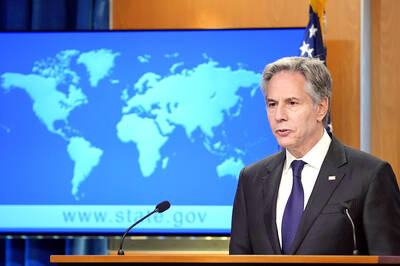
Beijing is continuing to commit genocide and crimes against humanity against Uyghurs and other Muslim minorities in its western Xinjiang province, U.S. Secretary of State Antony Blinken said in a report published on Monday, ahead of his planned visit to China this week. The State Department’s annual human rights report, which documents abuses recorded all over the world during the previous calendar year, repeated language from previous years on the treatment of Muslims in Xinjiang, but the publication raises the issue ahead of delicate talks, including on the war in Ukraine and global trade, between the top U.S. diplomat and Chinese


 RSS
RSS