


US and Afghan forces searching for three kidnapped UN workers smashed their way into downtown Kabul houses yesterday, officials and witnesses said.
About 10 people were detained in the pre-dawn operation, but there was no indication that the three foreigners had been found.
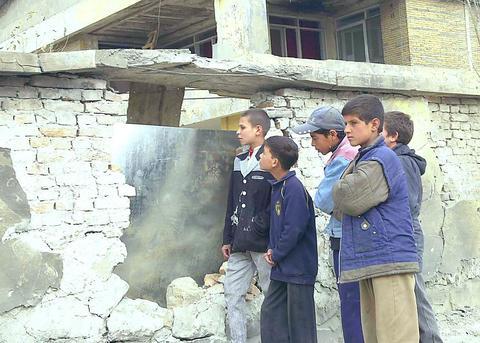
PHOTO: AP
A US military spokeswoman, Lieutenant Colonel Pamela Keeton, said the joint operation was "related to the hostage situation," but said she had no further details.
Security forces began the assault in the west of the city at about 4am, using rockets to blast a hole in a wall surrounding the two-story home of a doctor working for the UN, witnesses said.
The doctor, Munir Mosamem, and his 17-year-old son were detained, Mosamem's wife Zakia told The Associated Press.
The intruders searched the house and confiscated three mobile phones and part of a computer, she said.
UN spokesman Manoel de Almeida e Silva confirmed that a doctor with that name worked at a clinic for the world body in the city, but had no information about the raid.
Another eight men were detained in a derelict house next door where several impoverished families of recently returned refugees were living, witnesses said.
A woman who gave her name as Angoma, 28, said her husband was among the eight taken away with his hands bound and his head covered by a hood.
"They showed us pictures of the three hostages, two women and one man, and asked if we had seen them," she said. "I told them I recognized them from the television, but we don't know anything about them or where they are."
An elderly woman called Mabuba, sharing the doctor's house, also said she had been quizzed about the three.
"I told them no, and that we are very sad about this case," she said.
Armed men seized Philippine diplomat Angelito Nayan, British-Irish citizen Annetta Flanigan and Shqipe Hebibi of Kosovo in Kabul on Oct. 28, the first such abduction in the Afghan capital since the fall of the Taliban three years ago. It remains unclear where they are being held and by whom.
Afghan officials believe a criminal gang carried out the abductions and that negotiations have snagged over a ransom demand.
But it remains unclear if the kidnappers are working for a Taliban splinter group which has claimed responsibility and demanded that Afghan and US authorities free several prisoners.
The splinter group claims they are holding the three UN workers hostage, and said yesterday that the government was stalling negotiations while trying to search for the hostages, and warned the government not to play tricks.
Mullah Sabir Momin, a commander of the Jaish-e Muslimeen (Army of Muslims) Taliban splinter faction, said the government would be responsible for the fate of the hostages if it tried to deceive the kidnappers.
"The government is just trying to keep us busy with negotiations while at the same time searching for the hostages," Momin said by telephone from an undisclosed location.
"We want to tell the government, if they try to be clever during the negotiations, they will be responsible for any loss to the hostages," he said.

South Korea’s air force yesterday apologized for a 2021 midair collision involving two fighter jets, a day after auditors said the pilots were taking selfies and filming during the flight and held them responsible for the accident. “We sincerely apologize to the public for the concern caused by the accident that occurred in 2021,” an air force spokesman told a news conference, adding that one of the pilots involved had been suspended from flying duties, received severe disciplinary action and has since left the military. The apology followed a report released on Wednesday by the South Korean Board of Audit and Inspection,

Indonesian police have arrested 13 people after shocking images of alleged abuse against small children at a daycare center went viral, sparking outrage across the nation, officials said on Monday. Police on Friday last week raided Little Aresha, a daycare center in Yogyakarta on Java island, following a report from a former employee. CCTV footage circulating on social media showed children, most younger than two, lying on the floor wearing only diapers, their hands and feet bound with rags. The police have confirmed that the footage is authentic. Police said they also found 20 children crammed into a room just 3m by 3m. “So

About 240 Indians claiming descent from a Biblical tribe landed at Tel Aviv airport on Thursday as part of a government operation to relocate them to Israel. The newcomers passed under a balloon arch in blue and white, the colors of the Israeli flag, as dozens of well-wishers welcomed them with a traditional Jewish song. They were the first “bnei Menashe” (“sons of Manasseh”) to arrive in Israel since the government in November last year announced funding for the immigration of about 6,000 members of the community from the states of Manipur and Mizoram in northeast India. The community claims to descend from

‘TROUBLING’: The firing of Phelan, who was an adviser to a nonprofit that supported the defense of Taiwan, was another example of ‘dysfunction’ under Trump, a US senator said US Secretary of the Navy John Phelan has been fired, a US official and a person familiar with the matter said on Wednesday, in another wartime shakeup at the Pentagon coming just weeks after US Secretary of Defense Pete Hegseth ousted the Army’s top general. The Pentagon announced his departure in a brief statement, saying he was leaving the administration “effective immediately,” but it did not provide a reason or say whether it was his decision to go. The sources, who spoke on condition of anonymity, said Phelan was dismissed in part because he was moving too slowly to implement reforms to


 RSS
RSS