


Myanmar's ruling military junta has freed one of the country's best known, longest-imprisoned dissidents as part of a general release of almost 4,000 prisoners, a member of the dissident's family said yesterday.
Student activist Paw U Tun, who goes by the name Min Ko Naing, is one of several dozen political prisoners who believed to have been released since Thursday, when the junta said it was suspending the terms of 3,937 prisoners.
It said they had been wrongly charged by a state intelligence agency.
There was no indication, however, that Myanmar's most famous political prisoner -- Nobel Peace Prize laureate Aung San Suu Kyi -- would be freed from house arrest. She has been held since May last year.
However, unconfirmed reports said at least two dozen members of Suu Kyi's opposition National League for Democracy party have also been freed.
Min Ko Naing's family members said on condition of anonymity that he was with them in the capital, Yangon, after being released from a prison in the northwest. They gave no further details.
Min Ko Naing, 42, was a zoology student at a university in the capital when he became a charismatic leader of a 1988 popular uprising against military rule, in place since a 1962 coup.
After the military violently suppressed the 1988 pro-democracy demonstrations, he was arrested and sentenced to 20 years in jail for his political activities in Myanmar, also called Burma.
The sentence was later commuted to 10 years, but he was kept in detention under a law that allows imprisonment without charges or trial.
The US Campaign for Burma, a Washington-based group that lobbies for regime change in Myanmar, said Min Ko Naing's eyesight had deteriorated badly in prison and he had a slight fever, but was otherwise well when he returned to his family.
"Needless to say, it was a happy and tearful family reunion," said a statement from the group.
The release of another prominent prisoner, journalist Win Tin, was expected yesterday. The 74-year-old has been serving a 20-year sentence in Yangon after being jailed in July 1989.
UN Secretary-General Kofi Annan welcomed the announcement of the releases "and is encouraged by reports that a number of people detained for political activities are included among them," UN spokesman Fred Eckhard said in New York.
Freeing Myanmar's political prisoners is a major demand of the UN and Western countries critical of the junta's poor human rights record and its failure to hand power to Suu Kyi's party, which won a 1990 general election.
US State Department Deputy Spokesman Adam Ereli said Washington noted the failure to include some top dissidents, such as Suu Kyi, among those freed.
"We call upon the Burmese authorities to release these individuals and all political prisoners immediately and unconditionally," Ereli said.
British Foreign Office Minister Douglas Alexander also called for "freeing all the other political prisoners who languish in Burma's prisons."
State-run radio and television had announced on Thursday night that the prisoners had been wrongly charged by the former National Intelligence Bureau, dissolved by the junta last month.
The bureau had been headed by former Prime Minister General Khin Nyunt, who was ousted on Oct. 19 and has been accused of corruption and insubordination.
Khin Nyunt's removal was believed to have been orchestrated by hardline junta members.
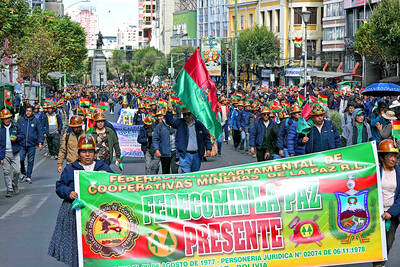
The Bolivian government on Friday struck a deal with protesting miners, but was still grappling with blockades and demonstrations by other workers across La Paz. Other groups are still blocking access roads into the city, which is also the seat of the government. Police on Thursday prevented the miners from entering the main square by using tear gas, while the demonstrators hurled stones and explosives with slingshots. Protests against the policies of Bolivian President Rodrigo Paz have convulsed the Andean nation since early this month, and roadblocks were choking routes into La Paz throughout Friday, the national road authority said. Miners demanded that Paz
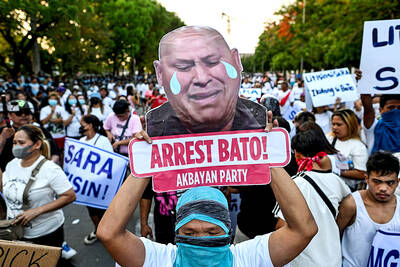
The Philippines said it has asked the country’s Supreme Court to allow it to arrest former Philippine president Rodrigo Duterte’s chief drug war enforcer to stand trial in an international tribunal. The International Criminal Court (ICC) last week unsealed an arrest warrant against Philippine Senator Ronald dela Rosa, accusing him along with Duterte and other “coperpetrators” of the “crime against humanity of murder.” Dela Rosa briefly sought refuge in the Philippine Senate last week while asking the Philippine Supreme Court to stop an ongoing attempt by government agents to arrest him. “By his own conduct, he has placed himself outside the protection of
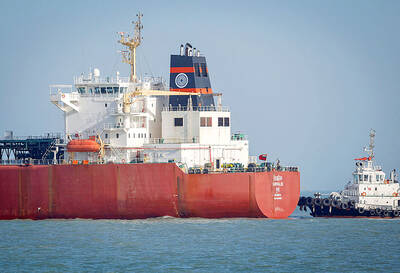
A ship anchored off the United Arab Emirates (UAE) was seized and taken toward Iran and another — a cargo ship near Oman — sank after being attacked, authorities said on Thursday, as tensions escalated near the Strait of Hormuz. It was not immediately clear who was behind these incidents, but they happened as a senior Iranian official reiterated his country’s claim of control over the waterway and another said it had a right to seize oil tankers connected to the US. The turmoil in the strait has been a sticking point for weeks in talks between the US and Iran to
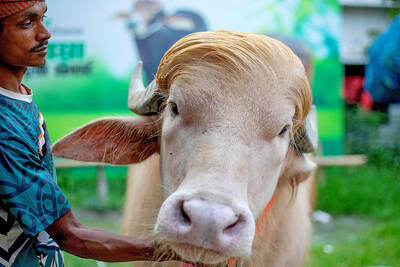
Crowds in Bangladesh are flocking to snap photographs with an unlikely social media star — an albino buffalo with flowing blond hair nicknamed “Donald Trump” that is due to be sacrificed within days. Owner Zia Uddin Mridha, 38, said his brother named the 700kg bull over its flowing helmet of hair resembling the signature look of the US president. “My younger brother picked this name because of the buffalo’s extraordinary hair,” he said at his farm in Narayanganj, just outside the capital, Dhaka. Mridha said that a constant stream of curious visitors — social media fans, onlookers and children — have come throughout


 RSS
RSS