


Japan said yesterday it wanted Russia to return all four Kuril islands, snubbing Moscow's renewed talk of returning two of them to end the dispute that has prevented the countries from formally ending World War II.
Prime Minister Junichiro Koizumi said "Japan cannot be content" with the return of two of the four islands just off northern Japan, which were seized by Soviet troops in 1945.
"We maintain the policy of concluding a peace treaty only after clarifying who owns the [all] four of the islands," Koizumi told reporters.
The government said Koizumi would raise the Kuril dispute with Russian President Vladimir Putin if they meet on the sidelines of a summit of the APEC forum in Chile this weekend.
Chief Cabinet Secretary Hiroyuki Hosoda said "Japan and Russia have a common policy" that they will conclude a peace treaty by resolving the status of all four islands. "We have not changed our stance of continuing strenuous negotiations in accordance with this policy," Hosoda, the top government spokesman, told a news conference.
Foreign Minister Nobutaka Machimura said it was not appropriate to react to each remark by Russian leaders over the dispute.
The renewed focus on the peace deal comes amid Japanese efforts to outbid China for a new oil pipeline from Siberia that could quench Asia's growing energy thirst.
The issue of the Kurils, whose Japanese residents were expelled after the Soviet takeover, has prevented the two nations from signing a post-war peace treaty and restricted Japanese investment in Russia. Putin said Monday he was ready to revive peace talks with Japan on the islands -- Habomai, Shikotan, Etorofu and Kunashiri.
"We have always implemented and will continue to implement our [Soviet era] obligations -- especially ratified documents -- but of course only to the extent to which our partners are ready to implement these very same agreements," Putin said in televised remarks.
His comments referred to a 1956 declaration signed between Moscow and Tokyo in which Japan would receive two of the four islands in exchange for signing a peace treaty.
Putin is due to visit Japan next year to commemorate the signing of the first treaty between Japan and tsarist Russia 150 years ago.
Koizumi has demonstrated his determination for Japan to resume control of the islands, sailing near Habomai in September after ignoring Russian warnings that the trip would hamper talks on a bilateral peace treaty.

When a hiker fell from a 55m waterfall in wild New Zealand bush, rescuers were forced to evacuate the badly hurt woman without her dog, which could not be found. After strangers raised thousands of dollars for a search, border collie Molly was flown to safety by a helicopter pilot who was determined to reunite the pet and the owner. A week earlier, an emergency rescue helicopter found the woman with bruises and lacerations after a fall at a rocky spot at the waterfall on the South Island’s West Coast. She was airlifted on March 24, but they were forced to

CONFIDENCE BOOSTER: ’After parkour ... you dare to do a lot of things that you think only young people can do,’ a 67-year-old parkour enthusiast said In a corner of suburban Singapore, Betty Boon vaults a guardrail, crawls underneath a slide, executes forward shoulder rolls and scales a steep slope, finishing the course to applause. “Good job,” the 69-year-old’s coach cheers. This is “geriatric parkour,” where about 20 retirees learned to tackle a series of relatively demanding exercises, building their agility and enjoying a sense of camaraderie. Boon, an upbeat grandmother, said learning parkour has aided her confidence and independence as she ages. “When you’re weak, you will be dependent on someone,” she said after sweating it out with her parkour classmates in suburban Toa Payoh,
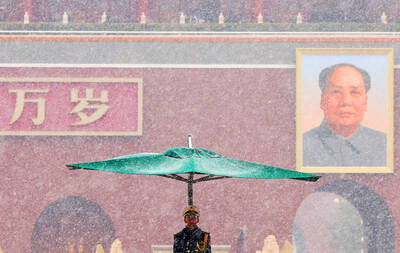
Chinese dissident artist Gao Zhen (高兟), famous for making provocative satirical sculptures of former Chinese leader Mao Zedong (毛澤東), was tried on Monday over accusations of “defaming national heroes and martyrs,” his wife and a rights group said. Gao, 69, who was detained in 2024 during a visit from the US, faces a maximum three-year prison sentence, said his wife, Zhao Yaliang (趙雅良), and Shane Yi, a researcher at the Chinese Human Rights Defenders group which operates outside the nation. The closed-door, one-day trial took place at Sanhe City People’s Court in Hebei Province neighboring the capital, Beijing, and ended without a

‘TOXIC CLIMATE’: ‘I don’t really recognize Labour anymore... The idea that you can implement far-right ideas in order to stop the far right is nonsense,’ a protester said Tens of thousands of people on Saturday marched through central London to protest against the far right, weeks ahead of local elections and six months after Britain saw one of its largest far-right demonstrations. Organized by hundreds of civic groups, including trade unions, anti-racism campaigners and Muslim representative bodies, Saturday’s Together Alliance event was billed as the biggest in UK history to counter right-wing extremism. A separate pro-Palestinian march had also converged with the main rally. While organizers claimed 500,000 had turned out in total, the police gave a figure of about 50,000. Protesters carrying placards with slogans such as


 RSS
RSS