


Incoming European Commission President Jose Manuel Barroso revamped his EU executive for parliamentary approval and proposed Italian Foreign Minister Franco Frattini as candidate for justice commissioner.
Dutch Prime Minister Jan-Peter Balkenende, who is chairing the EU summit, welcomed the changes and said they would go a long way toward soothing the objections which brought the 25-nation EU to the brink of an institutional crisis last week.
"Mr. Barroso has a good and balanced team," Balkenende said on Thursday.
Barroso said he would present his new team to European Parliament leaders yesterday, barely a week after the legislature forced him to back down and jettison embattled Italian candidate Rocco Buttiglione.
After hearings for the new candidates, Barroso is expected to put his team to a parliamentary vote during the session of Nov. 15.
"Now I am ready to go to parliament," Barroso told reporters. "I have made the necessary and sufficient changes ... I have worked hard over recent days to build bridges and find a balanced solution."
Balkenende said Barroso should be confirmed as soon as possible.
"Lets hope that Mr. Barroso can get quickly to work with his new team," he told reporters.
Barroso completed his reworked lineup, which also includes the shuffling of two other candidates, after Italian Prime Minister Silvio Berlusconi proposed, during an EU leaders summit, his foreign minister as Italy's new representative on the EU executive.
Frattini, who will also be a vice president on the new executive, replaces Buttiglione. The conservative Roman Catholic said during his confirmation hearings last month that homosexuality was "a sin" and later criticized single mothers.
Buttiglione's remarks and initial refusal to quit his nomination enraged EU lawmakers, and a majority of parties, including Socialists, Greens and Liberals, threatened to veto the new team.
Martin Schulz, the leader of the Socialist group in the European Parliament who led opposition to Barroso's team, welcomed the changes and told German daily Aachner Nachrichten, it was "a basis for good cooperation."
In other changes to his nominated lineup, Barroso said he would shuffle former Hungarian foreign minister, Laszlo Kovacs from energy to taxation and customs. He also accepted the new candidate from Latvia, former ambassador to the EU Andris Piebalgs, as a replacement for Ingrida Udre. And he said he would continue to back Dutchwoman Neelie Kroes, the candidate for the post of EU antitrust commissioner, who had come under criticism for her potential conflict of interest with major businesses.

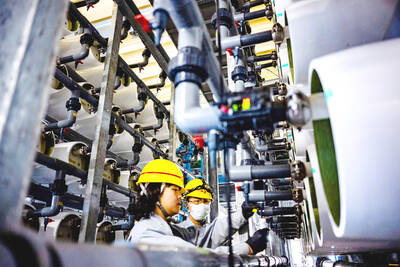
HIGH HOPES: The power source is expected to have a future, as it is not dependent on the weather or light, and could be useful for places with large desalination facilities A Japanese water plant is harnessing the natural process of osmosis to generate renewable energy that could one day become a common power source. The possibility of generating power from osmosis — when water molecules pass from a less salty solution to a more salty one — has long been known. However, actually generating energy from that has proved more complicated, in part due the difficulty of designing the membrane through which the molecules pass. Engineers in Fukuoka, Japan, and their private partners think they might have cracked it, and have opened what is only the world’s second osmotic power plant. It generates

When a hiker fell from a 55m waterfall in wild New Zealand bush, rescuers were forced to evacuate the badly hurt woman without her dog, which could not be found. After strangers raised thousands of dollars for a search, border collie Molly was flown to safety by a helicopter pilot who was determined to reunite the pet and the owner. A week earlier, an emergency rescue helicopter found the woman with bruises and lacerations after a fall at a rocky spot at the waterfall on the South Island’s West Coast. She was airlifted on March 24, but they were forced to
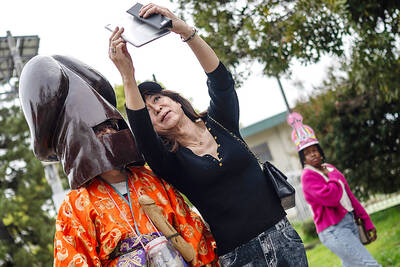
Showcasing phallus-shaped portable shrines and pink penis candies, Japan’s annual fertility festival yesterday teemed with tourists, couples and families elated by its open display of sex. The spring Kanamara Matsuri near Tokyo features colorfully dressed worshipers carrying a trio of giant phallic-shaped objects as they parade through the street with glee. The festival, as legend has it, honors a local blacksmith in the Edo Period (1603-1868) who forged an iron dildo to break the teeth of a sharp-toothed demon inhabiting a woman’s vagina that had been castrating young men on their wedding nights. A 1m black steel phallus sits in the courtyard of

JAN. 1 CLAUSE: As military service is voluntary, applications for permission to stay abroad for over three months for men up to age 45 must, in principle, be granted A little-noticed clause in sweeping changes to Germany’s military service policy has triggered an uproar after it emerged that the law requires men aged up to 45 to get permission from the armed forces before any significant stay abroad, even in peacetime. The legislation, which went into effect on Jan. 1 aims to bolster the military and demands all 18-year-old men fill out a questionnaire to gauge their suitability to serve in the armed forces, but stops short of conscription. If the “modernized” model fails to pull in enough recruits, parliament will be compelled to discuss the reintroduction of compulsory service, German


 RSS
RSS