


Iraqi interim Prime Minister Iyad Allawi sought to calm European anger yesterday over his description of states that opposed the US-led war to oust former president Saddam Hussein as "spectators."
But several EU leaders said his comment, on a visit to Rome on Thursday, were unhelpful ahead of a first meeting at which the 25-nation bloc is due to offer him a modest aid package as it seeks a fresh start after bitter divisions over Iraq.
"What I said is that history is history, past is past. We need to start operations, to start a new chapter and look to the future. We definitely want to forge a positive alliance with Europe," Allawi told reporters after a breakfast meeting with British Prime Minister Tony Blair in Brussels.
Luxembourg Prime Minister Jean-Claude Juncker, one of the European critics of the war, told reporters: "I don't like the expression `spectator states' at all. I don't understand it, and if I do understand it right, I don't like it at all."
Meanwhile, Dutch Foreign Minister Bernard Bot, whose country holds the EU's rotating presidency, denied that French President Jacques Chirac was boycotting the lunch because of bad relations with Baghdad.
"That has other reasons," he said when asked about Chirac's planned early departure from an EU summit, missing the Allawi lunch to fly to the United Arab Emirates to express condolences for the death on Tuesday of its founding leader, Sheikh Zayed bin Sultan al-Nahyan.
France managed to get a phrase explicitly welcoming Allawi deleted from the draft summit statement, diplomats said.
Instead the text said: "The European Council met Iraqi Prime Minister Allawi to discuss the situation in Iraq and reiterated its strong support for the political process in Iraq and the Iraqi interim government."
"I think that what we should do is look towards the future, forget about the past," Bot told reporters on arrival for the second day of the EU summit.
"What is very important is that we give off a signal that we are interested in Iraq, that we are willing to help to [re]construct the country," he said, underlining a newly-agreed EU package of financial and other support.
"It is a very positive package. What is important now is that we start this dialogue and continue it on the highest possible level. I have full confidence that we will have a good meeting today," he added.
The EU aid package is relatively small, consisting of 16.5 million euros (US$21 million) in financing for elections due in January, support for developing the justice system and help for a UN protection force for the elections.
The EU support for Allawi was meant to heal deep rifts within the bloc over the Iraq war and signal a new start in cooperation with the US after President George W. Bush's re-election on Tuesday.
In a draft statement seen by reporters, the EU leaders signalled their will to improve relations with Washington.
"The EU ... looks forward to working very closely with President Bush and his new administration to combine efforts, including in multilateral institutions, to promote the rule of law and create a just, democratic and secure world," the draft statement said.
On Thursday, some EU leaders expressed hope that the second Bush administration would give a fresh start to transatlantic ties and allow for progress in Iraq and across the Middle East.
But Blair rubbed salt in some European leaders' wounds in an interview with The Times published yesterday, saying some people were "in a sort of state of denial" about Bush's victory.
Both Allawi and Blair expressed their determination that the elections in January would go ahead despite persistent violence.
"It's absolutely crucial for the security of our own country that that [elections] happens," Blair told reporters.
"These people that are trying to create circumstances of chaos and instability in Iraq are doing so because of their fear of the democratic process," he said.
In the longer term, the 25-nation EU envisages extending preferential trade terms and preparing a trade and cooperation agreement which would formalize commercial links for the first time once Iraq has a constitution in 2006.

South Korea’s air force yesterday apologized for a 2021 midair collision involving two fighter jets, a day after auditors said the pilots were taking selfies and filming during the flight and held them responsible for the accident. “We sincerely apologize to the public for the concern caused by the accident that occurred in 2021,” an air force spokesman told a news conference, adding that one of the pilots involved had been suspended from flying duties, received severe disciplinary action and has since left the military. The apology followed a report released on Wednesday by the South Korean Board of Audit and Inspection,

Indonesian police have arrested 13 people after shocking images of alleged abuse against small children at a daycare center went viral, sparking outrage across the nation, officials said on Monday. Police on Friday last week raided Little Aresha, a daycare center in Yogyakarta on Java island, following a report from a former employee. CCTV footage circulating on social media showed children, most younger than two, lying on the floor wearing only diapers, their hands and feet bound with rags. The police have confirmed that the footage is authentic. Police said they also found 20 children crammed into a room just 3m by 3m. “So

About 240 Indians claiming descent from a Biblical tribe landed at Tel Aviv airport on Thursday as part of a government operation to relocate them to Israel. The newcomers passed under a balloon arch in blue and white, the colors of the Israeli flag, as dozens of well-wishers welcomed them with a traditional Jewish song. They were the first “bnei Menashe” (“sons of Manasseh”) to arrive in Israel since the government in November last year announced funding for the immigration of about 6,000 members of the community from the states of Manipur and Mizoram in northeast India. The community claims to descend from
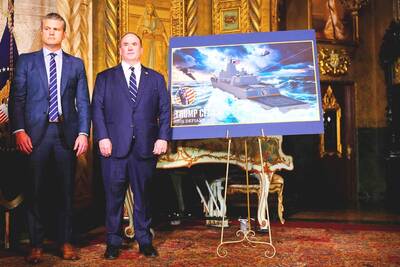
‘TROUBLING’: The firing of Phelan, who was an adviser to a nonprofit that supported the defense of Taiwan, was another example of ‘dysfunction’ under Trump, a US senator said US Secretary of the Navy John Phelan has been fired, a US official and a person familiar with the matter said on Wednesday, in another wartime shakeup at the Pentagon coming just weeks after US Secretary of Defense Pete Hegseth ousted the Army’s top general. The Pentagon announced his departure in a brief statement, saying he was leaving the administration “effective immediately,” but it did not provide a reason or say whether it was his decision to go. The sources, who spoke on condition of anonymity, said Phelan was dismissed in part because he was moving too slowly to implement reforms to


 RSS
RSS