

A strong earthquake yesterday shook an area in northern Japan still recovering from last month's magnitude-6.8 quake, the Meteorological Agency said. The latest tremor sent residents dashing under tables, and led to at least one injury.
A magnitude 5.2 jolt, an aftershock to last month's quake, struck at 8:57am and was centered about 20km below the earth's surface in a rural part of Niigata prefecture about 250km north of Tokyo.
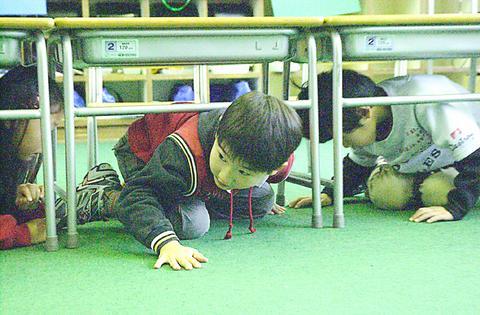
PHOTO: AP
The agency warned of the possibility of more strong quakes over the next month.
The Oct. 23 earthquake and several large aftershocks in the days that followed killed 38 people and injured over 2,000. It was the deadliest quake to hit Japan since 1995, when a magnitude 7.2 quake killed 6,000 people in the western city of Kobe.
On Thursday, city officials said a 40-year-old man, who was cooking at a market when the shaking began, suffered burns to his hand by a hot pan. Officials received reports of burst water pipes and minor landslides of rain-loosened topsoil.
Television footage showed telephone poles and trees swaying and buildings shuddering when the temblor struck. Inside Ojiya city hall, near the site of the worst destruction from last month's quake, officials holding a meeting grabbed their chairs or ducked below tables while the building shook.
Officials said the shaking automatically triggered safety devices that shut down a nuclear reactor at a power plant and temporarily cut electricity to express "bullet" trains in the area.
Tokyo Electric Power Co spokesman Motoyasu Tamachi said the nuclear plant in Kashiwazaki city was being inspected but that the shutdown had no impact on the outside environment.
The aftershock hit as many public schools in the area reopened for the first time since last month's quake.
Over 46,000 people remain in emergency shelters in Niigata on Wednesday because their homes were completely or partially destroyed in the quake. Many were also too afraid to go home as aftershocks continue, creating the risk their homes will be further damaged.
Japan, which rests atop several tectonic plates, is among the world's most earthquake-prone countries.
A magnitude 5 earthquake can cause damage to homes if it occurs in a residential area.

Philippine Secretary of National Defense Gilberto Teodoro Jr on Tuesday hit out at China at an international forum after a memo asserting Beijing’s position over their longstanding maritime dispute was delivered to him while he was speaking on stage. The unusual incident was captured on video at the Seoul Defense Dialogue as the secretary was responding to a question about “gray zone” coercion in the South China Sea. The video shows what appears to be a conference staffer placing it on the table next to him while speaking. “I have a note here, I think this is from China,” he said, describing
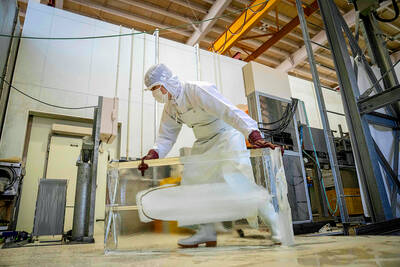
PAINSTAKING PROCESS: Ice makers freeze water for up to 72 hours, replace tainted water with a fresh batch once freezing begins, and are constantly stirring In the historic Japanese city of Kanazawa, craftsmen painstakingly shape and slice blocks of ice destined to chill negronis in some of the world’s trendiest bars. The men work for Kuramoto Ice, a century-old company in Ishikawa on the Sea of Japan coast and one of dozens of Japanese firms producing ultra-clear, premium ice. This luxury product, believed by those in the industry to melt more slowly than regular blocks, is a staple of Japan’s cocktail culture, but its popularity is also spilling over to bars abroad, from the US to Australia, who pay as much as ¥200 (US$1.28) per cube. Kuramoto Ice
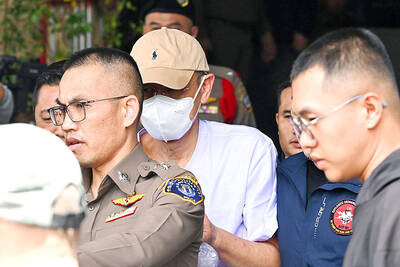
Thai police yesterday said that they arrested a senior Buddhist monk on suspicion of embezzling US$2.8 million intended for his monastery, alongside a suspected female accomplice he was having sex with. The case is the latest scandal to hit the clergy in Buddhist-majority Thailand after a sex and extortion case involving senior monks last year prompted public outrage and calls for greater scrutiny of temple finances. Phra Wachirayan Wi, the 66-year-old abbot of the 14th-century Wat Phutthaisawan in the ancient capital of Ayutthaya, was arrested on Thursday on charges including embezzlement and money laundering, lead police investigator Pattanasak Bupphasuwan said. A 47-year-old woman
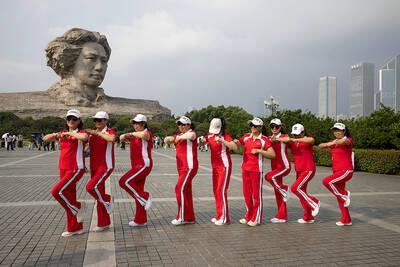
China yesterday marked half a century since the death of Mao Zedong (毛澤東), founder of the People’s Republic, who brought roughly one-quarter of the world’s population under communist rule and whose specter still haunts China’s future. Mao’s death on Sept. 9, 1976, at age 82, mourned by many and welcomed by some who suffered under his nearly three-decade rule, also hastened the end of the Cultural Revolution, a frenzied mass movement he launched in 1966. The party later condemned the Cultural Revolution as a grave error for which Mao bore primary responsibility, but still reveres him, saying his achievements outweigh his mistakes. Mao’s


 RSS
RSS