


British Prime Minister Tony Blair tried to bridge the trans-Atlantic rift over Iraq, urging a "fractured, divided and uncertain" world to unite in the wake of US President George W. Bush's election victory.
Blair, Bush's strongest international ally in the invasion of Iraq, congratulated the president on his re-election -- and tried to nudge him toward re-engaging with the stalled Middle East peace process.
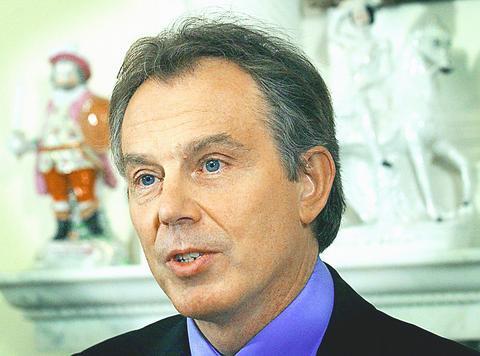
PHOTO: AP
Speaking on Wednesday at his 10 Downing Street office after talking to Bush by phone, Blair said working toward Israeli-Palestinian peace was "the single most pressing political challenge in our world today."
"Therefore we must be relentless in our war against terrorism and in resolving the conditions and causes on which the terrorists prey," Blair said. "We should work with President Bush on this agenda. It is one which all nations of goodwill would surely agree."
Those remarks appeared aimed at Britain's European neighbors, many of whom opposed the US-led invasion of Iraq and were wary of a second Bush presidency.
Bush's perceived unilateralism, his refusal to sign the Kyoto Protocol on global warming, his rejection of an international criminal court and the incarceration of detainees at the US military base in Guantanamo Bay, Cuba, also have also to his unpopularity among Europeans, including many Britons.
Blair said Bush's re-election "comes at a critical time. A world that is fractured, divided and uncertain must be brought together to fight this global terrorism in all its forms, and to recognize it will not be defeated by military might alone."
The unswerving loyalty of the centrist Blair to the right-wing Republican Bush has angered many Britons, especially among left-wing sections of the governing Labour Party. Many Britons believe Blair slavishly follows US foreign policy without exerting real influence, and he is frequently mocked as Washington's poodle.
Blair tried to dispel that image on Wednesday, painting the trans-Atlantic relationship as a two-way street. While pledging support for the US-led war on terror, Blair also stressed the importance of bringing democracy to Iraq, as in Afghanistan, and to fighting poverty and injustice in Africa and elsewhere in the world. And Blair called for renewed commitment to Israeli-Palestinian peace.
It is widely assumed in Britain that Blair backed Bush over Iraq in return for a pledge that Washington would push harder for peace in the Middle East.
The "road map" peace plan for Israel and the Palestinians put forward by Bush last year has largely stalled.
Blair said he "have long argued that the need to revitalize the Middle East peace process is the single most pressing political challenge in our world today."
Blair's remarks were echoed by Egyptian President Hosni Mubarak and German Chancellor Gerhard Schroeder, who appealed to the US to push for the "road map" plan.
After meeting with Mubarak in Bonn, Schroeder said peace efforts would go more smoothly with cooperation from Europe, Russia "and above all, the United States of America, so that this process can be implemented better."
Blair called on Europe and the US to "build anew their alliance" in the wake of Bush's victory.
"All of us in positions of leadership, not just President Bush, have a responsibility to rise to this challenge. It is urgent that we do so," Blair said.
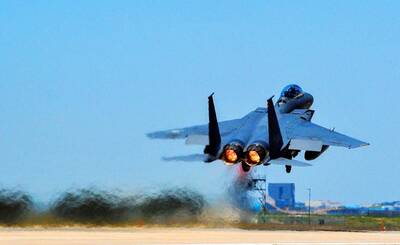
South Korea’s air force yesterday apologized for a 2021 midair collision involving two fighter jets, a day after auditors said the pilots were taking selfies and filming during the flight and held them responsible for the accident. “We sincerely apologize to the public for the concern caused by the accident that occurred in 2021,” an air force spokesman told a news conference, adding that one of the pilots involved had been suspended from flying duties, received severe disciplinary action and has since left the military. The apology followed a report released on Wednesday by the South Korean Board of Audit and Inspection,
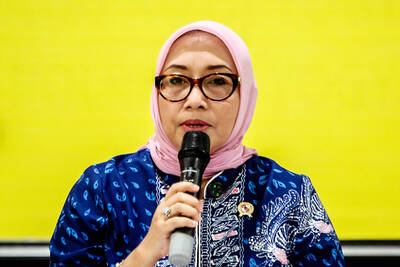
Indonesian police have arrested 13 people after shocking images of alleged abuse against small children at a daycare center went viral, sparking outrage across the nation, officials said on Monday. Police on Friday last week raided Little Aresha, a daycare center in Yogyakarta on Java island, following a report from a former employee. CCTV footage circulating on social media showed children, most younger than two, lying on the floor wearing only diapers, their hands and feet bound with rags. The police have confirmed that the footage is authentic. Police said they also found 20 children crammed into a room just 3m by 3m. “So
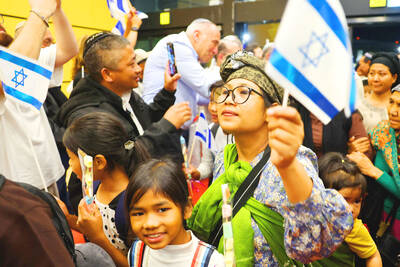
About 240 Indians claiming descent from a Biblical tribe landed at Tel Aviv airport on Thursday as part of a government operation to relocate them to Israel. The newcomers passed under a balloon arch in blue and white, the colors of the Israeli flag, as dozens of well-wishers welcomed them with a traditional Jewish song. They were the first “bnei Menashe” (“sons of Manasseh”) to arrive in Israel since the government in November last year announced funding for the immigration of about 6,000 members of the community from the states of Manipur and Mizoram in northeast India. The community claims to descend from
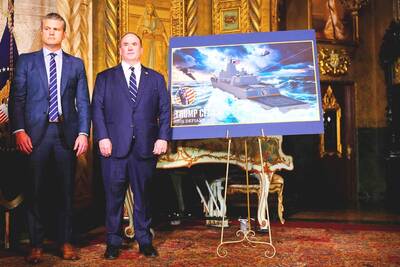
‘TROUBLING’: The firing of Phelan, who was an adviser to a nonprofit that supported the defense of Taiwan, was another example of ‘dysfunction’ under Trump, a US senator said US Secretary of the Navy John Phelan has been fired, a US official and a person familiar with the matter said on Wednesday, in another wartime shakeup at the Pentagon coming just weeks after US Secretary of Defense Pete Hegseth ousted the Army’s top general. The Pentagon announced his departure in a brief statement, saying he was leaving the administration “effective immediately,” but it did not provide a reason or say whether it was his decision to go. The sources, who spoke on condition of anonymity, said Phelan was dismissed in part because he was moving too slowly to implement reforms to


 RSS
RSS