


A furious Thai senator has punched his colleague in the face in the midst of a sitting session as tensions flared over who was to blame for the deaths in custody of 78 Muslims in the kingdom's south last week.
In the unprecedented scuffle, Bangkok senator General Pratin Santiprapob, a former national police chief, took a swing at his counterpart from Mae Hong Son province, Adul Wanchaithanawong, who had stormed from his seat towards him.
The brawl occurred as another senator from the capital, Chermsak Pinthong, a prominent critic of the government, released a booklet criticizing the military's handling of a protest last week that led to the 78 deaths.
Officials said the Muslims died after they were piled into military trucks for transport into custody on Oct. 25 following a demonstration at Tak Bai in Narathiwat. Chermsak claimed that he had traveled to the region to interview doctors over the deaths.
"This incident has hurt the reputation of the Senate," said Upper House Speaker Suchon Charlieklue. "I hope we're not going to turn into a Taiwanese parliament."
In the normally sedate senate, Adul interrupted Chermsak as he spoke on the podium to tell him he had spoken for long enough, prompting Pratin to leap to his defense and allude to "somebody" being a major drug trader.
Adul demanded that Pratin name who he was referring too, but Pratin sat silently. Then Adul leapt to his feet and walked towards Pratin, who stood up and made a double jab at Adul's face as stunned senators looked on.
"It was my instinct to defend myself because Adul looked threatening," the former police boss told reporters afterwards.
The meeting continued after Pratin was escorted from the chamber by security.
To lose one's temper in public in Thailand is seen as a serious loss of face, particularly for people in positions of respect.
Meanwhile, warnings that Muslim insurgents may try to abduct Buddhist teachers and students prompted most schools in the violence-wracked southern provinces to close yesterday, education officials said.
Education Minister Adisai Bodharamik said he had warned Buddhist teachers in the three Muslim-majority provinces they might be targets of attacks and hostage-taking by the militants.
An official in Narathiwat, speaking on condition of anonymity, said only 41 of the province's 351 schools remained open yesterday, a day after a Buddhist leader in the province was beheaded by suspected rebels.
Most schools in Yala province and some in Pattani were also shut, the official said.
Elsewhere in the south, a Buddhist rubber tapper was slashed to death and two other people were wounded by gunfire, with the incidents seen by officials as revenge for the deaths of 85 Muslim demonstrators last week.
The body of Nguan Neiwton, a Buddhist rubber tapper, was found late on Tuesday in a rubber plantation in Yala province, police Lieutenant Colonel Narin Boosaphan said. His head was brutally slashed by a machete, the officer said.
In the third province, Pattani, a gunman on the back seat of a motorcycle opened fire on Wichien Wonchan, a road construction worker, seriously wounding him in the back, police Lieutenant Suvit Phoosathit said. A road sweeper was also wounded by gunfire in a separate incident, Suvit said.
"The troubles in the south have come with the global realities of a more radical brand of Islam in some areas," Thai Prime Minister Thaksin Shinawatra told an economics conference in Singapore via videolink from Bangkok.
Thaksin said that last week's deaths "should never have happened," adding that it "was not the government's intention to shoot its own foot by creating an incident that would cause such great trouble for itself."

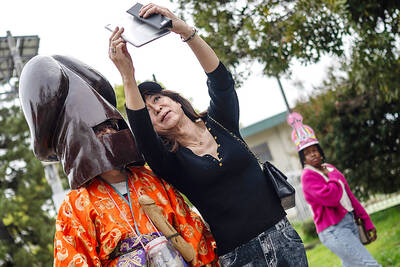
Showcasing phallus-shaped portable shrines and pink penis candies, Japan’s annual fertility festival yesterday teemed with tourists, couples and families elated by its open display of sex. The spring Kanamara Matsuri near Tokyo features colorfully dressed worshipers carrying a trio of giant phallic-shaped objects as they parade through the street with glee. The festival, as legend has it, honors a local blacksmith in the Edo Period (1603-1868) who forged an iron dildo to break the teeth of a sharp-toothed demon inhabiting a woman’s vagina that had been castrating young men on their wedding nights. A 1m black steel phallus sits in the courtyard of

HIGH HOPES: The power source is expected to have a future, as it is not dependent on the weather or light, and could be useful for places with large desalination facilities A Japanese water plant is harnessing the natural process of osmosis to generate renewable energy that could one day become a common power source. The possibility of generating power from osmosis — when water molecules pass from a less salty solution to a more salty one — has long been known. However, actually generating energy from that has proved more complicated, in part due the difficulty of designing the membrane through which the molecules pass. Engineers in Fukuoka, Japan, and their private partners think they might have cracked it, and have opened what is only the world’s second osmotic power plant. It generates

JAN. 1 CLAUSE: As military service is voluntary, applications for permission to stay abroad for over three months for men up to age 45 must, in principle, be granted A little-noticed clause in sweeping changes to Germany’s military service policy has triggered an uproar after it emerged that the law requires men aged up to 45 to get permission from the armed forces before any significant stay abroad, even in peacetime. The legislation, which went into effect on Jan. 1 aims to bolster the military and demands all 18-year-old men fill out a questionnaire to gauge their suitability to serve in the armed forces, but stops short of conscription. If the “modernized” model fails to pull in enough recruits, parliament will be compelled to discuss the reintroduction of compulsory service, German

Hundreds of Filipinos and tourists flocked to a sun-bleached field north of Manila yesterday, on Good Friday, to witness one of the country’s most blood-soaked displays of religious fervor, undeterred by rising fuel prices. Scores of bare-chested flagellants with covered faces walked barefoot through the dusty streets of Pampanga Province’s San Fernando as they flogged their backs with bamboo whips in the scorching heat. Agence France-Presse (AFP) journalists said they saw devotees deliberately puncturing their skin with glass shards attached to a small wooden paddle to ensure their bleeding during the ritual, a way to atone for sins and seek miracles from


 RSS
RSS