


Malaysia's most charismatic dissident Anwar Ibrahim -- released two months ago from jail -- kicked off his political comeback yesterday, vowing to restart a campaign for democratic reforms and racial equality.
"Don't think that just because Anwar Ibrahim is free, everything is settled," Anwar said in a speech to more than 1,000 supporters who gathered at his house to welcome him from his foreign trip.

PHOTO: AFP
"The release of Anwar is the beginning of a new chapter. In this chapter we must defend the fate of all people in Malaysia and ensure that our leaders are not arrogant and greedy," said the former deputy prime minister.
In a sign that the government was tightening the noose on his political comeback, police set up road blocks on all major roads to prevent Anwar supporters from going to the Kuala Lumpur International Airport where he arrived early yesterday after almost two months in Germany and Saudi Arabia. The government also refused to permit a welcome rally at a soccer stadium.
But an estimated 1,000 followers who managed to sneak past the blockade cheered loudly and chanted "Reformasi," the slogan of his political reform movement, as he slowly walked out of the terminal, holding the hand of his wife, Azizah Ismail.
"I am very happy to be back home. I will push forward my agenda for reform and work hard for the people," Anwar, 57, said, smiling broadly and wearing a garland of flowers someone had thrown around his neck.
Anwar, however, promised not to take to the streets as he did in 1998 after being fired from the government and the ruling United Malays National Organization party during a power struggle with then Prime Minister Mahathir Mohamad, his former mentor and longtime colleague.
Anwar was subsequently arrested, tried and sentenced to 15 years in jail on sodomy and corruption charges.
The sodomy charge was overturned by a court and he was freed from jail on Sept. 2 as he had already served his corruption conviction. He went to Germany on Sept. 4 for back surgery and later to Saudi Arabia on pilgrimage.
The corruption conviction means he cannot hold a public post until 2008 although he has been named special adviser to the opposition People's Justice Party that Anwar's wife started when he was in jail.
Anwar told his supporters at his house that he would seek out a meeting with Mahathir's successor, Prime Minister Abdullah Ahmad Badawi, who completed one year in office yesterday.
The meeting would be to discuss "a new approach in Malaysian politics with the agenda of change and reform," Anwar said, taking a conciliatory approach to his former colleagues turned political foes.
"Our struggle remains, our fight remains. My agenda is to bring change and reform," said Anwar. He praised Abdullah for initiating several democratic changes such as less interference in the judiciary and the press, but stressed that "our problems remain plenty."
"We want to create a Malaysia that truly stands for justice and goes beyond the interests of just one race or party. We will need the support of everyone," Anwar said, referring to the government's policy of giving special privileges to the Malays over Chinese and Indians.
He said his main concerns were the large gap between the rich and the poor, race relations and corruption. He also made it clear that he has no intention of joining UMNO.

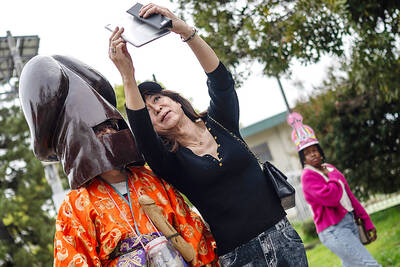
Showcasing phallus-shaped portable shrines and pink penis candies, Japan’s annual fertility festival yesterday teemed with tourists, couples and families elated by its open display of sex. The spring Kanamara Matsuri near Tokyo features colorfully dressed worshipers carrying a trio of giant phallic-shaped objects as they parade through the street with glee. The festival, as legend has it, honors a local blacksmith in the Edo Period (1603-1868) who forged an iron dildo to break the teeth of a sharp-toothed demon inhabiting a woman’s vagina that had been castrating young men on their wedding nights. A 1m black steel phallus sits in the courtyard of

HIGH HOPES: The power source is expected to have a future, as it is not dependent on the weather or light, and could be useful for places with large desalination facilities A Japanese water plant is harnessing the natural process of osmosis to generate renewable energy that could one day become a common power source. The possibility of generating power from osmosis — when water molecules pass from a less salty solution to a more salty one — has long been known. However, actually generating energy from that has proved more complicated, in part due the difficulty of designing the membrane through which the molecules pass. Engineers in Fukuoka, Japan, and their private partners think they might have cracked it, and have opened what is only the world’s second osmotic power plant. It generates

JAN. 1 CLAUSE: As military service is voluntary, applications for permission to stay abroad for over three months for men up to age 45 must, in principle, be granted A little-noticed clause in sweeping changes to Germany’s military service policy has triggered an uproar after it emerged that the law requires men aged up to 45 to get permission from the armed forces before any significant stay abroad, even in peacetime. The legislation, which went into effect on Jan. 1 aims to bolster the military and demands all 18-year-old men fill out a questionnaire to gauge their suitability to serve in the armed forces, but stops short of conscription. If the “modernized” model fails to pull in enough recruits, parliament will be compelled to discuss the reintroduction of compulsory service, German

Hundreds of Filipinos and tourists flocked to a sun-bleached field north of Manila yesterday, on Good Friday, to witness one of the country’s most blood-soaked displays of religious fervor, undeterred by rising fuel prices. Scores of bare-chested flagellants with covered faces walked barefoot through the dusty streets of Pampanga Province’s San Fernando as they flogged their backs with bamboo whips in the scorching heat. Agence France-Presse (AFP) journalists said they saw devotees deliberately puncturing their skin with glass shards attached to a small wooden paddle to ensure their bleeding during the ritual, a way to atone for sins and seek miracles from


 RSS
RSS