


It pays to read the signs before leaving your car in a carpark or other private land in England: security guards can impose enormous instant fines, and enforce them by immobilizing your car with a wheel clamp.
In response, a British motoring body is inviting nominations for England's most offensive carpark security guard, most of whom work for small companies that specialize in wheel-clamping work.
A clamp, sometimes dubbed a "boot," is a metal device that locks over one wheel of the car, preventing it from rolling freely.
The RAC Foundation said that in one recent case, a nurse's car was clamped twice when she stopped to help an elderly fall victim at a crossing.
The nurse had parked in a pub car park in order to help the elderly lady. On her return found that her car had been clamped.
When she explained what had happened, the clamper and the owner of the pub refused to listen, clamped a second wheel and demanded ?120. The foundation is now running a search for the "worst cowboy clamper" annually.
Last year, this dubious honor went to a clamper who allegedly immobilized a car while the driver was asleep inside, threatened some clamped motorists with large dogs and forced a pregnant woman to walk with her young child to a cash point 3km away.
The RAC Foundation said its files on some of the nastiest guards include clampers who threatened to hold a mother's 3-year-old daughter ransom until she collected the ?60 fee from a bank.
A postman was clamped while delivering a parcel to his customer's front door and a hearse was clamped with a dead body in the back.
Wheel clamping on private land is not allowed in neighboring Scotland, but is permitted in England and Wales, where an authority grants licenses to the clampers. From next February, clamping without a Security Industry Authority license will become an offence.
Edmund King, executive director of the RAC Foundation, said: "There is huge concern amongst many motorists who are often coerced into paying large amounts of money, when they have parked quite innocently. They feel they have no rights and no means of redress."
The foundation promotes motoring interests and works alongside the RAC, a firm that provides breakdown repairs and insurance.

‘IN A DIFFERENT PLACE’: The envoy first visited Shanghai, where he attended a Chinese basketball playoff match, and is to meet top officials in Beijing tomorrow US Secretary of State Antony Blinken yesterday arrived in China on his second visit in a year as the US ramps up pressure on its rival over its support for Russia while also seeking to manage tensions with Beijing. The US diplomat tomorrow is to meet China’s top brass in Beijing, where he is also expected to plead for restraint as Taiwan inaugurates president-elect William Lai (賴清德), and to raise US concerns on Chinese trade practices. However, Blinken is also seeking to stabilize ties, with tensions between the world’s two largest economies easing since his previous visit in June last year. At the

UNSETTLING IMAGES: The scene took place in front of TV crews covering the Trump trial, with a CNN anchor calling it an ‘emotional and unbelievably disturbing moment’ A man who doused himself in an accelerant and set himself on fire outside the courthouse where former US president Donald Trump is on trial has died, police said yesterday. The New York City Police Department (NYPD) said the man was declared dead by staff at an area hospital. The man was in Collect Pond Park at about 1:30pm on Friday when he took out pamphlets espousing conspiracy theories, tossed them around, then doused himself in an accelerant and set himself on fire, officials and witnesses said. A large number of police officers were nearby when it happened. Some officers and bystanders rushed

Beijing is continuing to commit genocide and crimes against humanity against Uyghurs and other Muslim minorities in its western Xinjiang province, U.S. Secretary of State Antony Blinken said in a report published on Monday, ahead of his planned visit to China this week. The State Department’s annual human rights report, which documents abuses recorded all over the world during the previous calendar year, repeated language from previous years on the treatment of Muslims in Xinjiang, but the publication raises the issue ahead of delicate talks, including on the war in Ukraine and global trade, between the top U.S. diplomat and Chinese
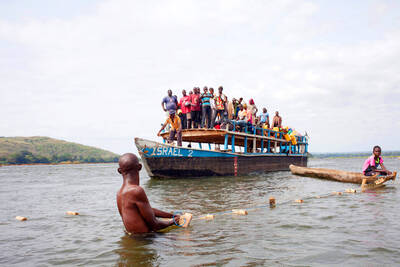
RIVER TRAGEDY: Local fishers and residents helped rescue people after the vessel capsized, while motorbike taxis evacuated some of the injured At least 58 people going to a funeral died after their overloaded river boat capsized in the Central African Republic’s (CAR) capital, Bangui, the head of civil protection said on Saturday. “We were able to extract 58 lifeless bodies,” Thomas Djimasse told Radio Guira. “We don’t know the total number of people who are underwater. According to witnesses and videos on social media, the wooden boat was carrying more than 300 people — some standing and others perched on wooden structures — when it sank on the Mpoko River on Friday. The vessel was heading to the funeral of a village chief in


 RSS
RSS