


Giant billboards call for unity. Posters assure skeptics that the January election will be fair. Car bumper stickers plead for divine protection for a nation that needs all the help it can get.
With anger and despair mounting over a seemingly endless cycle of violence, Baghdad's streets, airwaves and newspapers are being used to reassure the city's 6 million residents and try to imbue them with hope.
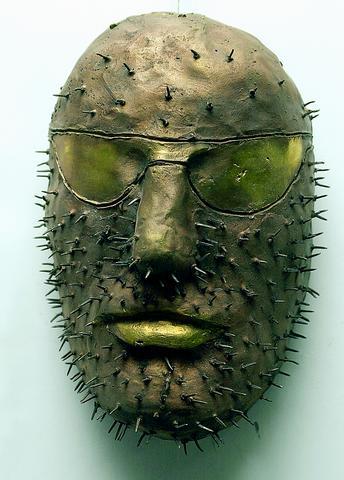
PHOTO: AP
That's a tough sell in a city where most people have lost a friend, a relative or an acquaintance to the violence. Thousands of middle class families are fleeing the country in search of safety.
Yet, Baghdadis -- a racially and religiously diverse people -- are again showing signs, albeit small, of the resilience that helped them through three wars since 1980. They are seeking ways to restore a semblance of normalcy to their life while a vicious 17-month-old war pitting militants against US and Iraqi forces rages around them.
"Divided we fall. Iraq: one nation, a promising future," declare giant billboards at the city's main squares with the image of a crack in a wall slashing the word "divided" in half.
Sponsored by an alliance of independent politicians and intellectuals, another one, depicting a pair of hands building a wall symbolizing Iraq, says: "Our hands build it and protect it."
"Remember how Abu Nawas street looked like?" asks a giant poster in a central Baghdad square, referring to a thoroughfare along the Tigris river once teeming with restaurants and nightspots. The area is now a thicket of blast barriers, sandbags and razor wire with dozens of armed security guards protecting hotels used by foreign contractors and journalists.
"God willing, and with every-one's help, we will restore its glory," promises the poster sponsored by Baghdad's local government.
Some Iraqis say they may be too afraid to vote in January's key election if security does not improve by then. Some also question the vote's legitimacy given the presence of 160,000 US and other foreign troops in Iraq. Hundreds of posters by the Independent Electoral Commission of Iraq address these fears.
"Iraq will in January witness the birth of a life of dignity and prosperity when the first democratic and fair election will be held on this benevolent land ... your vote is the future of Iraq," say hundreds of blue posters plastered across the city.
Al-Sharqiyah, a new privately owned Iraqi satellite television channel, is airing a series of brief interviews with ordinary Iraqis calling for a halt to the violence during the holy month of Ramadan, which began over the weekend.
Baghdad's embattled police have suffered dozens of casualties in car bombings blamed on militants. Not surprisingly, some police patrol cars bear window decals saying "May God protect this nation." Others boast Iraq's flag in what appears to be a message to militants that the police work for Iraq, not the US.
Such propaganda may provide little solace to the city's residents. Yet this city has always displayed a glimmer of hope even during some of its darkest moments.
Less than two weeks after a truce ended fighting in the Baghdad Sadr City slum between US troops and Shiite militiamen, the fruits of peace already are in evidence. Small trees have been planted on median strips where mounds of festering trash grew during weeks of fighting.
Small armies of street cleaners are now hard at work and tens of thousands of children have returned to school.
"Things are different now," said Sanaa Jabr, a 29-year-old school teacher and mother of three who lives in Sadr City, home to about 2.5 million, mainly Shiite Muslim Iraqis.
"Now we have security and stability. Thank God ... its making people more comfortable," she said.
The holy month of Ramadan which began last week has provided a welcome distraction from death and destruction. Baghdad residents are glued to their TV sets after eating iftar, the sunset meal that breaks their fast, to watch the usual Ramadan fare of sitcoms, soaps and talk shows.
What Iraqis have had to endure in Baghdad since the US-led invasion of Iraq -- violence and a perceived use of excessive force by the US military -- was showcased in an exhibition of sculptures and an advertisement by the US Army unit in charge of security in the capital.
The 33 bronze sculptures by artist Ali Risan on display at Hewar gallery are mostly human faces, some of dead people, but mostly of Iraqis tormented by despair or physical injury.
Six of the works track the deterioration in the face of an American soldier. The first bears a hint of a smile that Risan says dates back to the days prior to the invasion in March last year which held promise for many Iraqis who wanted to be rid of Saddam's regime.
The next five show the same face with nails and hooks stuck in his face -- the impact of a roadside bomb, says the artist -- to one erupting with sores and finally, disintegration.
"There isn't a single person in Iraq who did not know someone killed by the Americans," Risan said. "Those of us who don't fight the Americans, give them looks that kill. That's the least we can do."
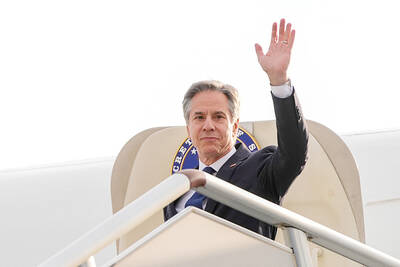
‘IN A DIFFERENT PLACE’: The envoy first visited Shanghai, where he attended a Chinese basketball playoff match, and is to meet top officials in Beijing tomorrow US Secretary of State Antony Blinken yesterday arrived in China on his second visit in a year as the US ramps up pressure on its rival over its support for Russia while also seeking to manage tensions with Beijing. The US diplomat tomorrow is to meet China’s top brass in Beijing, where he is also expected to plead for restraint as Taiwan inaugurates president-elect William Lai (賴清德), and to raise US concerns on Chinese trade practices. However, Blinken is also seeking to stabilize ties, with tensions between the world’s two largest economies easing since his previous visit in June last year. At the
Nearly half of China’s major cities are suffering “moderate to severe” levels of subsidence, putting millions of people at risk of flooding, especially as sea levels rise, according to a study of nationwide satellite data released yesterday. The authors of the paper, published by the journal Science, found that 45 percent of China’s urban land was sinking faster than 3mm per year, with 16 percent at more than 10mm per year, driven not only by declining water tables, but also the sheer weight of the built environment. With China’s urban population already in excess of 900 million people, “even a small portion

UNSETTLING IMAGES: The scene took place in front of TV crews covering the Trump trial, with a CNN anchor calling it an ‘emotional and unbelievably disturbing moment’ A man who doused himself in an accelerant and set himself on fire outside the courthouse where former US president Donald Trump is on trial has died, police said yesterday. The New York City Police Department (NYPD) said the man was declared dead by staff at an area hospital. The man was in Collect Pond Park at about 1:30pm on Friday when he took out pamphlets espousing conspiracy theories, tossed them around, then doused himself in an accelerant and set himself on fire, officials and witnesses said. A large number of police officers were nearby when it happened. Some officers and bystanders rushed

Beijing is continuing to commit genocide and crimes against humanity against Uyghurs and other Muslim minorities in its western Xinjiang province, U.S. Secretary of State Antony Blinken said in a report published on Monday, ahead of his planned visit to China this week. The State Department’s annual human rights report, which documents abuses recorded all over the world during the previous calendar year, repeated language from previous years on the treatment of Muslims in Xinjiang, but the publication raises the issue ahead of delicate talks, including on the war in Ukraine and global trade, between the top U.S. diplomat and Chinese


 RSS
RSS