


Wearing Guantanamo-style orange suits, young Iraqis aged between nine and 18 years sit in Iraq's sole correction center hoping that the once-a-week permitted visit will bring them the sight of their families through the wire screen.
"I was against it, but the Americans imposed this suit for security reasons. If the detainees escape, they would be easily recognized," said Wali al-Khafaji, director of the al-Karkh center in Baghdad.
"Security detainees," who are under the US army's sole custody, have to wear the overalls -- which provide a harsh reminder of the uniform worn by detainees at the controversial US military prison in Guantanamo Bay, Cuba.
A US army spokesman said the US military in Iraq detains 40 minors who fall into this category.
Kidnappers in Iraq have also taken to using the orange overalls, forcing their captives to wear them in an obvious reference to Guantanamo Bay, sometimes before cutting off their heads, filmed on gruesome and graphic video.
Iraq's human rights ministry has asked for more correction centers to be opened in other provinces so that inmates can be closer to families living far from the capital, said a member of the prionners' committee at the ministry, Saad Sultan.
Approval of this is not expected any time soon as other ministries have to be consulted and agree, in this country known for its rigid bureaucracy.
At the Baghdad correction center, about 200 delinquents share four dormitories built around a square courtyard cut by a volleyball net. A small library allows the inmates to escape their daily hardships and read.
But many of the young men visibly suffer from the loneliness imposed when families live in remote provinces. The fresh blue paint on the walls, the smell of soap, the three daily meals and the songs from a television, do little to lift their spirits.
Ibrahim, 15, was caught stealing money in the northern city of Mosul. He was sentenced to seven years in jail.
"My parents live far from here and come to visit me once a month. I miss them," he said.
Mohammad, 18, has not seen his parents for three months. His mother is in a prison for women and his father in a jail in Baghdad. The three were detained over a case of rape and theft.
His only brother, aged 12, is free and shuttles between the three prisons.
Ahmed, 16, was more lucky. His parents live in Baghdad and never miss the weekly visit. But like the other detainees, he still has to talk to them without physical contact, standing behind a yellow line painted on the floor about a meter away from the wire screen.
The laws hang over from the harsh regime of former president Saddam Hussein. Some of the youngsters will have to wait years for release.
"If those who are younger than 15 years are sentenced to a maximum of five years in jail, those who are older can get sentences of 15 years in prison," said Khafaji who called for the 1983 law for minors to be amended.
"This law does not make a difference between the theft of a bottle of water and that of a safe. The verdict is the same," he explained.
Many of the delinquents are from Baghdad's impoverished neighborhoods, mainly the Shiite northeastern slum of Sadr City.
Nearly 90 young inmates are awaiting trial, said prison spokesman Qais al-Mukhtar. They're not supposed to be held without trial more than six months, but the law is often hard to implement.

‘IN A DIFFERENT PLACE’: The envoy first visited Shanghai, where he attended a Chinese basketball playoff match, and is to meet top officials in Beijing tomorrow US Secretary of State Antony Blinken yesterday arrived in China on his second visit in a year as the US ramps up pressure on its rival over its support for Russia while also seeking to manage tensions with Beijing. The US diplomat tomorrow is to meet China’s top brass in Beijing, where he is also expected to plead for restraint as Taiwan inaugurates president-elect William Lai (賴清德), and to raise US concerns on Chinese trade practices. However, Blinken is also seeking to stabilize ties, with tensions between the world’s two largest economies easing since his previous visit in June last year. At the

UNSETTLING IMAGES: The scene took place in front of TV crews covering the Trump trial, with a CNN anchor calling it an ‘emotional and unbelievably disturbing moment’ A man who doused himself in an accelerant and set himself on fire outside the courthouse where former US president Donald Trump is on trial has died, police said yesterday. The New York City Police Department (NYPD) said the man was declared dead by staff at an area hospital. The man was in Collect Pond Park at about 1:30pm on Friday when he took out pamphlets espousing conspiracy theories, tossed them around, then doused himself in an accelerant and set himself on fire, officials and witnesses said. A large number of police officers were nearby when it happened. Some officers and bystanders rushed

Beijing is continuing to commit genocide and crimes against humanity against Uyghurs and other Muslim minorities in its western Xinjiang province, U.S. Secretary of State Antony Blinken said in a report published on Monday, ahead of his planned visit to China this week. The State Department’s annual human rights report, which documents abuses recorded all over the world during the previous calendar year, repeated language from previous years on the treatment of Muslims in Xinjiang, but the publication raises the issue ahead of delicate talks, including on the war in Ukraine and global trade, between the top U.S. diplomat and Chinese
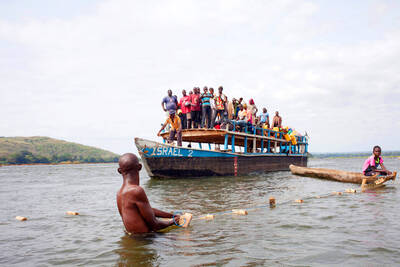
RIVER TRAGEDY: Local fishers and residents helped rescue people after the vessel capsized, while motorbike taxis evacuated some of the injured At least 58 people going to a funeral died after their overloaded river boat capsized in the Central African Republic’s (CAR) capital, Bangui, the head of civil protection said on Saturday. “We were able to extract 58 lifeless bodies,” Thomas Djimasse told Radio Guira. “We don’t know the total number of people who are underwater. According to witnesses and videos on social media, the wooden boat was carrying more than 300 people — some standing and others perched on wooden structures — when it sank on the Mpoko River on Friday. The vessel was heading to the funeral of a village chief in


 RSS
RSS